From Angel to Exit Episode 27
Struggling With Niching? How Erik Olson Used SEO and Structure to Scale 3 Agencies
Erik J. OlsonFounder, Array Digital
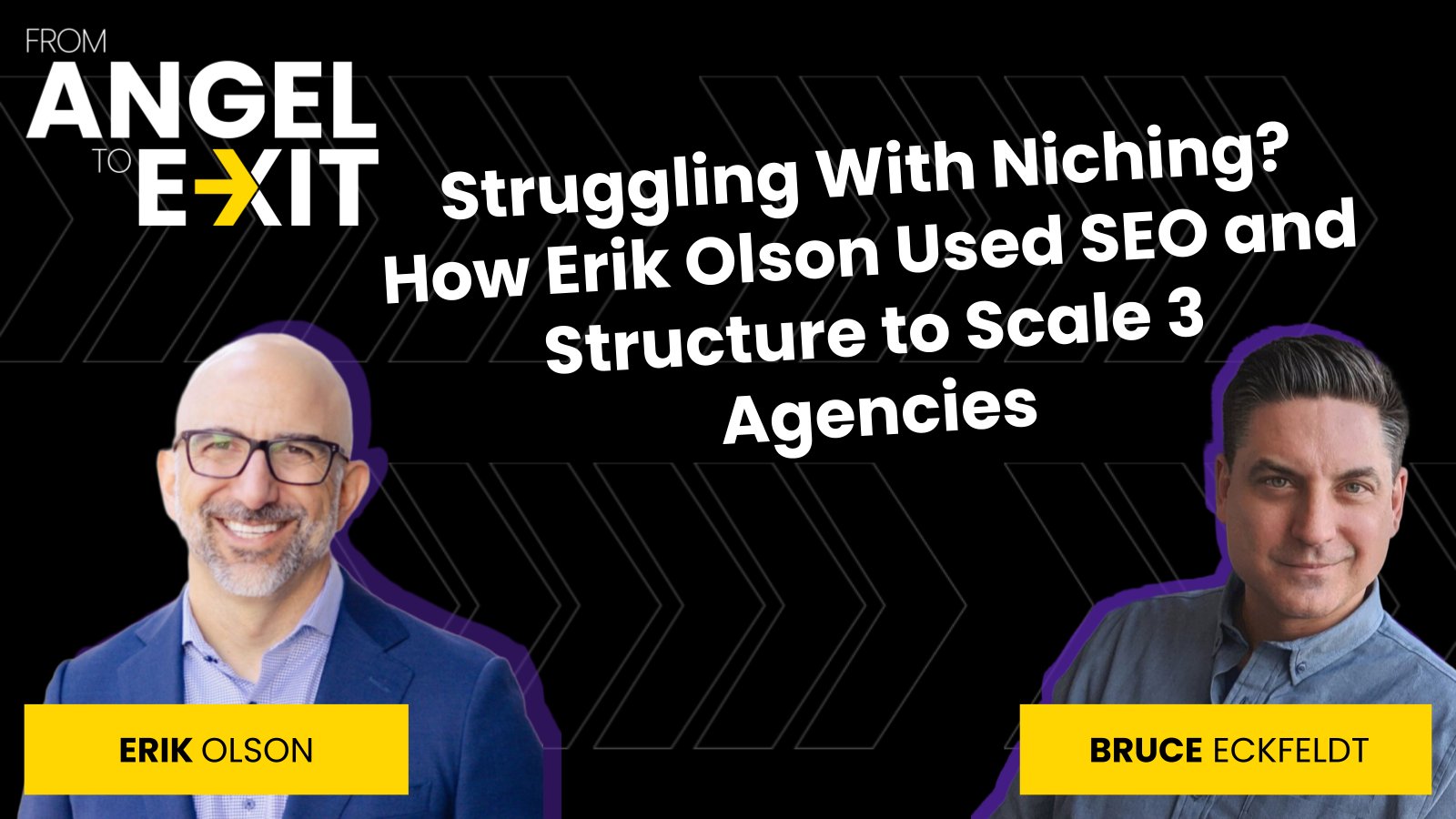
Listen to the Episode.
Play the full conversation right here, or pick a chapter to jump straight to that moment. Prefer your own app? Every episode is on Spotify, Apple Podcasts, and the rest.
About This Episode.
Start with the key takeaways, the ideas worth bringing back to your leadership team. Then read the full story of the conversation, or use the chapters above to jump straight to the moment that matters most to you.
- Pivoted from software development to digital marketing after discovering greater long-term value in recurring services.
- Built three niche-focused agencies with distinct brands to balance risk and maximize focus.
- Developed a repeatable playbook to launch new agencies: leader + niche + first customer.
- 91% of current revenue is recurring, key for private equity interest.
- Created Proxa Brands as the platform-level entity to unify and eventually exit the portfolio.
- Plans to grow via both organic launches and targeted acquisitions of $500K, $1M agencies.
- Implemented strong process automation (e.g., Asana templates, Zapier) to streamline onboarding and operations.
- Culture and post-sale leadership retention are essential in structuring for a PE-ready business.
From civil engineer to multi-agency founder, Erik J. Olson shares how he built Array Digital, Rival Digital, and Crush Digital by focusing on niche verticals, systematization, and recurring revenue. In this episode, he breaks down how he de-risks niching, structures scalable operations, and preps for a $100M exit by building a PE-ready platform brand. Founders looking to scale with structure, or build something worth acquiring, will find playbook-worthy insights throughout.
Watch the Video.
Prefer to see the conversation? The full episode plays right here on the page, so you can watch while you follow the takeaways or read along with the transcript. Every episode of From Angel to Exit is also on my YouTube channel, along with short clips from each conversation.
About the Guest.
The background behind the conversation, and where to find this guest online.
Erik J. Olson
Founder, Array Digital
Erik J. Olson is a civil engineer turned agency founder who built Array Digital, Rival Digital, and Crush Digital. He focuses on niche verticals, systems, and recurring revenue to build companies buyers want.
- instagram.com/erik.j.olson
- erik@proxabrands.com
Full Transcript.
The complete conversation, lightly edited for readability. Open it to read along, or search the page for a topic or a name.
Read the full transcript
Bruce EckfeldtWelcome, everyone. This is From Angel to Exit. I'm Bruce Eckfeldt, I'm your host. Our guest today is Erik Olson. Erik is founder and CEO of three different agencies: Array Digital, Rival Digital, and Crush Digital. We're going to talk to him about the play he's got going, his strategy. We've had a couple of conversations, and I'm really intrigued not only by what he's doing, but by how he's thinking about it and how it's come about.
I think he's got a really interesting way of thinking about how to approach the businesses, but also how to create a platform and create something that hopefully is going to be more valuable and potentially quite sellable when he gets to that point. He's been doing a lot of work on this, and he's got a lot of insights on the process. So with all that, Erik, welcome to the program.
Erik J. OlsonThank you, Bruce. I appreciate the invitation. I'm glad to be here.
Bruce EckfeldtIt's a pleasure to have you on. Before we dive into the different agencies and this platform you've been building, I'd love to get a little background. In our prep for this, you mentioned you were originally a civil engineer, I think it was. I'm curious what the professional background was and how you got into business. Tell us a little bit about that.
Erik J. OlsonSure. I went to Virginia Tech back in the early '90s, so I'm getting up there in age, I guess. I went for civil engineering. When I got out, I was doing construction project management, so I was surrounded by tradespeople: electricians, carpenters, things like that. Then I bought an old house and I was working on it. This is around '98 or so. I thought, wow, wouldn't it be great if there was a website where someone like me, who needed contractors to come into their house, could connect with contractors who needed the work?
So I got this idea for something like Angie's List. Angie's List was already around, but I wasn't aware of them. I started to try to build this thing and I stumbled. I went to Barnes and Noble, I read a lot of books, and I taught myself how to program. I hired a freelancer, and he initially provided me code, and then it turned into a mentorship. So I learned how to code, got into software development, and switched careers completely. I was a software developer for about 15 years.
I won't go into all the details of that, but towards the end, I was running a software company. We would build mobile apps and data-intensive web applications, and we would spend a lot of our clients' money building these things. We'd hand it over to them, and then they didn't do anything with it. It just sat on the shelf and rotted away. I had learned through my experience of trying to build that Angie's List kind of thing that you have to market. I wasn't very good at marketing. Then I noticed my clients weren't very good at marketing, and in my experience there were a lot of companies out there that weren't very good at marketing.
So we started to tiptoe into marketing, because I wanted something that was impressive. I wanted to say I built Uber. We were building great software, but it just rotted away. So we started to do a little bit of marketing, and then a little bit more. Then I started to realize that the marketing was actually more valuable than the thing we had just built for the client.
So we hired one digital marketer. I didn't understand what he was doing. I didn't understand why clients kept paying us month after month. I spent about a year super deep diving into digital marketing, because I really wanted to prove to myself that it was something of value, that we weren't just ripping people off. I needed to understand how it worked. About a year into it, I was so convinced that we pivoted the entire company. We walked away from custom software development, the thing that I brought to the table, the thing I was very good at, and went all in on digital marketing. That was back in 2018.
Fast forward to today, and we have three digital marketing agencies that each focus on a different niche. I'm a very big believer in niching, but I also don't like the risk that comes with it. If your industry collapses for some reason, I want a backup plan. So we have three separate companies, separate brands, separate teams, each one run by a president and each one focusing on a different niche.
Bruce EckfeldtIt's interesting. I hear you on the strategic focus point of view. You want that niche in terms of a really clear customer, a really clear offer, real competitive differentiation, but that creates a certain amount of risk associated with concentration in an industry or even with particular customers. So when did that idea first come up of creating separate brands? Because that's a pretty specific move to handle the whole "I'm going to diversify behind the scenes, but stay focused from a positioning point of view." How did that decision play out?
Erik J. OlsonIt is interesting, because I'm not aware of a lot of people doing what we've done. Most of the time, when an agency like mine decides it's time to niche... Actually, I was just on a Slack group and someone was talking about how they wanted to niche and they didn't know what to do. This comes up all the time. We had the same problem. We thought about it for years and years. It's risky to go from being a generalist, where you're engaging with your local network and getting work from them for various different things, to all of a sudden saying, "We only work for" insert industry, because you're just afraid. And what about your current clients? So we were very fearful of doing that.
Array Digital was the first agency we created, in 2017. I was worried about risk mitigation. This is probably the second time I've brought this up. I was worried about making that big change. I'm all for making big change, but I don't want to take unnecessary risk. So in order to determine if this made sense for us, I had an opportunity to run an experiment, and the experiment was to stand up a second agency.
Several things came together all at once. We got the PPP money from the government. Thank you, Uncle Sam. We had to do something with that. I had someone who appeared to be a really strong web developer who wanted to do something, maybe on his own, maybe partnering with someone else. He was relatively young and didn't know where to go, and he reached out to me. So I had this quite capable person who wanted to do something.
Third, I had an exclusivity conflict at Array Digital with an HVAC company. We couldn't take on a new HVAC company because of our existing one. We had exclusivity. So we were having to walk away from about $7,000 a month of new revenue. And I thought, that sucks. I really don't want to walk away from this revenue. What could we do?
We very quickly formed a second agency, Rival Digital. It solved all those problems. I could hire the talent. I could take advantage of the PPP money and do something with it. We could take on that new client, and we could also experiment with niching. That experiment lasted about a year. Rival's still up and running, and they're doing great, by the way. We saw that this niching thing was working in the second agency. Wow, that's really cool. What if we did the same thing back at the mothership at Array Digital?
We decided to do that. About a year or two after Rival, we went all in on niching Array Digital to law firms. So now we had home services and HVAC, and we had law firms. That's when I started to think about the portfolio concept, maybe a portfolio of niche agencies. But I hadn't really fleshed it all out until roughly a year and a half ago.
We had someone who worked at Rival who was a strong developer and was ready for the next thing. He needed an opportunity. He had heard me preaching that we want to grow a big portfolio of companies so that we could have unlimited opportunity. When you start saying these things to your people, they remember, and they start to remind you that you said you were going to grow a big thing and there's opportunity for people who want it. He wanted something bigger. Okay, cool.
He had some contracts he was doing on the side, so we bought those contracts, formed Crush Digital, and focused them on medical practices. It certainly wasn't the original plan. The original plan was to take Array Digital and make it really big, but I didn't know how. And it solved a lot of problems, but it's also created new problems that I'm now having to solve.
Bruce EckfeldtEasier problems, hopefully.
Erik J. OlsonUsually they're easy problems, I would say. We have the three agencies, but then we have a layer of folks above the agencies, like myself. I don't work for any given agency. I help with all of them. So we have this small staff. How do we share the costs? And of course, no one's ever happy about how much I have to charge them for these internal services. Then there's the separation of concerns between me and the presidents. Me backing out of Array about a year ago and putting a president in place caused a lot of disruption. So we're having to work through those kinds of growing pains, but they're all good, positive growing pains.
Bruce EckfeldtI have this image of an amoeba. When it gets big enough, it splits, and then there are two amoebas. There's a certain amount of deciding, "Okay, I'm going to cleave off part of one business to form the new business." You've gone through this now twice. What's the playbook? Is it, "I need a technical leader, I need a first customer," and if I get those ingredients, that's enough to be the starter to the sourdough that gets the next thing going? What's the formula you've figured out?
Erik J. OlsonYou're absolutely right, and we do want to do this. We want to create a fourth agency, a fifth agency. I want to give our folks the opportunity to grow. It reduces my risk, because we're dealing with different industries. And frankly, as they each grow, I'm going to do better. Everyone's going to do better. I'd rather have three or four or five companies than one, as long as it can be managed. It has to be managed growth.
But to your question about the formula, thing one is I need a very capable leader. Every time, it's been someone who's very knowledgeable about web development and SEO. We do a lot of SEO here. SEO is not dead. It's changing quite rapidly, but it's certainly not dead. So we need people who can change with the changing technologies as well. That's the core. If someone can build a website and get it ranked in whatever the ranking machine is now and in the future, Google, ChatGPT, then they can do an awful lot of good for their clients. Then there are a couple of other outlier services, things like social media and online advertising, and we have people in the portfolio who can help with those.
But we need the capable person, and we need some idea of the niche. The more concrete, the better. We already have law firms. We have home services companies, mostly HVAC. And we have medical practices, mostly med spas. So what would be next? Which industry are we going after? What's the next hot thing? Roofing is hot, even though we can cover that with Rival Digital. Maybe it makes sense to spin off a niche in roofing. Garage doors.
Bruce EckfeldtLet's talk about that. It feels like there's a heuristic here about the definition of a niche. Niche, niche, tomato, tomato. With roofing, from an industry point of view, my first thinking is that it's part of a home, so let's just make it part of home services. Is it about the nature of the service and how it sells or how it gets bought? What makes you want to think about it as a different company?
Erik J. OlsonRight. How narrow do you go, or how much do you combine? At Rival Digital, we started off HVAC and HVAC only, and we would turn away anyone else that was not HVAC. Within a span of three months after forming that company, they knew more about HVAC than Array Digital had learned in the previous three or four years. They just knew 10 times as much as we did. They focused. There's a lot of power in focusing, and they grew very quickly in that realm.
They expanded, because with HVAC in particular, there aren't a lot of pure-play HVAC companies. A lot of them will do plumbing in addition to HVAC, or electrical. So they started to branch out. Now, if you redefine the niche from HVAC contractors to home services, all of a sudden you're talking in generalities. If I go ask a plumber, "What do you do?" he or she will say, "I'm a plumber." He or she will not say, "I'm a home services company."
So the further you get away from that tight niche, the more your messaging has to be somewhat generic, which means it's not going to land the same way it would if it was hyper-niche. The tighter, the better. The tighter the community or the more distinct the community, the better. The goal is that when we put our messaging out into the world and people look at our website and our social media, they think, "This company understands me."
It's that tight. It's like we're talking directly to you. Bruce, if you were a plumber, I want you to say, "Wow, these guys are a marketing company that works in my particular super niche within plumbing. They're for me." And it's to the detriment of everybody else. You're effectively telling everyone else, "You're not my kind of person." But I want Bruce to say, "I want to hire you," because there are plenty of people like that out there. There's a feel to it, there's a nuance to it. Now, why did I say roofing?
Bruce EckfeldtI get it. I think of the ski shop that also sells patio furniture. They do it because it's complementary, or it's counter-cyclical. So if you were going to be an agency for those folks, do you go for ski shops, or patio furniture shops, or patio and ski shops? It's really about how the buyer thinks of themselves, not how you think about the business or what the category of the business is. So give me roofing. Why is roofing being cleaved off from home services? Because they see themselves as a different kind of business?
Erik J. OlsonThat's right, you're absolutely right. As of right now, we do work with roofers at Rival Digital, but it's a little bit of a different subculture from, say, the mechanics, the people who work in HVAC, electrical, things like that. It's a different way they do business. They do a lot of outsourcing and a lot of sales, and not a lot of servicing. There's no recurring revenue in roofing. So it's a different environment. They also have a small handful of their own conferences. It's just roofing. Not roofing and plumbing, just roofing.
Bruce EckfeldtGot it. So there's a market, a place you can actually go and meet them.
Erik J. OlsonThat's another nice thing about niching. Once you define the niche, you know who you need to go talk to. Let's say roofing, just as an example. What roofing companies are around here? You can do a Google search and you'll get a long list. Awesome. Where do these people hang out? What conferences do they go to? When do they go to them? There's probably a cycle in roofing. I don't know exactly what it is, but I'm sure there's a busy season and a slow season. They're probably busier in the spring than in the fall, so their conferences are probably in the off season.
So you learn all those nuances. How do they speak? What do they value? I can tell you roofers don't want to do any repair work. There's no money in it. They want to replace a roof. Knowing that a roofer wants new replacement jobs is good to know going into a conference or a sales pitch. But then again, their customers typically aren't thinking, "I need to replace the roof." They're thinking, "I have a leak and I need that leak fixed." So there's nuance there between our clients and their customers.
Knowing all of that is very helpful, and those are just different things than, say, plumbing. You don't replace the plumbing in your house. You fix the toilet. Any nuance like that, the more you can know about it, the better. And the further apart it gets in the nuance, the more likely it is that you may want to spin off another specialized agency.
Bruce EckfeldtInteresting. So you need the leader, you need the niche. What else is key when you're thinking about launching a new business? What else is in the formula?
Erik J. OlsonA couple of months ago, I put together an investment thesis. I don't have it up on my screen right now, but it covers the things we would be looking for if we were to invest in an industry or acquire another agency. What's important? Ideally, there is low seasonality in that business. All things being equal, I would prefer that our clients are busy all year round, so that their seasonality doesn't affect my seasonality.
In HVAC, interestingly, there's very high seasonality. They get slammed in the summertime, and then their phone doesn't ring for two months in the wintertime, unless they're up north and pipes are freezing. But in most of the country, that's not as big of an issue. So generally speaking, you want low seasonality.
Also, generally speaking, you want a lot of interest from people with money who are looking to get into that industry, in particular private equity. Private equity is driving a ton of activity in things like garage doors. For whatever reason, garage doors are hot when it comes to PE. HVAC is hot. Roofing is hot. They like investing in those businesses. If private equity is coming in and buying a business, they're also investing a lot of money into that business with the intent of growing it, which means they need someone like us to help them get more business. That's a good thing.
If there's an industry with no PE activity, that's a negative. I'm not saying it won't work. With law firms, there's a lot less PE activity than with HVAC, and it still works out for us. But there are several factors like that I look into.
Bruce EckfeldtYou've done this twice now. Is there a process to it? "We have to get this thing in place, then this thing, then this." What's the order of events to build a sustainable, scalable new business?
Erik J. OlsonI'd love to say we have it down to the point where we just press a button and it happens, but we're not there yet. The first time we spun off a company, which was Rival Digital, we completely winged it. We screwed so much up.
Bruce EckfeldtI'm always curious about the learnings. Every learning has a story behind it. What are some of the stories behind your learnings here?
Erik J. OlsonIt's pretty embarrassing. First, just picking a name. I'll speak for myself, I don't know about most people, but when it comes to a name, you come up with a name and a concept, and then you go see if the domain name is available. Ideally there's a perfect match, Rival Digital and rivaldigital.com, as an example. Sometimes that's not the case.
For Rival, at first we wanted something that was tough and kind of gritty, something metallic, built in a furnace. So we came up with the idea of Forged Local. Forged in a furnace. Wow, that's tough. I went and bought the domain name and everything. We were about to take it to the next couple of steps, and then for some reason I did a dictionary search on the word "forged."
Bruce EckfeldtI was just going to say, forged.
Erik J. OlsonThe word "forge" has two meanings. One is that it was made in a furnace. The other is that it's fake, a forged document, for example. And I thought, oh my, we can't. We had debates: "Well, the main definition is what we want." "Yeah, but you're never going to escape the secondary definition." So we had to change it. And by the way, we did all this literally within about two days. It was crazy. So learning number one: don't try to do this in two days. Come up with a plan.
Mistake number two. I have a partner, and his name is Kevin. It was, "All right, I'll do this, you do this." The thing he was going to do was register with the IRS and get an EIN, an employer identification number. So he did it. Cool, we got the EIN, we're good to go.
Fast forward about a year after standing up Rival. My lawyers and CPAs were asking, "What did you do? How did you move this money around?" We just moved stuff around. And they said, "You can't do that." So they got involved to try to clean up our mess. And they asked, "Why is it that the IRS thinks Kevin owns 100% of the company?" And he said, "I don't know what you're talking about." It was a mistake. When he was filling out the form, he thought he was doing it right, but he put himself as a 100% owner and I got nothing. I wasn't even named.
So we had to go clean that up. He still gets documents three years after the discovery. Every once in a while, he gets a document in his name and it's, "Oh God, I thought we took care of this." So the lesson learned is: come up with a plan.
The second time we did it, at Crush Digital, we had a little more time. We knew roughly what needed to be done by thinking back to Rival. And I told everybody, as we're executing, write down what you do. So the second time, we at least wrote it down as we were going, and now we have a really good list. My business manager has taken that and put it into an Asana template. So we're close to the point where you can press the button. We definitely know more about what we need to do, although we still make mistakes.
At Crush Digital, we just discovered a year and a half after forming the company that, oops, we never got a local business license. We were paying the business license tax for Array and for Rival, and I thought, huh, did we get a bill for Crush? No. Well, that's weird. I wonder why. We never got a business license, so we have to take care of that now.
Bruce EckfeldtI always find businesses are full of these little things. You just don't understand until you get into it. So looking at expansion, it seems like you've got some experience in launch-a-new-agency mode. Talk to me about other ways you're looking at growing. You mentioned acquisitions. What's the thinking between rolling your own and building a new agency versus finding someone who's already doing this, maybe at an early stage, maybe struggling, where you could come in and take an equity stake or buy them outright? How have you looked at that inorganic growth?
Erik J. OlsonOne of my goals for 2025 is to acquire an agency that's doing between $500,000 and $1 million of top-line revenue. Again, I have an investment thesis, so I know what I'm going after. I'm definitely looking for someone who has more niching, more recurring revenue, and less seasonality with their clients.
I also know there are a lot of agency owners who are just not really into the business aspect of it. They're creators, and they like the craft of whatever they do, whether it's building websites or social media, but the business part, they think, sucks. That's where I come in. That's where I thrive, actually. I even have a mastermind called the Business of Agency Mastermind, which is where we talk about business. Today we're going to be talking about new business development. So that's my zone of genius, if you will. That's where I bring a lot of value.
When it comes to acquiring an agency, there are countless agencies out there that just want to do the work and don't want to get screwed with business licenses and EINs and insurance and all that crap. I get it, but it has to get done. So I think there's an opportunity for people to get some relief, focus on what they do best, where they bring the highest value, and become part of the platform we're building, where we've defined a lot of these things. We've taken care of HR. We have a system for the 401(k). We've got CPAs, legal. We've taken care of a lot of those kinds of problems. Some people have never even taken care of those problems, and they may have been operating for years. So this could be some relief for them.
It helps us grow faster versus doing it organically again, which I'm totally game for. But number one, I have to have the next leader, and at this point I'm fresh out of the next person. So we have to grow that person, and that takes time. An acquisition is just a faster way of doing it.
I've studied a lot about private equity. This is what they do when they gain ownership of a company. They start buying other companies and bringing them in. They can grow much faster. And then they triage... not triage, is that the right word? Where you buy low and sell high.
Bruce EckfeldtArbitrage.
Erik J. OlsonArbitrage. I was so close, I was off by a couple of letters. They arbitrage things like multiples. I'm actually to the point where I can start doing that to some degree.
Bruce EckfeldtWhat do you anticipate being the set of challenges that come with the acquisition and integration process, versus the challenges you've already started to figure out in terms of launching new agencies?
Erik J. OlsonProcess and culture, because no one does things the same. Culture is one of those soft, squishy things. It's hard to quantify. On a scale of one to 10, what is your culture? You can't say, "I'm a 10 and you're a seven." It's just different. So the culture would be different. We'd have to learn their culture and probably adjust a little, and they would learn ours. There's a lot of time required. That's honestly about a year-long process to mesh and get to the point where you understand each other.
So culture is a big one, and then process. Everyone has a different belief in the way things are done. The way you bill clients. Do you give them a pass if they're late on their invoices or not? You name it. Everyone's got an opinion about everything that's done in a business, and the chances of someone choosing the same options in their independent agency as I did in mine are very slim. So again, it's going to be a merging: "Okay, so how do you all do it? Here's how we do it." And trying to take the best of all the pieces, but anything we do in our organization, we'd want to make it the best thing that applies to everybody.
As time goes on, I have other leaders who have their own thoughts and their own influence, and I actually need to start selling internally to them. "Hey, this is a good idea. I know you like doing A, but think about B." Sure, I could just tell them we're doing B and that's it, but it's best to do it from a position of influence and discussion, taking the time and hugging people. I'm being nonchalant about it, but you need to make sure people feel heard, and that you hear them and they hear you.
Bruce EckfeldtI'm not surprised you were trained as an engineer. The whole systems approach, how do I standardize, how do I put a process to these things, is definitely coming through. What's the ultimate goal? Where do you ultimately take all this? Do you want to have 150 agencies under your belt? What does the trajectory look like for you?
Erik J. OlsonBack in 2017, when we were doing $1 million a year of revenue, just barely, we went to a learning event. I'm part of a group called the Entrepreneurs' Organization. There was a day-long learning, and the speaker said, "Think about a big hairy audacious goal. What's your BHAG? What's the big thing you want to accomplish? Not just today or this year, but in your career." And I thought, ah.
So we started to think about it. Maybe 10 offices. This was before COVID. But I could game that system. We need 10? Just go get a coworking space over there.
Bruce EckfeldtTen WeWorks.
Erik J. OlsonEmployees was the same. Maybe we could have 500 employees, but actually fewer employees is better than more, so that doesn't make a lot of sense. When it came right down to it, it was money. Money usually doesn't lie. So I started to think about what revenue I want to get to. What's a big company? $50 million, $75 million? You know what, $100 million has a nice ring to it. I didn't know what that meant. $100 million is a big number, but I had a long way to think about it.
So I started to put a little more teeth into it over time, a little more and a little more. I actually have a picture behind my monitor that I'm looking at. It's the vision, the painted picture of what it looks like when we get to $100 million. It's a scene in Las Vegas full of tables, and all the employees are there, and we have DJs. I wrote about it. I have a book called Million Dollar Journey right behind me. That's the opening scene. The opening chapter is the visualization of this event: we made it to $100 million.
But it took me a long time to define what that even means. What's $100 million? Is it top line? Is it at one agency? Does it include ad spend or not? These were all decisions that had to be made at some point as I added more and more clarity to the vision. Now it's $100 million, either revenue or sale price. I don't really care which I get to first for the portfolio.
If you think about the sale price, I want to sell the entire portfolio for $100 million one day, and it has to be as a platform. I'm not going to carve out this company and send a piece here and a piece there. So I'm building a platform. I know we need a brand at the platform level and a company at the platform level. We do have a parent company, and I just went through a branding exercise with a branding agency, and we landed on Proxa. Proxa is going to be the name of the platform. We have proxabrands.com. Again, domains are difficult to find as exact fits. I wish I could get proxa.com, but someone's got it for now.
So we're going to be rolling out this new brand soon. Maybe by the time this goes live, proxabrands.com will be live. Rival Digital is going to be building the website. We're putting together what I would call a platform. That's private equity speak. Typically in PE, a platform is a company they buy, and then they can bolt on other companies. Well, I'm going to deliver as much of that bolt-on scenario as possible: the staff above the agencies, and as many agencies as makes sense. I'm not committing to a number of agencies going forward, but I know I want more, and I want to sell this whole thing in one chunk.
Now, I believe the fastest way for me to get from where we're at now, which is roughly a $6.5 million run rate, to $100 million is not to wait until I get to the point where I can sell for $100 million or we're doing $100 million in revenue. It's to sell somewhere between here and there and partner with PE. Sell to PE, reinvest some of my funds, continue to run it, and then use the deep pockets of a private equity firm to build it up as fast as possible and sell a second time for $100 million. That's where I'm leaning right now.
Bruce EckfeldtYou mentioned that you've been talking with some private equity folks and figuring out what that looks like. I like this idea that it's almost like you're doing customer development. You're building a product for private equity, so you're talking to that customer and figuring out what they want to buy and how they want to buy it. What are you learning about what PE wants and how they want it? What insights are driving your decision-making on how you structure and organize your platform to be highly valuable and highly viable for private equity?
Erik J. OlsonHaving that vision of wanting to sell one day for a big number, and knowing who's going to buy it, probably PE at that number, helps drive everything I'm focused on. I'm not there yet as far as being ready to sell, but we're closing in on it, and I'm doing the research and figuring out what that potential buyer wants. What does a private equity firm want? Actually, what does any buyer want?
Number one, they want a legitimate company. They don't want any smoke and mirrors. There are a lot of agencies that outsource everything to the Philippines, and I wouldn't want to buy that. That's risky. I'd want to buy a company that's staffed by a capable team. We have mostly people in the United States, full-time W-2 employees, which, as you know, is more expensive. We do augment with some people overseas, but the vast majority are in the United States.
They want capable leaders. I want capable leaders, my presidents, who will get me to the sale. I need them to be on board, which means I need to give them some financial incentive to get to the sale. I can't just say, "You're not going to get a cut of the sale, but I need you to fully support it, and maybe you'll have a job afterwards, maybe not." I need to make it enticing. So I had to put together plans to get them to the sale.
What I recently found out from my lawyer, just in the last week or two, is that it's not just about getting them to that finish line. That's the starting line for the company that buys them. So private equity, or any buyer for sure, not only wants the top leadership to get to the transaction, they want to make sure those leaders are around afterwards. How do you make sure people stick around? The best way is to give them equity.
What I'm doing right now is a transaction bonus. They get a cut of the proceeds. But they could take that cut of the proceeds and go off to a beach somewhere, and the buyer wants to make sure they don't. You can't enslave people, but what you can do is give them a really fat carrot to incentivize them to stick around, and that's usually equity. So I need to think about that.
Bruce EckfeldtYeah, we got rid of that a couple hundred years ago.
Erik J. OlsonRecurring revenue. A buyer wants recurring revenue. If anyone listening was going to buy a company, wouldn't you rather have recurring revenue than have to go chase the next project all the time? That's exhausting. I'd rather know I'm buying this contract right here, and it's a two-year contract that doesn't expire for 20 months. That's solid. That's something you could literally take to the bank and get a loan on. So I need to focus on recurring revenue, which I do.
I need to measure it. How much of our revenue is recurring? Right now it's 91%. We got to 91% without ever even knowing what the number was. I just knew more was better. Now that I have a number, I can start to ramp it up. What's it going to take to get to 95%?
The other thing a buyer wants is retained ARR, annual recurring revenue. So I said, number one, how do I even figure this out? Retained ARR is how much of the revenue you had a year ago from your clients you still have. Look at your clients from a year ago. Say you have 10 clients. Fast forward to today. For those same clients, let's say only seven remain. How much revenue is coming out of those seven versus the original 10? That gives you a ratio. Just coming up with that methodology and understanding what retained ARR is took a while.
Then being able to measure it took a while. We're currently at about 83%, which is okay considering we've never looked at it before. But I know from my discussions with PE, from reading books, from being on the private equity subreddit, and from seminars, these free PE and investment banker trainings that happen all the time, that they're looking for 90%, ideally 95%. That's a lot. So what are we going to do? How do I ensure that I retain the ARR? Because if we can retain it, that's less selling, and if we sell on top of it, then we're growing.
There are a lot of factors like that. Process. Written process. Not just "we do it the same way every time." No, there's a written document. What we've done is we have written documents backed by automation and templates. For example, when we get a new client, we fill out a Google form, it fires off a Zap, it spins off an Asana template with all the tasks in it, and we change these templates over time. Just this morning, one of the presidents asked, "Hey, I want to change this to be assigned from this person to that person going forward." Sure, no problem. Little tweaks. 1% adjustments as often as we can make them, and before you know it, it really adds up.
The final thing I'll mention that buyers want, in particular PE, is that they really don't want someone like me, the owner, running operations. That's something you have to come to grips with as an owner. They don't want to be completely dependent on me. Ideally there's a senior executive-level team running the show. Then, if they want, they could buy the show and say, "Okay, previous owner, we don't need you anymore. Here's a bunch of money. Go to the beach." Or they could choose to keep the owner.
So I had to take myself out of the lead position at Array Digital, which was my baby. That was very difficult. It was also very disruptive, I discovered, because it took about a year to get to the point where we knew where Erik had all of his fingers and all the dysfunctions he left behind.
Bruce EckfeldtAll the things he enabled.
Erik J. OlsonExactly. All the stuff he was willing to tolerate, but the new leadership is not. And new leadership has new ideas, and you want to give them room to exercise those. So it was disruptive, but we're now roughly a year and a half into that transition, and that's good. If I wanted to, I could take a month off, but I've got stuff to do. It's a difficult thing to get to. It requires people, it requires growth, it requires revenue to achieve a lot of those things. You need some breathing room in your finances to be able to hire a president to replace you.
Bruce EckfeldtOne final question. I'm curious, ultimately, what do you do with all this? You do an initial sale, you get a second bite of the apple, you get to the $100 million sale. Then what? What's the big plan? Where do you go from there once you achieve this?
Erik J. OlsonI think it's going to take another six to 10 years before I get to the point where I'm walking away, and it'll be tough, of course. Right now I really enjoy mentoring other people. I mentioned the Entrepreneurs' Organization. I currently mentor a group there. I have my mastermind of agency owners, and I mentor there. At a certain point you think, wow, I actually know a little bit these days. It took a long time to get here. I can help these other people avoid really bad mistakes. When you file with the IRS, make sure you include your partner.
Bruce EckfeldtGet your local business license.
Erik J. OlsonExactly. Stuff like that. So I really enjoy mentoring, and I really enjoy coaching. I'll probably do that for a good amount of time afterwards. Honestly, I want to do some traveling, and I want to give back to the community. My wife and I have been talking about how we could do that, whether it's getting more involved in homeless shelters or things like that. There are a lot of people suffering out there in the world.
There's someone I've listened to in the past, Grant Cardone, who says it's your responsibility to be ultra successful and make a bunch of money so that you can help other people. On the one hand, he's always selling products and courses. He's very good at that. But on the other hand, that's actually a pretty noble thing. In that regard, it's not a bad thing to make a bunch of money. You could do a lot of good. You could help a lot of people if you decide to do that.
So I'd like to get more involved in that, because it's a tough world out there. I live a very privileged life. I don't live a fancy, opulent life. Can you see the toy plane that was over here? My wife gave this to me. The vision is to eventually get a real one, but I'm far from that. We have a very modest lifestyle, but some people are having it really tough. Month to month is very difficult. If we could do something, and I'm not saying just give them money, but do something to help people get ahead, I'm interested in that.
Bruce EckfeldtI love it. There's a lot of responsibility that comes with success. I've certainly found that, both in the work I've done and with the leaders I've worked with and coached over the years. There's a strong sense of fortune. They were privileged and lucky and worked very hard, but they're also in a good position that is not always the case for everyone.
Erik J. OlsonAnd I know we're going to wrap it up, but it's interesting, speaking from my personal experience. It's year after year of struggling, really stressed out. Where is the next project going to come from? What happens if this whole thing goes away? The shame that would come if this whole thing went away. What would I do next? How would I feed my family? You just grind, grind, grind. And at a certain point you look up and think, oh, I guess we're kind of doing it.
So there's definitely been a mental shift for me personally. It's not that I've taken my foot off the pedal, but I'm not as stressed about it. I still want to pursue the goals, but it's interesting when you start thinking about what life is beyond the daily grind. It's a big world out there.
Bruce EckfeldtErik, it's been a pleasure. I know we covered a lot, a lot of great insights for folks around running companies. I love this idea of a platform. I'm very curious to hear how things play out. We'll have to do a follow-up episode at some point when you start getting ready for at least that first private equity infusion. If people want to find out more about you and the businesses, what's the best way to get that information?
Erik J. OlsonIf you go there right now, there's probably nothing up at proxabrands.com. Hopefully by the time this episode comes out, we'll have proxabrands.com up, or a landing page. My email is working. It's Erik, E-R-I-K, at proxabrands.com. You can certainly find me all over social media: LinkedIn, Instagram. I hang out on Instagram a lot, and on Instagram I'm erik.j.olson, so E-R-I-K dot J dot O-L-S-O-N. That's my internet name, Erik J. Olson, so if you search anywhere, I should come up.
Bruce EckfeldtYou've cornered the market on Erik J. Olsons. Perfect.
Erik J. OlsonIt feels kind of weird to start saying you have a middle initial, but that's what you need to do in marketing to make yourself a little bit distinct.
Bruce EckfeldtI know. I'll make sure all that information is in the show notes so people can get to it. Erik, thank you so much for taking the time today. It's been a pleasure.
Erik J. OlsonThank you, Bruce. That was a lot of fun. I appreciate it.
Never Miss an Episode.
Know the moment a new episode goes live. Subscribers also get a say in future guests and the topics we cover.
Other Related Episodes.
More conversations that connect to this one. Or browse the full archive by topic or by guest.
Aaron Levenstadt
How narrowing services and understanding buyers led to a successful agency exit.
Listen and Read
Travis Luther
How building and selling Queen Anne Pillow and TrialLine both started with solving a real problem.
Listen and Read
Robert Heil
Lessons from scaling EdTech ventures, leading M&A deals, and taking the CEO seat after a founder exit.
Listen and Read