From Angel to Exit Episode 28
Burned by Broad Services? How Specialization Scaled Pedestal Search to a Successful Exit
Aaron LevenstadtFounder, Pedestal Search
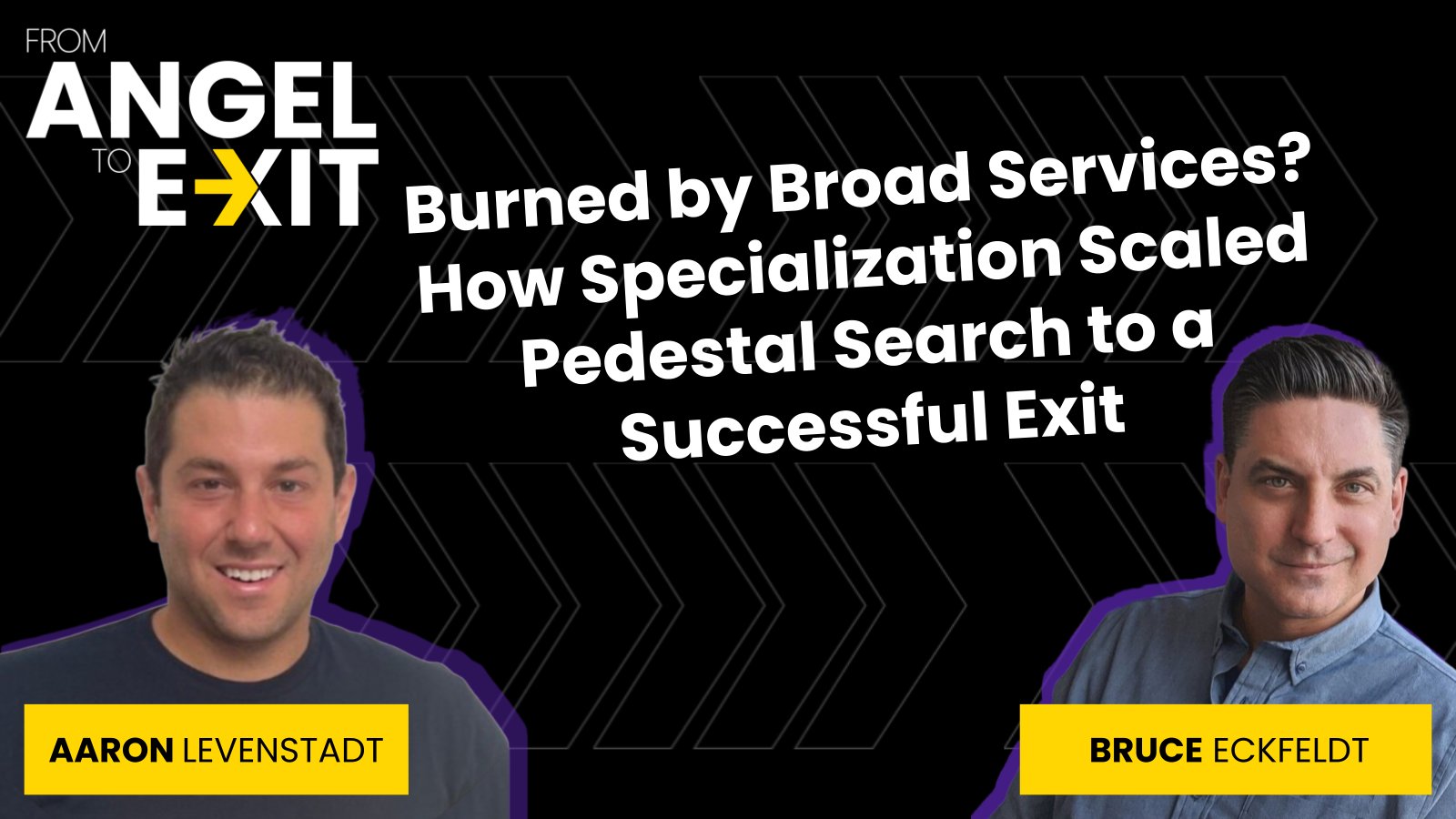
Listen to the Episode.
Play the full conversation right here, or pick a chapter to jump straight to that moment. Prefer your own app? Every episode is on Spotify, Apple Podcasts, and the rest.
About This Episode.
Start with the key takeaways, the ideas worth bringing back to your leadership team. Then read the full story of the conversation, or use the chapters above to jump straight to the moment that matters most to you.
- Specializing in one core service enabled true scalability and efficiency.
- Buyer psychology is essential, structure sales conversations like a landing page.
- Systematized warm outreach turned dormant leads into high-conversion pipelines.
- Saying no to work outside your niche builds stronger client trust and delivery results.
- Reframing sales and post-sale language unifies team efforts and drives clarity.
- Presenting "reasons not to buy" in M&A builds credibility and smooths diligence.
- Productization creates repeatability without losing personalization.
- Planning for exit early enables more favorable deal structures and post-sale freedom.
Aaron Levenstadt, founder of Pedestal Search, shares how he went from early days at Google to building and exiting a successful SEO-focused agency. In this episode, he breaks down the power of narrowing services, mastering buyer psychology, and awakening sleeping leads through smart systems. His story offers actionable insights for founder-CEOs navigating growth, productization, and business exits. If you're scaling an agency or considering your own exit strategy, this episode is a goldmine.
Watch the Video.
Prefer to see the conversation? The full episode plays right here on the page, so you can watch while you follow the takeaways or read along with the transcript. Every episode of From Angel to Exit is also on my YouTube channel, along with short clips from each conversation.
About the Guest.
The background behind the conversation, and where to find this guest online.
Aaron Levenstadt
Founder, Pedestal Search
Aaron Levenstadt started his career at Google, then founded Pedestal Search and built it into a successful SEO agency that he sold. He helps agency owners specialize, productize, and prepare for an exit.
- linkedin.com/in/aaronlevenstadt
Full Transcript.
The complete conversation, lightly edited for readability. Open it to read along, or search the page for a topic or a name.
Read the full transcript
Bruce EckfeldtWelcome, everyone. This is From Angel to Exit. I'm Bruce Eckfeldt, I'm your host. Our guest today is Aaron Levenstadt. He is an exited entrepreneur. We're going to hear about his story, the company Pedestal Search, the growth and exit story he has, and then what he's doing today. Aaron is working with a lot of entrepreneurs on that journey and that process. I'm excited to talk about that and to see how his exit set him up and also taught him a bunch of things that he's now applying. Excited for the conversation, excited to learn a little bit more. With all that, Aaron, welcome to the program.
Aaron LevenstadtThank you, Bruce. Thanks for having me. Looking forward to this.
Bruce EckfeldtIt's a pleasure. Before we dig into the company and the growth and the exit story, we'd love to get a little background, professionally or even from an education point of view. What was the story before this? Did you always want to be an entrepreneur? Was this your destiny when you were in kindergarten? Did you say you wanted to scale and sell a business? What was the backstory?
Aaron LevenstadtYeah, first day of kindergarten. No, the backstory is I did my undergrad at Stanford. This was the earlier internet days. When I finished undergrad, I joined a group at Google that was really responsible for the core search products. At that time it was paid and natural search, and I was on these core product teams working on those products.
From my educational experience through to that experience working on these products at Google, I felt very fortunate in the sense that, at a young age, very early in my career, I got a front seat onto how this was going to change so much of how we live and do business and interact with each other.
Then the story goes from there. I'm getting exposure to this stuff professionally, growing up at Google. And I had a few friends who said, "Hey, you're working at Google. Would you mind taking a look at how we're doing search?" I was happy to do that, and I was able to sit down and give advice wherever I thought I could be helpful.
In one of those meetings, with a large national eye care brand, we went through their Google Ads account. I remember they were spending, I don't know, six figures or more a year on search terms that were geared towards animals, dogs and cats. And in the meeting I'm thinking, "Do you guys operate on animals?" And they said, "Well, no, this is not a veterinary clinic." I said, "Okay, do you know that you're spending six-ish figures or more a year on advertising to people who are looking for dog cataracts?"
I realized there was a really interesting opportunity in the space, because it was just so complicated and challenging for businesses, rightfully so, to get their heads wrapped around this stuff. That was really the beginning of what became Pedestal Search, which was our firm.
Bruce EckfeldtWhen did you make the leap, or know that you really wanted to focus on building this company rather than continuing your employment at Google or other ventures? When did you go all in?
Aaron LevenstadtI was at Google for a good while, and then I left Google and was helping some of these businesses with this stuff while I attended law school. I went to law school and never practiced a day in my life. Not to say that was a bad experience. I have tons of friends in the legal profession, and they love it. It just wasn't for me in terms of practice.
While I was in law school, I was working with businesses, helping them figure this out. So that was really the beginning. Then when I finished law school, I basically elected not to practice law and instead to really start building the firm that was going to focus on helping businesses nail their search marketing initiatives.
Bruce EckfeldtWhere did you feel like you really knew what you were doing in terms of building a company, and where did you feel like, "My gosh, I have no clue what I'm doing on this part of the company"?
Aaron LevenstadtEspecially early on, but over the course of time, I felt like that a lot. There were many points in time where I thought, man, what am I doing here? I have no idea how to figure this out. In terms of some specific instances, first of all, just fully wrapping my head around the finances: how a business operates and lives and breathes, and some of the things I think folks can take for granted on that front. Cash flow as it's different from a P&L, as it's different from accounting earnings, the way numbers flow through the business, and really getting a very good handle on that. That took me more than a minute to figure out. So that's one.
The other is sales, and I mean the actual language and the way a sales conversation runs. This is still a conversation I have with agency owners many times a week: how they're actually running their pitches, their sales conversations with buyers. That took me a while to figure out. I think the gap for me there was really understanding the difference between how I was putting something out into the world and how a buyer, from the buyer's perspective, call it buyer psychology, was absorbing it.
As I studied this more and more and went further down this rabbit hole, I became fascinated with psychology. I've read so much on psychology and how it works, specifically buyer psychology in these kinds of constructs. Then I applied that learning to actually running our sales process and structuring the conversations. I kind of quip on this: your sales conversation should almost feel like a landing page. It's a very structured way, way more than I initially thought, and way more than a lot of folks I speak to today feel it should be.
I think there's this idea of, "I understand a little bit about them, I'll fill out the conversation, we'll have a good chat, and we'll see if there's something to do together." But I found that was very inefficient, if not just wrong, in the sense that you really have to understand who the buyer is, understand what you're selling, understand their problems. They don't even have to articulate it. And then you have a way of structuring this.
I created a bit of a framework around this that I call the three Ws. First, you have to understand specifically why the buyer is speaking with you, why they're getting on the call. And you should know that before the call starts. The second W is why this situation. You have to help them understand, if they don't already, that it's like Game of Thrones: winter is coming. If they don't figure this out with you or somebody like you, they are going to have a big problem.
The third is why you, and this is something that needs to be put on the table, ideally by you. They shouldn't have to ask why you're the right fit or the right provider. That's something you get on the table and explain. And here's an interesting nuance I learned: "why you" is really not about capabilities. "Why you" is about why, if this doesn't work out between your firm and the buyer's firm, it's bad for everybody. You have to articulate that, so the buyer understands it's mutually assured destruction if it doesn't work for everybody.
Bruce EckfeldtI've got risk and potential pain in this deal just as much as you do.
Aaron LevenstadtExactly. Versus my capabilities.
Bruce EckfeldtAs you grew the company, what were some of the inflection points for you as a leader? As the company grew, where did you shift focus and put your energy? What did you notice?
Aaron LevenstadtEarly on in the company's growth, we would take on a number of different kinds of work. Yes, we were search driven and search focused from our early days, coming from my experience having worked on the algorithms at Google. But we would also take on different kinds of projects: web dev, Facebook marketing, Instagram story ads, and a bunch of other stuff. And I learned along the way that that was a mistake.
A quick little backstory on this. I was in a community, an EO group, and I was talking with another guy in my roundtable. Great guy, the nicest guy, and we would chat regularly. I was positioning this to him: here's where we're at with the firm, and we're thinking about different growth levers. He was one of the people who offered the idea, "Why don't you just open this up and start doing X, Y, Z, A, B, C?"
I think the advice was very well intentioned, but he was coming from e-commerce. His business is e-commerce. In e-commerce, that advice can work in certain businesses. If you're running, I don't know, a bike e-com business and you want to create a SKU for helmets, and you already have manufacturing, and you pop it on the website, that makes a lot of sense. But in the agency world, adding another offering is effectively running another business. You've got to staff it, you've got to keep your eyes on it, performance metrics around your team. It's a whole other animal.
So creating these other lines was effectively creating a bunch of other businesses. What we ended up doing over time was we pared all that back to this one offering. We really only focused on helping clients get discovered as productively as possible on search.
Bruce EckfeldtWas there a type of client you focused on, or a type of client situation?
Aaron LevenstadtWe had a number of different verticals, so the vertical was not specific. It wasn't as if we just worked with one industry. But there was certainly an ideal client profile, so to speak. The client would typically be mid-market. They weren't so small that this felt novel and they were questioning every keystroke. And they also weren't so enterprise level that it took 18 phone calls and 12 emails to get anything approved. So we worked with what we called the magic middle market, the mid-market firm.
They had typically gotten to a point with search where they either felt they were spending so much on paid that they had to figure out a way to supplement it with an organic growth lever, or they had already had some success with organic and really wanted to figure out a way to level it up, and they wanted to bring on support to do that. Those were two very good client profiles that we honed in on.
Bruce EckfeldtAt what point did you feel like you had something that was scalable and potentially big? When did you go from "I've got this crappy startup" to "I've got a real company here with some real potential"?
Aaron LevenstadtWe were doing more general-level stuff, and as we evolved to a single offering, just the search element, that became woven into all of our language, which I think is a big part of this: how you communicate with clients both before and after they become a client. Pre-client in the sale, and then post-client once they're working with the firm.
We'd get clients saying, "You guys are already handling our Google Ads. Can you also handle our TikTok and our Facebook? We're more than happy to pay you for that." But the answer was no. And I got more and more comfortable with, "Listen, the same way I'm not going to accept your money to play ping pong or shoot pool for you, those aren't my core competencies." Nobody would want to watch me play ping pong for free. That's another story for another day.
To answer your question, the firm grew a lot more as the offering became a lot more specific and clear and productized to a certain degree, and also as everybody in the firm used the same language. When we're asked to do other things, we don't do them, we say no, and we explain that there are great people who can do those things. It's just not what we do. We would say things like, "If you ask us to do those things, we won't do right by you. But the search stuff we do, we're going to continue nailing that. We're going to hit that out of the park. That's what we do best, and that's what we dial in on for you, the client." As we got more comfortable with that transition and the language we used in these ongoing conversations with clients, it became clear.
Then there's the productization piece. I remember one piece of great advice I got from a prominent businessperson. We sat down and talked about a bunch of different things. In this business, a tech-enabled agency, we had some tech behind what we did. And he said, "What you've got to figure out, as close as you can without losing personalization, is how to sell tickets to a movie instead of shooting the movie again and again for every viewer."
That went through my mind philosophically, and then we started doing it in the firm. Okay, this is what we're going to do. Yes, it's going to be a little different for this firm versus that firm, and we'll obviously need to change the Google Ads or change the content. But the fabric of the way we do it, the rubric, is consistent. You're not reshooting the movie scene. You're running the same storyline, the same Hollywood line.
Bruce EckfeldtI like that. We may put different costumes on, and it may be in black and white.
Aaron LevenstadtIt's Brad Pitt, not Tom Cruise. Exactly right. As we embraced that philosophically, and then in the actual production of the firm's output, that was the point where I really started noticing that this was really taking off and had serious legs. If we just continued to dial in and focus, we were going to continue to hit goal after goal, and eventually get to the sale.
Bruce EckfeldtAny big inflection points in the growth process? Crux moments where you needed to make big decisions, or restructure things, or leadership issues? I always find there are interesting stories in the growth process, before we get to the transaction.
Aaron LevenstadtI'll go back to language again, because I think it's underrated how you speak both internally and externally within your firm. We would get pushback. Even when some of the AI stuff started coming out, clients would ask, "SEMrush or SEO tool X has this AI thing. Do we really need to be doing this?" There were implications to that when we started getting pushback, either in the pitch or in regular account management. Getting very clear on how to manage those points in the client conversation, where the client is in a way questioning the value at the table, was important.
I remember somebody explained this to me, and it stuck with me and became part of our conversational narratives. If I were to hand you a manual and maybe some tools that try to teach you how to fly a Boeing 747, at your desk and at your computer, are you planning on jumping into a cockpit and flying the plane? It's rhetorical. Nobody would do it.
Bruce EckfeldtI hope not.
Aaron LevenstadtExactly right. Similarly, there have been tools doing this stuff for decades, whether it's Ahrefs or SEMrush in this world or ChatGPT in a different context. But unless you have people who are strategically guiding these initiatives, that's where the rubber hits the road. You push a button and you get some output in the data you're looking at. So what do you do with that? What do you do with the data and the outputs from these things?
As we were growing, we started to get pushback, because our client base grew and our clients came from different places. Even less warm, meaning not first- or second-degree connections. Third, fourth degree: we don't know these people. They're only there because they found us in an ad or a referral or whatever. Continuing to articulate the value, and figuring out ways to articulate it, would have been one.
The other would have been getting access to great advisors, putting people around me who have done this. I mentioned my friend, the e-commerce owner. Again, a great person. But surround yourself with people who have done this kind of thing.
The other thing we figured out, which I'll hone in on here, is a really great way to continue to generate leads and keep leads very warm, by what we called awakening sleeping leads. In our business, and I think this is comparable with many businesses of all different shapes and sizes, you interact with people, whether it's through an online forum or a conversation, and it doesn't always lead to business. In fact, more often than not, it doesn't. So how do you follow up with those people with some scale, while keeping those messages very personalized, so they're clearly not just on an email nurture where everybody gets the update?
When we figured out how to do that, which we now help firms with through systems, that was a huge unlock. You have people who are interested in working with you, but it doesn't lead to business right away. Timing's off. The budget doesn't get approved for six months. "We love you guys, but give us six months." And then they forget, and you forget too.
You don't have to hit that person back with, "Hey, has the budget been approved yet? Are you guys ready to work with us?" There's a way of having a very personalized but structured, methodical cadence of outreach, continued warm touch points. Systematizing that was a massive unlock because of the return on that investment, both the capital we used to develop the system and the time actually using it. Second to none.
Bruce EckfeldtGame changer. At what point did the idea of an exit really start to come to fruition? When did you start thinking, "Okay, I need to start thinking about exiting. I need to put a time frame to it. I need to start focusing on tasks and activities directed towards that kind of transaction"? How did that play out for you?
Aaron LevenstadtAs we got closer to COVID, and then through COVID, we started getting more and more inbound interest. I would get LinkedIn messages and other kinds of messages from folks: "Hey, have you thought about selling the business? Have you had any thoughts about potentially partnering around the business?" Most of them I would largely ignore, or I'd get on a quick conversation and realize this was not a real buyer, in a bunch of different senses.
At one point I ended up taking a call, and I don't remember why I took that particular call. Maybe it was a Tuesday, I'd just had a coffee, I had an opening in my calendar, whatever.
Bruce EckfeldtIt was a Tuesday. I had a good breakfast.
Aaron LevenstadtI got on the call, and it was an interesting conversation. When we started to talk about what the deal could look like, it was close, but not quite where I would have liked it to be. So I ended up politely telling them, "Listen, let's keep in contact, but for now, kick rocks, and let's revisit." Then maybe three to six months later, they got back in contact and said, "We can now offer this, we can now offer that," on a bunch of things we had talked about earlier. That's when I started to think about it more seriously.
That was also in conjunction with having a decent sense of what I wanted to do if I wasn't going to be running the firm. In my case, I wanted to figure out a situation where I could invest in other firms. I have investments in digital agencies where I help them with their growth as a strategic investor. I also wanted to support entrepreneurs through a couple of other initiatives. One is community. I'm passionate about communities and being involved in them. And then also through the warm outreach, reawakening sleeping leads software, which was so valuable in my firm. I was thinking about ways I could help others with that.
So I had these different ideas for what I could be doing after this. As those ideas were percolating and this deal was getting closer and closer to where I was looking for a deal to be, that's when things started melding and really taking shape.
Bruce EckfeldtI love the idea that it was a push and a pull. You were thinking about wrapping up your involvement with the current business: "I'm ready for a change, I see some opportunity, I'd love to get some chips off the table." But there was also something pulling you forward, other things you wanted to do and wanted to set yourself up to be successful in. In terms of what you envisioned doing next, how did that shape your approach to the deal, in terms of terms, timing, structure, what you retained out of the deal?
Aaron LevenstadtIt was influential, in the sense that I did have other interests, and I had been working on this for probably 11 or 12 years at that point. Not that that's that long. People work on their businesses for a lot longer, and that's all good. But I wanted to explore other areas professionally. And as the deal started to take shape over time, I did not want any kind of conventional earnout. I was clear about that at the top of the conversations with our eventual acquirer.
We were able to structure a situation where there was a monetary piece of the deal that was paid over time, which helped them, because they were funding the deal with some equity, and there were bank covenants around when cash could be outlaid. So that was a win for them, in the sense that they couldn't have put that out based on their covenants. And on my end, it was just a time marker, a timestamp as to when those payments would be made, and Aaron isn't tied to them. That was a big piece. There was no contingency on Aaron.
For some of your listeners, I think part of the reason our acquirer was okay with that was because we had done things along the way. Everything in our firm had standard operating procedures around it. We had other people involved in selling at that point. It wasn't just Aaron. Because we had those systems and key pieces in place, they were comfortable not seeing Aaron as a key man risk, so to speak.
Bruce EckfeldtAnything you didn't get right? Anything that was an issue in terms of valuation or terms, that was contentious, or that you had to work out or compensate for? Any errors in the deal?
Aaron LevenstadtYou only see this in hindsight, so now I'm Monday morning quarterbacking this conversation.
Bruce EckfeldtTuesday afternoon quarterbacking here.
Aaron LevenstadtExactly, Tuesday afternoon quarterbacking. One, we were on a hockey-stick level of growth while the transaction was underway. We were just growing very quickly, for some of the reasons we've already talked about. I'm very happy with how everything worked out, and we actually ended up retrading on the original LOI, but in hindsight I think we could have been even more aggressive on that.
There's a frame around deals where only the acquirer executes a retrade. A retrade typically happens when a company's numbers are dropping during the deal, and the acquirer says, "Listen, the terms don't make sense anymore." I was fortunate in that we ran it the other way and said, "Now it's going," for anybody who's not watching this on screen, "up and to the right. So we're going to need a different deal," which is effectively retrading the deal. And they did. They did move the marker, but in hindsight I think we could have been even more aggressive there.
Bruce EckfeldtBut to your advantage.
Aaron LevenstadtThe other thing that was contentious, and I urge everybody who's going to go through this process to think about it, is the non-compete. It got worked out, and I didn't feel it was overly onerous, but they pushed hard on it, and so did I. The deal almost fell apart around it. We were thinking, "All right, I don't know if we're going to be able to meet on this." I don't think we spoke for about two weeks after that conversation. Then we finally regrouped and it got figured out, but we needed a break.
Bruce EckfeldtA cooling-off period, we call it, in negotiation terms.
Aaron LevenstadtExactly right. A cooling-off period. With those kinds of things, you need to think through what you want to be doing after, and how that aligns with their objectives or how they want to run the business. I also urge you, early on in your thinking, to think about them and their business structure. Maybe they really need you to stick around because they don't have operators, or they're not an operational entity. Maybe that's going to work for you, maybe it's not, but you've got to think about it from their vantage point. And then the non-compete: think about how comfortable you are with the non-compete being offered and what you'd like. Those are two.
I'll also share one other piece of advice on this, because it's counterintuitive. When we first started getting into conversations with this acquirer, and I don't mean the first or second conversation prior to an LOI, but the period I think is called management meetings, where you're having more serious conversations and potentially some other people are involved. Before one of those meetings, I got this advice from people who have done this exact journey, agency owners who scaled and sold firms. I tapped one of them as I was going through this, and this advice was so counterintuitive to me, but so helpful.
The advice was that when you're sitting in that management meeting, when the conversations are beyond preliminary, you should list off, almost like a Dave Letterman top 10, the reasons why they should not buy your business. I remember hearing that advice and thinking, wouldn't it make sense for me to explain why they should buy the business? And this advice, which was spot on, was: no, don't do that.
Bruce EckfeldtI love it.
Aaron LevenstadtNot that you shouldn't talk about the great parts of your business. That's fine. But you should also tell them, "Listen, here are the seven or 10 things about this business that, if I were in your shoes, I would want to understand and think about, so that everybody's on the same page moving forward before we all start investing more time and energy into this."
I'll tell you the benefits of this. It did a couple of things. One, it set the table: "I want to be very open and upfront with you on all the reasons why, if I'm a buyer, I may not want to buy this kind of business." That builds a lot of trust, because you're offering that information before it's even asked. You're telling them, "Here are the skeletons in the closet," before they even have to open the closet door.
The other reason it's really powerful, which I didn't realize until much later in the process, and certainly didn't appreciate when I brought it up in that meeting, came when we got into due diligence. That's a long and fun process where everything you've ever written, every contract, is being tabled and pored over. There was a part of due diligence called the quality of earnings, where the earnings are being evaluated and they look at where the cash is flowing.
One of the items I had flagged for them in that top seven or top 10 list was that some of our contracts don't auto-renew. Every November, I think it was November, those clients cancel the contract, and then it renews in February when their budgets renew. So there's a drop that gets picked back up a couple of months later.
So the accountant or the lawyer on their end who was going through the QoE sends an email, and there are 17 people on it: "We're noticing that in November there's this big drop-off." And he doesn't CC the two people I had met with initially. So I see this email come in, and there are 17 questions being asked about it. I just add the two people I'd spoken to originally and say, "Hey, Doug and Dan, this was number seven of the reasons we talked about in our third conversation. We've already dealt with this." And they write back, "Oh, guys, this has already been dealt with. Move on."
It was very helpful in ways I did not appreciate, and I think it's really powerful to take that kind of initiative early in the process.
Bruce EckfeldtI call it the caveat emptor conversation. You want to have that up front, early, for two reasons. As you mentioned, it gets all the things on the table, so you build trust. But it's also interesting because of the whole psychology thing. When you start to try to convince them not to buy the company, it triggers a competitive thing in them: "No, don't tell me what I can buy and not buy. I want to buy this thing." So it's kind of a head game. Part of the process.
I know we're coming up on time here, but one thing specific about the deal. You mentioned this tool, this reawakening cold leads thing. Was that a piece of technology you specifically had to carve out? How did you handle that? Because I've seen situations where founders get in trouble because they want to take some IP or clients or something, and if they don't carve it out specifically as part of the deal, it can get a little dicey. Was that part of the negotiation?
Aaron LevenstadtThat's a really good point. What we were doing with that stuff had no bearing on the deal. There was no part of the deal that incorporated it.
Bruce EckfeldtGot it. So that was separate technology, or know-how, that you could carry with you outside the sale. Cool. So tell us what you're doing now. You had a nice exit. You had these visions of things you wanted to do next. How has that played out?
Aaron LevenstadtExactly. It's been great, and it's been a lot of fun. I'm getting to invest in firms where I feel I can add a lot of value, firms that are looking for strategic growth capital. I'm able to provide that through what's effectively my family office. So I'm providing that growth capital and supporting those firms as they're gearing up in their journeys and continuing to grow. That's been a very enjoyable and interesting endeavor.
The other is a community of agency owners who are interested in learning from one another and from people who have scaled and sold. We bring in different people who have scaled and sold and expose them to the community, and that's been really fun. And the third thing is this specific system and software around reawakening sleeping leads: a very personalized, easy, efficient way to touch these people on a regular basis, which they then turn into business.
Bruce EckfeldtExcellent. If people want more information on you or any one of these ventures you've got going on, what's the best way to get it?
Aaron LevenstadtYou can find me on LinkedIn. I believe I'm the only Aaron Levenstadt, so that's an easy way to find me. Another way is to shoot me an email. It's aaron@joinagencyalliance.com, so those three words all together. The website, joinagencyalliance.com, is there too. Those are the best ways to get hold of me.
Bruce EckfeldtPerfect. I'll make sure all that information is in the show notes so people can get it. Aaron, thank you so much for taking the time today. It's been a pleasure.
Aaron LevenstadtThank you, Bruce. It's been a lot of fun.
Never Miss an Episode.
Know the moment a new episode goes live. Subscribers also get a say in future guests and the topics we cover.
Other Related Episodes.
More conversations that connect to this one. Or browse the full archive by topic or by guest.
Erik J. Olson
How niche verticals, systems, and recurring revenue helped him build three agencies.
Listen and Read
Travis Luther
How building and selling Queen Anne Pillow and TrialLine both started with solving a real problem.
Listen and Read
Scott Allison
How he scaled a boutique PR firm into a global agency, and why complacency costs founders value.
Listen and Read