From Angel to Exit Episode 30
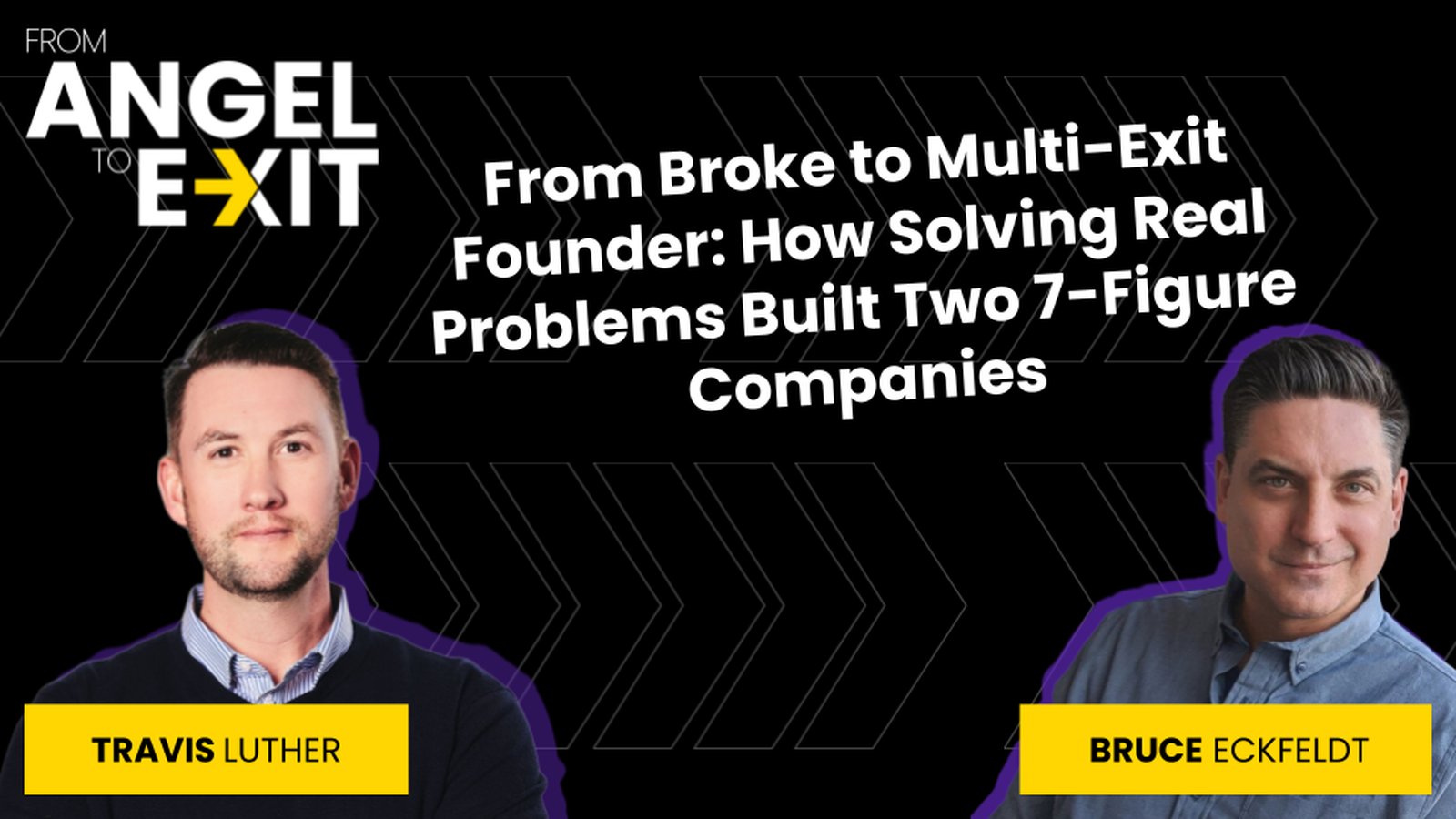
From Broke to Multi-Exit Founder: How Solving Real Problems Built Two 7-Figure Companies
Travis LutherFounder, Moso Pillow
Listen to the Episode.
Play the full conversation right here, or pick a chapter to jump straight to that moment. Prefer your own app? Every episode is on Spotify, Apple Podcasts, and the rest.
About This Episode.
Start with the key takeaways, the ideas worth bringing back to your leadership team. Then read the full story of the conversation, or use the chapters above to jump straight to the moment that matters most to you.
- Solving a real, painful market problem is more important than building a passion project.
- Choose business partners with complementary skills, not just shared interests.
- Know your exact cost of goods sold to price effectively and grow profitably.
- Valet Ads taught Travis about high-margin, scalable ideas hidden in plain sight.
- Queen Anne Pillow scaled fast with SEO and customer education during COVID.
- Selling too soon without testing the full market may leave money on the table.
- Life post-exit can bring emotional uncertainty if you haven’t planned what’s next.
- Travis’s new venture, Moso Pillow, aligns impact, purpose, and entrepreneurship.
From hustling for baseball cards as a kid to exiting multiple businesses, Travis Luther shares his extraordinary journey of entrepreneurship, reinvention, and impact. In this episode, Travis opens up about building and selling Queen Anne Pillow and Trial Line, the emotional complexities of life post-exit, and his new mission with Moso Pillow. Packed with raw insights, hard-won lessons, and founder-to-founder wisdom, this is a must-listen for any entrepreneur aiming to scale with purpose and exit with clarity.
Watch the Video.
Prefer to see the conversation? The full episode plays right here on the page, so you can watch while you follow the takeaways or read along with the transcript. Every episode of From Angel to Exit is also on my YouTube channel, along with short clips from each conversation.
About the Guest.
The background behind the conversation, and where to find this guest online.
Travis Luther
Founder, Moso Pillow
Travis Luther is a serial founder who built and sold Queen Anne Pillow and TrialLine. He now leads Moso Pillow and speaks openly about the emotional side of life after an exit.
- Website
- travisluther.com
- instagram.com/travisscottluther
Full Transcript.
The complete conversation, lightly edited for readability. Open it to read along, or search the page for a topic or a name.
Read the full transcript
Bruce EckfeldtWelcome, everyone. This is From Angel to Exit. I'm Bruce Eckfeldt, I'm your host. Our guest today is Travis Luther. He is an exited founder of two different companies, TrialLine and Queen Anne Pillow. We're going to hear about those, the stories and the experiences he had, and what he's doing today. He's doing some interesting work, and I hope we have time to get into it, what he's doing with the community and some really important work as well. So I'm excited about all that. Let's get into it. Travis, welcome to the program.
Travis LutherGood morning, Bruce. Thanks for having me.
Bruce EckfeldtIt's a pleasure. It's Monday morning, and this is our first conversation, I think, for both of us. Before we get into the founding stories and the exit stories, we'd love to get a little personal background. What was your personal and professional background? How did you get into business? Did you always want to be an entrepreneur in kindergarten? Was this your dream? Give me a little bit of that story.
Travis LutherI came from a very poor family. My mom got pregnant with me when she was 15 and was a single mom of three boys by the time she was 19. So as I grew up, we lived largely on state assistance and welfare. Money, unfortunately, was always front and center in my mind, whether it was not having any of it for the things I wanted, like Nikes or something like that, or the shame of other people knowing I didn't have it. So from a very young age, I started looking for opportunities to take care of myself or get the money I needed for baseball cards and stuff. Like many entrepreneurs, I had a lot of paper routes. I would go dumpster diving on the weekends, recycling aluminum and glass and taking it to the grocery store for nickels. So I always had this entrepreneurial spirit about me.
As I got older, I moved out of my house a couple of weeks before I turned 16 and had to drop out of high school, unfortunately, to take care of my two younger brothers. I think my interest in entrepreneurship shifted from this fun thing that got me the things I wanted to a realization: man, I don't have a lot of opportunities in life, and I'm probably going to have to create them for myself. That's when I really started looking at owning businesses as a permanent part of who I was going to be and what I was going to do.
At 16, I opened a skateboard and snowboard shop with a friend of mine. We took a loan from his parents and ended up getting robbed. Not robbed at gunpoint, but somebody broke in and stole everything. So that was my first lesson about insurance. You've got to have insurance.
Bruce EckfeldtOh boy. And it only counts if you get it before the event.
Travis LutherThat's right. Then that same friend and I started a coffee shop a couple of years after that. I just continued on, trying things that were not very successful, not realizing the lessons I was learning along the way. Then in 2004, I think, I moved to Denver, and all that history of things I had tried and failed at came together in unison as I started a new business doing advertising. I suddenly started having success, realizing what I'd learned and applying those lessons to my businesses. So for the last 20, 25 years now, I haven't had to work for anybody else. I've been a self-sustaining entrepreneur.
Bruce EckfeldtGood for you, man. I have two questions. One, what were some of the lessons you learned that came together at that point? I certainly know the school of hard knocks. Sometimes you wish there were easier ways to learn some of these. The second one, and you can answer them in whatever order you want: when did you feel like you went from needing to be an entrepreneur, needing this to get by and create the income you needed, to "Hey, I actually have something going here. My core needs are met, and I'm now creating something with real value that's changing my life"?
Travis LutherI can back into that. Part of my story, kind of unrelated to business, is that I hadn't gotten a college education. So when I came to Denver, I was having some success in business, but I also wanted to go finish the degree I had started. After that, I didn't feel like I was done with school. I really enjoyed learning, so I went to grad school too.
I say all this to say that a year or two after I finished grad school, I ran into somebody I knew through the university, and she saw I was part of EO, the Entrepreneurs' Organization, which the university was helping sponsor. She invited me to come back to the university as an adjunct, and I ended up getting weaseled into teaching full-time for four years. I didn't realize that was what was going to happen. I don't know if that was always her plan. It started out with, "Hey, could you come be a mentor?" and before I knew it, I was writing a syllabus for three or four different classes.
What I loved about that is it gave me an opportunity to distill those lessons down into some work I could give to the students, and some warnings: "Hey, this is where I screwed things up, and this is how you'll be successful faster if you avoid it." The first thing I pounded into them was that you have to be solving a problem in the market. You have to be solving a problem that's so painful that people are actually willing to spend money to fix it.
If I look at some of my earlier businesses, the skateboard and snowboard shop and the coffee shop, those were more like passion projects. At the time I was really living this whole "if you do what you love, you'll never work a day in your life" idea. But there's some information missing from that scenario, which is: if you do what you love, and it solves a problem for somebody, and they're willing to pay for that...
Bruce EckfeldtAnd they have money that can pay for it.
Travis LutherSo that CliffsNotes version, without all the information, was what I was relying on. I was doing things I loved. I loved skateboarding at the time. I loved going to coffee shops and seeing art and watching bands. But no one ever asked me to do that. It was never presented to me as a problem. It wasn't like we didn't have enough skateboards in town.
So that's really what I teach. Make sure you're solving a problem, that you're not just doing something you think would be fun or good for you. Unless you want an owner-operator hobby business, and that's fine. But if you want to build an enterprise that's going to take care of you and eventually your family, and give you retirement and money to buy a home and all those things, you have to solve a problem at scale, or at least solve a problem for more than just yourself. For me, solving the problem of having a coffee shop to hang out in never got me the millions of dollars I really wanted to have a good life. So that's the first one.
The second one I always talk about is partners. New entrepreneurs always say, "Oh, Bruce is just like me. He'll make a great partner. He and I love all the same things. We know all the same things. We're going to go build this widget company." And then Bruce and I get down to brass tacks, and we have no other skill set that would be helpful to building the company. So I say, look at your partners as pieces of a working puzzle. Just because you agree about stuff doesn't mean it's going to accelerate your efforts as an entrepreneur. It's much better if Bruce is a finance-minded person and Travis is a marketing-minded person. That's probably a better fit than Bruce and Travis both having an excellent finance background but not knowing how to sell anything.
The third thing I always talk about is your cost of goods. I have many lessons, as you can tell. I love to talk. But the top three are: find a problem that really matters, pick partners who are complementary, not the same, and really understand your cost of goods.
I often go back to my coffee shop example. My whole pricing strategy was figuring out what Starbucks charged, then charging a little less and thinking that would be enough incentive to pull everybody from Starbucks to my coffee shop. And to be perfectly honest, I never knew how much it cost me to make a latte. When I thought about it, it's not just the latte. It's the espresso and the milk and the cup and the sleeve that goes over it and the little straw that goes inside, and how often someone puts a sweetener in it, and how often somebody takes a carrying tray. You really have to understand every little detail of your cost of goods sold so you can price appropriately and profit appropriately to stay alive and grow.
Bruce EckfeldtI've seen that not happen too many times.
Travis LutherAnd it gets really hard in services too. If you're a graphic designer or something like that, it's even harder to figure out. I think your second question was, when did I realize it was all coming together?
Bruce EckfeldtExactly. When did you feel like you went from scrappy, trying to figure out how to put this together to make an income, to having something with actual enterprise value that's going to grow and has some future in it?
Travis LutherMy first big success and my first company in Denver was a company called Valet Ads. When I moved to Denver, I did it largely to return to school, because I had believed all this stuff that some people close to me were saying: entrepreneurship is a pipe dream, you need to go to college, and you need to settle down like everyone else. Like I said, for the 10 years before that, I had been building and basically burning businesses to the ground, and I was starting to wonder if I had what it took to be an entrepreneur. That had gotten in my head a little bit.
So I came to Denver. My best friend had moved out here, and he said, "Just come out and check it out." I started college, and while I was going to school, I worked as a valet at night, parking cars in Cherry Creek, which is the ritzy part of Denver. While I was sitting there handing out these giant valet tickets, I thought, gosh, what if I could sell advertising on these? What if I could take the blank side of this valet ticket and sell stuff to these people who obviously have money, really high-end people?
I went to the owner of my valet company and told him the idea. He said, "I don't think it's going to work, but if you want to try it, go for it." And I said, "Okay, if you don't think it's going to work, do you care if I reach out to every other valet company in Denver and ask them to partner with me too?" He said, "I don't care what you do." There must have been five or six valet companies in Denver, and I partnered with all of them. I got a volume of something like 30,000 tickets a month that I thought I could circulate.
Then I put a little packet together, and within two weeks I had my first client, Mercedes-Benz, doing a lease deal. Once that first ticket was out there, I just got calls. I did great business. My first commission was something like $14,000. The year before I got here, my total income was $9,000. So in one transaction, I made more money than I had all year. I couldn't believe it.
I did a deal with Kroenke Sports, who owns the Nuggets, the Pepsi Center, and the Avalanche. Part of my deal with them was trade, so I got some partial season ticket packages as well as the money. I had just started dating my wife at the time, and I said, "Hey, you want to go to a game?" She said, "Sure." We're sitting courtside, and she's thinking, who is this guy? Which is funny, because I was asking myself the same thing. This is a dream. This is totally going to fall apart.
But I think it was that recognition that I had taken an idea and solved a problem. The problem is, how do you reach the educated and affluent? I had figured out the best way to do that was to put an advertisement in their hand. It had nothing to do with skateboarding or music or snowboarding or any of these other things. I just saw an opportunity to solve a problem for advertisers.
And I also understood my cost of goods sold. I understood value pricing. What did it cost me to print those tickets? A couple thousand dollars. What did I charge for them? $20,000. How happy were the people who paid it? Tremendously happy. It wasn't cost-plus, where it cost me $3,200 to print the tickets, so let's add 100% and charge $6,000. It was, I created this cool idea that only I own, and people will pay a premium for it. That was a massive lesson. Having that money, those lessons, that understanding carried me into the next ventures, which were even more successful. So successful, in fact, that Valet Ads became a side project and then nothing at all.
Bruce EckfeldtLet's talk about the first company you ended up growing and selling. How did that idea come about? When did it start? How did it transpire?
Travis LutherQueen Anne Pillow was the first company I sold, though it didn't have as long a history as TrialLine. I'll talk about that pivot. The woman I took to the Nuggets game eventually became my wife, and she was a lawyer. At some point when we were first dating, she realized I had this knack for technology and art and design, so she referred me to other lawyers who were looking for work like that. Eventually I built a company called Lawfather. We served the digital design side, and eventually we did trial consulting. We went to court and made 3D animations and poster boards and all this stuff. We sat in trial and ran all the exhibits and demonstratives. I'll get back to that in a second, because it plays into the TrialLine exit.
While I was working there, I was also coaching Little League baseball, crawling all over the place picking up baseballs for little kids, and crawling all over courtrooms plugging in cables and taping down wires and all this stuff. Eventually my back gave out, and I had a couple of back surgeries.
While I was lying in bed, I remember seeing these ads: "We have this pillow that can fix your neck pain." I thought, is there any pillow that could fix my back pain? So I did a bunch of research online and found that there really was no back pain pillow per se. But what I did discover was that pillow shopping was such a silly, weird experience. You'd have a pillow that was $4, and a pillow that was $400, and understanding the difference between any of them seemed impossible. They just didn't explain it.
Bruce EckfeldtThey all look the same.
Travis LutherThey all look the same. I also had a background and expertise in online marketing, so I wondered if other people were having the same problem picking a pillow. I did some searches and basically found that something like 25 million people a month were searching for pillow-related questions. I don't know what the exact number was. But with my expertise in SEO and paid search, I thought there was an opportunity here.
So I made some pillows for myself, really liked them, decided to expand the line, and that became Queen Anne Pillow. Again, it was a problem-based business. My premise was, if I can educate people about the differences between pillows and how they perform, I can make better recommendations about which pillow is right for them. And if I can do that successfully, I should be able to build a pretty successful company.
I took that to heart with a really great customer service experience. If you had an issue, we would just continue to solve it until you got the pillow you wanted. So the people who seemed like a pain in the ass became these awesome advocates for what we were trying to do. They would leave reviews and talk about it on social.
That company grew pretty quickly. I brought my father-in-law into it. He had retired, and a couple of years after I'd launched, he asked, "Do you have anything I can do?" Like I said, I had the other legal tech company. I said, "I have this side project, a pillow business. You can help me." So he came in, and we turned that thing on.
Then what really happened was COVID. It was always growing. It had shifted from a side project to getting dual attention alongside my other company. And then over COVID it really rocketed. People were staying home and buying stuff for their bedrooms. It was a big-boy business at that point. It was not a side project. It was EO qualified, and we were starting to balance real challenges like cash flow especially. We'd be selling this massive amount of product, and that product would be sitting on boats for a long time.
It came to the point where we realized we were going to need some financing, we were probably going to need some partners, and it was probably time to expand the product line. My father-in-law was older, and this was always meant to be a side project for us. I wouldn't say he and I weren't in agreement, but we started the company for specific reasons, and those reasons, or those challenges, changed. Then we had this great couple of years after COVID, and I said, "Look, maybe now is just a good time to sell and call it good." It turned out we were right. We sold that in, I think, 2021 or '22.
Bruce EckfeldtSo the impetus to sell was situational: the growth of the company and the situations of the founders and key people involved. Once you decided to sell, what was your next step? How did you plot out the process? Who did you engage? What did you know and not know? I'm always curious, once people go down this path, what starts to happen?
Travis LutherI think the first thing he and I both wanted to know was, what's it worth? We were making nice distributions, and it was a pretty easy business to run. So: are we going to get to a number that makes it worth it for us to go through this headache and give up our distributions? Having been an entrepreneur for many years and around many entrepreneurs, I had some sense of how a business was valued.
The first thing we did was get an informal valuation from a broker who could tell us what the market looked like for pillows and manufacturing at the time. We took that multiple, which I think was about three and a half times seller's discretionary earnings or something, applied it to what our owner discretionary earnings were, and asked, is that enough money to jump? And it was, yeah, that makes sense. So we engaged with that broker, signed a formal agreement, and let him go to work: making listings, sending it out to his network, putting stuff online.
Bruce EckfeldtIn terms of actually finding a buyer, due diligence, term sheets, all that kind of stuff, any learnings there you'd pass along?
Travis LutherThe biggest lesson I took... Our business, like I said, was pretty simple. It wasn't a $100 million project. It was a business that could be bought with SBA financing, so there were a lot more people interested, I guess, because the route to financing the purchase was easier and less expensive. And this is a very different story than TrialLine, but the first company that seemed serious about buying ended up being the company that bought.
Bruce EckfeldtInteresting. That usually doesn't happen.
Travis LutherOh, no. When they came on the scene, they said, "Oh yeah, we'll pay the price." There was no negotiation, none of this offer and counteroffer. And I'm thinking, this is too good to be true. This will fall apart. And we just keep going through the due diligence and the process, and it never falls apart, and we sell the company.
In retrospect, what I realized is that we had a really good company. I had organized it. It was very solid. The financials were very solid. The revenue was very predictable. When you start due diligence, you usually take some escrow money, and that usually closes off the opportunity to entertain other offers or talk to other potential buyers. So this buyer comes in, he offers us exactly what we want, we take the escrow money, we go through due diligence, and he buys.
What I would do now is keep that door open more and see what other offers come in. Just because somebody comes in and makes an offer does not mean you have to sell to them. I wish I had waited a little longer to see who else came out of the woodwork and how they may have competed on price. Which is funny, because when we set the price, I was totally happy. I got the money, and I was totally happy. A month later I was thinking, what the hell did I do? I must have left money on the table.
Bruce EckfeldtIt's so true, because these prices are so relative, and it's so emotional, and it cuts into your ego. All of these things play both ways. In your case, it went the other way. I've seen deals fall apart because people have an inflated sense of what the company is worth, because they're tied into it emotionally. But on the market, it is what it is, and you're not going to find a buyer at that price. And they can't reconcile those two things.
So you're doing all this at the same time that TrialLine is going on. My first question as we go to TrialLine is, how did that experience shape your view of TrialLine, in terms of how the company should be run, its possible future, a possible exit? Did it set you up to say, "Oh, now I'm just going to do this again"?
Travis LutherLet's rewind a little bit. I told you I brought my father-in-law into the business. Great guy, love him to death. But family and business can get kind of bloody and weird. I remember making one promise to my wife: I will never let money or this business change me in any way that would create conflict between me and your father. There was nothing that would ever be worth destroying that relationship.
That being said, and not that the relationship was destroyed, I had a vision for what I wanted to do with Queen Anne Pillow, and I thought we could do more. But I also had TrialLine on the side, this other entity that was doing well and also had possibilities, maybe even bigger possibilities than the pillow company. It's interesting to think how I would have behaved if that wasn't the case. If all my eggs were in the Queen Anne basket, I don't know that I would have sold right then. I had this other thing that gave me some freedom and latitude not to be so wrapped up in the pillows.
Selling Queen Anne was also because I thought, I'm going to shift my energy to the software company, and I'm going to do it again with the software company. I'm going to commit so many years to building it up and then sell it. So that played a role in why and how we sold Queen Anne: the idea that I could go and do it again with the other company, which I had complete ownership of.
Bruce EckfeldtThat's interesting. I think that certainly plays into the dynamics for entrepreneurs, particularly if it's their first one and they've been at it a long time. They feel like this is their one shot, and they've got to really make it count. And if they don't have a plan for what they're going to do next, it puts a huge amount of pressure on that transaction and can really skew both the logic and the emotional process they're going through.
Travis LutherNot to skip over TrialLine, but since those sales, I've been invited to do a number of talks and panels on what life is like post-exit, and how it's different from what you thought it was going to be like. One thing I hear from fellow founders, and from myself, is exactly what you said: not enough of us had a plan for what we were going to do next.
You have this company for some number of years. Once you decide you want to sell, whether it's three years before the sale or three months, everything becomes about strengthening the company and building it and getting it ready for sale. What happens next is so rarely considered. What you believe is that as soon as the sale is done, you'll breathe this huge sigh of relief. Everything will be great. You'll have money in the bank, and then you can figure out what you want to do. A lot of us think that, and then within a couple of months, we realize we didn't plan for what we wanted to do. We hadn't thought about what was going to come next.
I remember my wife asked me, "Well, what do you want to do next?" I said, "All I want to do is re-sign up for my subscriptions to the Wall Street Journal and the New York Times. I want to get up every morning and read the papers, and that's it." That was the thing I hadn't had time to do for a really long time, and that was my plan.
What I realized, and what these other men and women I've spoken with or been on panels with realized, is that we are entrepreneurs. It's not that we are the owner of Queen Anne Pillow or the owner of TrialLine. We are people who get all of our vigor and excitement and thrill and purpose and meaning in life from building businesses. So when you don't have that and you don't know what you want to do, it becomes a very unsettling place. You feel very unsure about your place in the world. That's the first thing.
The second problem is this. Part of my reason for selling my businesses was that I was telling myself things like, "This is no longer aligned with who I am. This doesn't feel like what I had planned for myself." Twenty years ago, I never thought I would have this 18-year career in legal. I was always more of an art and design guy, a musician and stuff. So I was trying to grasp at doing something that felt more authentic to me.
But then you get your little bit of money, you get your little bit of free time, and you panic over not wanting to make a mistake next time. Because you're thinking, I made all these promises to myself. I made these promises to my wife. I told my kids I was going to go live authentically. And then: okay, I'll try this. No, that's not it. I'll try this. No, that's not it. I'll try that. You feel paralyzed by too many choices. You didn't make a plan pre-exit, and now you don't want to make the wrong choice or invest your money in the wrong thing, and you think, holy crap, I'm just stuck. I'm a marble statue of the man I used to be, and I can't make any freaking decision about what I'm going to do with my life.
Bruce EckfeldtThat's an interesting one. A lot of times when we start companies, it's a little bit like throwing caution to the wind. I'm trying to figure things out. It's opportunistic. There's not a whole lot of fear of failure. It's almost like, I kind of assume this isn't going to work, so I'm just going to go for it. I'm going to swing. But now that you're successful and you've got some money, it's, "I don't want to fail. I don't want to screw it up." And like you said, you get paralyzed.
Travis LutherTotally paralyzed. So, with TrialLine. The company I told you about that I started shortly after I met my wife was called Lawfather. When we first started, we did web design, SEO, and paid marketing for lawyers, mostly personal injury lawyers, trying to help them get clients from the internet. This started back in 2007, 2008, when that was the Wild, Wild West, and we could be very successful very fast and nail all of our promises. If you were with us, you got clients from the internet.
That definitely got harder and harder, and then the requests from our attorneys changed. They looked at us as a tech company because we did web and marketing, so they'd say things like, "Can you do any videotaping? Can you rent me a television? Can you come to trial with me and help make sure the projectors work?" So our business shifted from being a web coding company to being a technology company. We were spending more and more time in court, consulting with lawyers not on how to make websites that sold, but on how to make case presentations that sold, that won the jury over. It was actually pretty fun and very exciting. Totally unexpected.
The bulk of our business became consulting with lawyers, renting projectors, AV equipment, television monitors, going into trials and sitting there while the lawyers would turn back and say, "Mr. Luther, can you pull up Exhibit 14, go to page 6, and blow up paragraph 7?" That's what we did.
As part of that work, we made a lot of timelines that we would put on poster boards, and those poster boards would go on easels in front of the jury. And there came a time when I asked, can we make a digital one? Because the lawyers would come in and give you, let's say, 40 facts. Then they'd go have a deposition and come up with some new genius idea on how to win the case, and they'd want to move everything over and add 16 new facts. To them, it's no big deal. But for us, dealing with these layered files with thousands of layers, it's a very cumbersome thing. Or they'd have somebody on the stand, and then at lunch they'd say, "Hey, can we move the timeline all around because of what this person just said?" No, you can't. There's no way to do that, especially over lunch.
So I thought, there must be a web-based timeline program out there that can do this quickly. I went and looked, and the stuff I saw was not what I had in mind or very helpful. So I had one of my coders in the office code up a little something in WordPress, actually, just to finagle some stuff. I put a fake case in there, and I remember taking it home to my wife and showing her. I asked, "What do you think of this?" And she said, "I think this is the future of your company." And I said, "Yeah, I kind of do too."
So we started development of this SaaS-based interactive timeline program, where lawyers could make these timelines on their own. They could create a timeline with events, attach the relevant documents or bills or emails or voicemails or whatever to the events, and then make these beautiful presentations that they could open, close, swipe, and give themselves.
Bruce EckfeldtWhat's that one? There's a graphical one that's competitive with PowerPoint, but it has a lot of movement to it. Prezi. It sounds like a Prezi kind of format.
Travis LutherYeah, similar to Prezi, I would say. So I turned my personal attention and my finances toward developing this software while Lawfather continued to hum along. After about two years, we had something we were ready to present to the public. This was right at the beginning of 2019. We had no customers, really, but we were submitting our software to different competitions and legal tech boards and Twitter feeds and stuff like that, and we started getting a lot of traction. We won some awards, and we got invited to pitch competitions. By the end of 2019, it seemed like we were well on our way to a good 2020 and a good launch.
Early in 2020, we got invited to premiere it, if you will, at the ABA, the American Bar Association, tech show in Chicago. This is February of 2020. It's awesome. It's perfect. And then COVID. Good God. I didn't know what was going to happen. My other business was totally focused on going to trial, and they shut the courts down. The courts were closed for two years. It wasn't like a restaurant where I could have 50% capacity. Suddenly I had no business. Queen Anne Pillow had also taken a dump in those first couple of months, even though that turned around and changed.
I hate to tell another COVID horror story, but I just did not know what was going to happen, and I felt very panicked, and all of my cash had been dumped into this software. Then, kind of similar to what happened with the pillows, lawyers started doing some remote hearings. Eventually they started doing these remote bench trials, where you do a trial in front of a judge. So TrialLine started to get some traction because of its ability to present cases clearly in this remote setting, over Zoom. Our revenue built, and our customer base built.
Then I went through the Queen Anne thing, and I thought, okay, I'm going to sell Queen Anne and put all my attention on TrialLine. I did that for a couple of years. And then I kept having those feelings I talked about earlier: this isn't me, this isn't aligned with what I thought I would be doing or my purpose in the world. That was also combined with continued overhead and development debt that just never seemed to stop.
Bruce EckfeldtIt tends to do that.
Travis LutherSo I thought, I'm going to go out and sell. I'm at a point where I have enough revenue and enough customers that this is definitely valuable to somebody. So I started putting some feelers out. I was also getting a lot of contact from other tech companies and private equity groups that were interested in buying, or had been tracking my progress. This time it wasn't so much that I went out to a bunch of people. It was more the belief that because so many people were coming to me, maybe I should start to entertain these things. Before, I would say, "No, I'm not ready. I'm still working on it. I'll talk to you later." Now I said, "Let's do it."
Those engagements were a lot more cumbersome than the Queen Anne one. They required a lot more due diligence on the technology side, the development side, the potential, the intellectual property. There was a lot more sophistication involved. I set myself a deadline. I think I decided to sell in January of 2023, and if I hadn't sold by June of 2023, I was going to take it off the market and fully commit to five years of development, really building toward that $100 million sale price thing.
I went through due diligence with a couple of other legal tech companies that were also PE backed. It seemed like I was getting close to an offer I was going to entertain. And then that Silicon Valley Bank thing happened. The questions started getting stupider. The responses to things I would answer for them were just dumb. I could tell these weren't real people with real questions. These were scared people trying to figure out if this was really going to work, or if they should get out of it, and their money was now tied up or gone or whatever. Eventually it just fizzled out, and I was so frustrated that I also stopped engaging.
Then I was in South Africa with my wife. We were there for an EO event. My wife fell down some stairs and broke her leg, and we ended up getting stuck there for a month because she had to have massive surgery. She couldn't fly. She was in a wheelchair. It must have been May 1st, and my clock for selling the company was running out. The only conversations I was having were with people saying they were no longer interested.
So I left for Africa thinking I was going to sell the company and come home to a fresh start, and when I got to Africa I realized it was all falling apart. My wife has this massive medical crisis, and now we're renting a condo, waiting for her to heal so we can get back to our two teenage boys in the United States.
A couple of days before we left, a guy who had heard about my company being for sale called. He had a technology company in Oregon, working in secure data storage. He worked with a lot of people in finance but wanted to move into law. He saw the opportunity, just as I did, that law was moving to the cloud and there would be all sorts of needs for these cloud-based services, but the security issues needed to be solved. That was a lot of the pushback I got: HIPAA violations and not having secure data and all that. He knew exactly what he wanted to do, and he made me a very generous offer.
Bruce EckfeldtI love it.
Travis LutherI was so gun-shy, I think I asked him for something like $25,000 in escrow, when usually you ask for $5,000 or something. I was thinking, how serious are you? Because my heart has been broken. My wife is over here. I'm stuck in Africa. I just don't want to screw around with anybody anymore. And he gave me the money the next day. Within 30 days, we had the deal, and in probably 45 days, I had the money. So it went from the sky is falling, this is never going to happen, to this phone call that changed everything and helped me move on.
Bruce EckfeldtI have so many questions in there, and we're not going to have a huge amount of time. I'm curious, how has this shaped what you're doing now? How have these experiences as an entrepreneur going through these exits led to what you're focused on now, in terms of the impact you want to have and the work you want to do?
Travis LutherGoing back to my teaching and my own background, I've always wanted to inspire people toward entrepreneurship. So now I look more at the kinds of activities I can do to do that. It hasn't just been the teaching. Now I'm speaking, I'm coaching, I'm keynoting, I'm doing workshops. I have a real belief that this is a possibility for anybody. And I have a real belief, especially for people with my background, that this is the key to moving up the social ladder.
It gets a lot of tongue-in-cheek attention, but it doesn't get serious attention. If the world were serious about the possibilities for entrepreneurship to improve people's lives and alleviate poverty, we would be teaching it in grade school. We would be teaching it in middle school and high school. We would have more opportunities for it and more colleges with dedicated programs. I just don't see that. So I try to go out into the actual world and inspire people toward entrepreneurship, and show them that yes, it is possible. Just like anything else, you just have to know how to do it. There are 10 rules or whatever, and if you get those nailed, you're going to be successful. It's not as scary or risky as anything else.
Bruce EckfeldtIt doesn't have to be.
Travis LutherIt doesn't have to be. So that's what I've been working on personally. And I have always been an environmentalist in one way or another. While I owned my pillow company, I learned some hard truths about how that industry affects the environment and how big it is. So now I've launched a new company called Moso Pillow, mosopillow.com. That company is all about creating environmentally sustainable, non-toxic bedding products. I feel very excited about that, because, again, I'm back in bedding, but it's super aligned with what I'm trying to do for the world too.
Bruce EckfeldtI love it. I love the retooled focus here, figuring out how to level things up a little bit. Travis, it's been a pleasure. If people want to find out more about you, the work you've done, and the work you're doing today, what's the best way to get that information?
Travis LutherMy website, travisluther.com, is probably the fastest and easiest way. And I post most of my content on Instagram, which is @travisscottluther.
Bruce EckfeldtExcellent. I'll make sure that information is in the show notes. Travis, thank you so much for taking the time today. It's been a pleasure.
Travis LutherBruce, thanks for having me. I appreciate it.
Never Miss an Episode.
Know the moment a new episode goes live. Subscribers also get a say in future guests and the topics we cover.
Other Related Episodes.
More conversations that connect to this one. Or browse the full archive by topic or by guest.
Scott Allison
How he scaled a boutique PR firm into a global agency, and why complacency costs founders value.
Listen and Read
Aaron Levenstadt
How narrowing services and understanding buyers led to a successful agency exit.
Listen and Read
Erik J. Olson
How niche verticals, systems, and recurring revenue helped him build three agencies.
Listen and Read