From Angel to Exit Episode 29
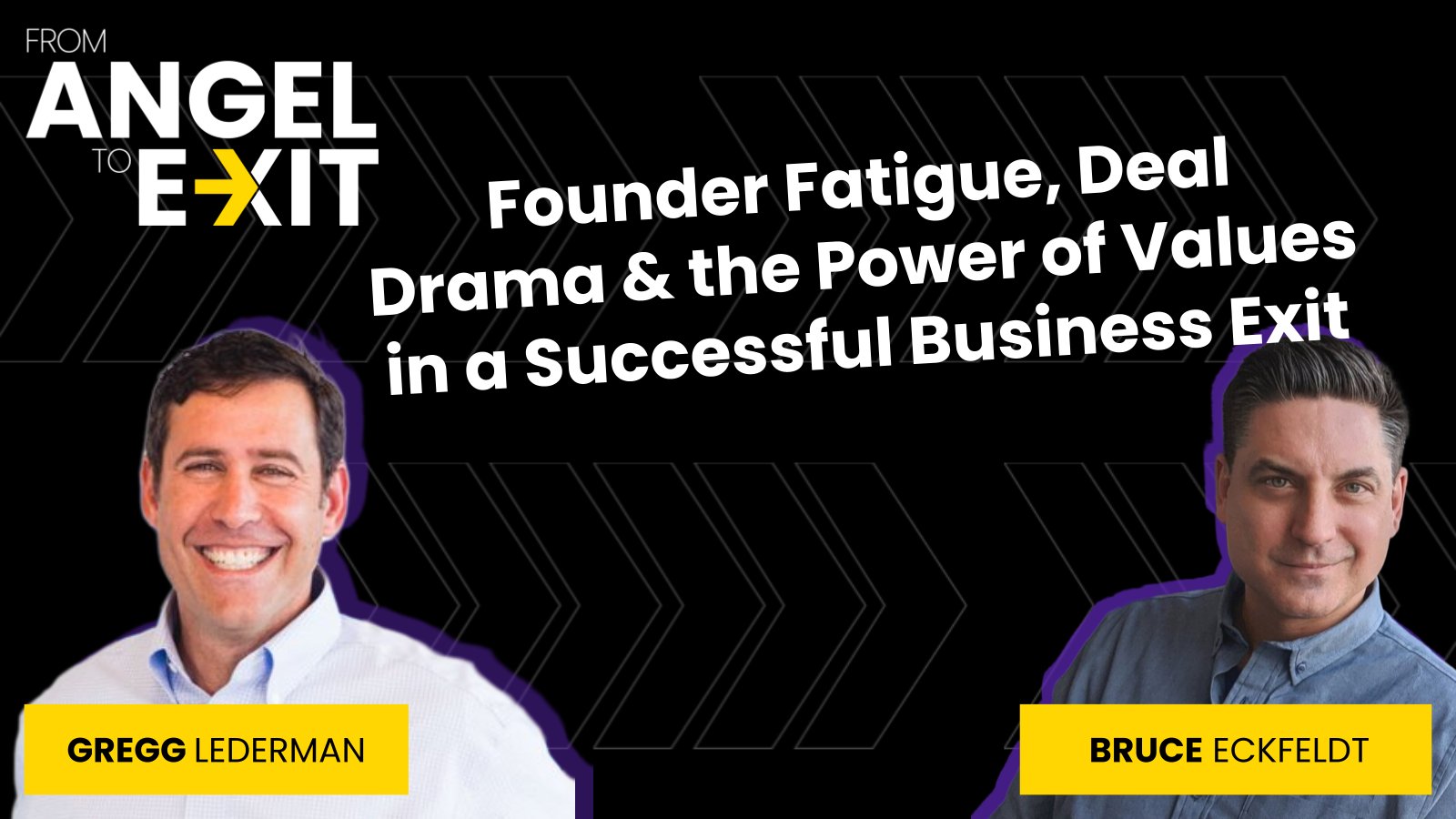
Founder Fatigue, Deal Drama, and the Power of Values in a Successful Business Exit
Gregg LedermanFounder, A Great Life Now
Listen to the Episode.
Play the full conversation right here, or pick a chapter to jump straight to that moment. Prefer your own app? Every episode is on Spotify, Apple Podcasts, and the rest.
About This Episode.
Start with the key takeaways, the ideas worth bringing back to your leadership team. Then read the full story of the conversation, or use the chapters above to jump straight to the moment that matters most to you.
- A values-based culture helped Brand Integrity stand out in a crowded market.
- Hiring people better than yourself is critical to scaling a founder-led business.
- M&A processes often lack integrity, be prepared emotionally and ethically.
- Not raising capital allowed control but limited speed, tradeoffs matter.
- Founders should define personal values before engaging in an exit.
- “Retrading” in M&A is real, expect late-stage changes in deal terms.
- Staying aligned with company culture should outweigh the highest valuation.
- Therapy and self-awareness can be survival tools during exit stress.
In this raw and powerful episode, Gregg Lederman shares how he scaled his values-driven SaaS company, Brand Integrity, from consulting to licensing, and ultimately sold it to a global buyer. He reveals the emotional toll, deal setbacks, and ethical challenges he faced, and how staying true to his core values helped him through. Gregg now leads “A Great Life Now,” helping leaders find purpose and self-awareness. This episode is a must-listen for founders navigating growth, burnout, and business exits.
Watch the Video.
Prefer to see the conversation? The full episode plays right here on the page, so you can watch while you follow the takeaways or read along with the transcript. Every episode of From Angel to Exit is also on my YouTube channel, along with short clips from each conversation.
About the Guest.
The background behind the conversation, and where to find this guest online.
Gregg Lederman
Founder, A Great Life Now
Gregg Lederman scaled Brand Integrity, a values-driven SaaS company, from consulting to licensing and sold it to a global buyer. He now leads A Great Life Now, helping leaders find purpose and self-awareness.
- Website
- gregglederman.com
Full Transcript.
The complete conversation, lightly edited for readability. Open it to read along, or search the page for a topic or a name.
Read the full transcript
Bruce EckfeldtWelcome, everyone. This is From Angel to Exit. I'm Bruce Eckfeldt, I'm your host. Our guest today is Gregg Lederman. Gregg has an amazing story about his exit, the drama and the experience of that. And he's actually doing some amazing stuff now with leaders, helping them with planning and really figuring out their purpose, their mission. So I'm excited to talk about it and to have a chance to talk with Gregg. Gregg and I always have great conversations. So with that, Gregg, welcome to the program.
Gregg LedermanGood to be back, Bruce. Amazing story? I hope I live up to the expectation. I don't know how amazing it is. It was more scary than amazing for me.
Bruce EckfeldtWell, that can be the amazing part. Before we get into it, let's do background. What was your professional background? How did you start your business? Give us a little of the backstory, and then we can talk about the business and how things unfolded.
Gregg LedermanSure. I started an organization called Brand Integrity back in '02. The concept of brand integrity was simple: know what your values are, your brand, who you are, and live it. I saw an opportunity to go into companies and help them define their values in a really unique way, and then integrate them into all their people systems, from how they hire to how they do performance reviews. And the big one was, how do you recognize your people?
We actually invented the first-ever online program for recognizing employees. Back in 2005, when we created the program, everybody was using email. No one had seen Facebook yet. So we created an online program, and then for the next three or four years we had to go out and educate everybody, because no one had ever seen anything like it before. Today they're everywhere. Everybody's got an online platform to go in and recognize people when they live the values. And we started to build all the Facebook-type features in as we were going and growing.
So that values consulting business started in '02, by '06 we'd launched this software, and over the next 10 years it evolved very quickly. In 2010, I think 90% of our revenue was still consulting revenue for values-based consulting, but by 2015 it had switched.
Bruce EckfeldtMostly product.
Gregg LedermanAbout 90% was license fees to use our technology for recognizing your employees, evaluating the engagement level of employees, and evaluating the engagement level of customers through some online surveys. So we'd really become a software business in the employee engagement space.
Bruce EckfeldtWhen you were young, did you want to become a CEO and an entrepreneur? What was the motivation to start the business to begin with?
Gregg LedermanThat's not only a great question, Bruce, it's one of my favorites to get, because my kids are all young adults, and I talk to their friends a lot about business and work. I love to tell this story. I got asked to speak, I want to say in 2015 or 2016, our really high-growth years, at the Simon School, where I got my MBA in the '90s. I taught there for almost 20 years, to MBA students at the University of Rochester, where I'm from.
One of the students asked, "Was there anything that happened in your career that was unexpected?" I paused, I'm on the spot, and I had the best answer to any question I've ever been asked. I said, "Look, if you had told me when I was graduating with my MBA in 1999 that I would be a New York Times bestselling author, that I would be the CEO of a technology company, and that I would be a professional speaker, I would have looked at you and said, you are out of your freaking mind." Because those were three things at the top of my list of things that would never happen to me.
I was a horrible writer in general. I didn't even write my own college essay. I used my friend's. He printed it off his new... remember the first Macintosh? It was one of those. It was 1986 or something. I used his essay. I didn't have the confidence to write my own college essay.
I know nothing about technology, even though my wife and kids think I'm the IT guy around here. I know nothing about technology, but I was the CEO of what had become a software business. And professional speaking: I told them about management communications at Simon. I'll never forget the day I had to get up and do my little presentation in front of the class. I can still feel the sweat dripping down my back. I was so nervous.
But when you have to go out and speak because you've got to feed your family, and you've built this values-based consulting business, and they want you to speak at their trade show or trade association, you go do it, and you're shaking the entire time. You know what? You figure it out. And then I realized, hey, I was pretty good at it. I could get paid for this.
Bruce EckfeldtThis is interesting, because I certainly had a similar experience. I was an architect, and I ended up with this business. I always felt like, am I really supposed to be running this thing? You have this kind of imposter syndrome. And then I think it's a combination: you start building some confidence, and you look around and realize no one else has a fucking clue what they're doing either. You're in the same boat. How did that shift for you? When did you feel like you knew what you were doing with this business, or had a sense of what your role was and where you were going with it? How did that play out in the early stages?
Gregg LedermanWhen I was sitting at that table with all these newly minted MBAs and got asked whether anything unexpected happened, I didn't have a canned answer. That's just what came to mind. I don't remember a specific time where there was a click. But I'll tell you, to be a successful entrepreneur, and for anyone who's going to optimize their exit, which I know is your theme here, they've got to know this.
The big lesson from that story was that life is what happens while you plan for everything else. I don't know who said that. I'd have to Google it, but it's genius. I didn't originate it, of course. I tell it to my kids and their friends all the time. Stop stressing out. You're 24 years old. Just go get a job and go do productive things. Life is what happens while you plan for everything else.
Regarding whether there was a moment where it shifted, there really wasn't. What happened is I learned what I think is the number one skill of a leader, which is to attract and retain good people. I was the quarterback, I was the CEO, so I get all the credit when it goes well and the exit happens. If it didn't go that way, who was going to get blamed? I would have deflected it, like all the other leaders do, to everybody else. But all kidding aside, I just attracted really awesome people to the organization. I mean awesome. Our people blew away the suitors who were looking to buy us. They could not believe how strong our thinkers were on the strategy side. Our IT guys and gals were just amazing.
Bruce EckfeldtWhen did that occur to you? When did you realize that was your job, that your real value was going to be pulling together a strong leadership team?
Gregg LedermanI think I fell into that too, because I'm not a technologist. I came up with an idea: we should have an online platform for recognizing employees, where you'd capture someone living the values. We started doing it in a paper-based format with Excel spreadsheets back in 2002. I had my first client at 100 employees, and it was not manageable. The next client only had about 80 employees. And after the second client, we canceled the offering. I remember another client who said, "I heard you have this cool recognition program." And I said, "No, we're not selling it anymore. You can't manage it in an Excel spreadsheet. It just doesn't work."
I didn't know technology any more than probably you or anyone else. Look, I had trouble setting my mic up here today. So I had to hire. Fortunately, I had a guy, Doug Bennett, who joined me, and another guy, Patrick, and they're both brilliant. They're the ones who made a lot of it happen.
Doug ran our entire technology group, to the point where, by the time we got to our really high-growth years and were hiring a bunch of people, he came to me, and I could tell he was nervous about the conversation. He said, "We really need you to stop being part of the interview process. You've got to trust that we're going to hire people who are values-based, who fit the values of Brand Integrity. We almost lost a guy because you asked him a question about DOS."
I said, "I was just messing around." He said, "But he didn't know you were messing around. And DOS isn't even a thing anymore." And I said, "I don't even know what DOS is. I just thought it would be an interesting question to see what his perspective was." So I had to hire great people and get out of their way. That's the number one job of a good leader.
Bruce EckfeldtIt's all ball bearings these days. I got it. At what point in the business did you feel like you had something potentially big? That you could grow, that this could be sellable? When did it occur to you that you had an asset that needed to scale and that you ultimately needed to figure out how to realize?
Gregg LedermanI think we thought that from the beginning, when we came up with the idea of recognizing employees online. One of the big mistakes I probably made, or someone could call it a mistake that we didn't grow as large as Facebook or something in the billion-dollar range, is that I didn't go out and raise a lot of capital. We self-funded it.
We have the Rochester Institute of Technology here, so I was able to put together a tech team. Or Doug was. He hired a guy named Matt Doyle from RIT. He was our first hire in the tech space other than Doug. And they built a team. Every year they'd go to the job fair and bring on a couple of RIT people, and they were phenomenal. So I just felt like it was going to be huge. But the mistake we made was that we ran it like a lifestyle company versus trying to take over the world.
So do I have any regrets? A friend asked me the other day, "Do you have any regrets in life?" I couldn't come up with any, but that was the one that was kind of percolating. Should I have gone out in 2010, when it was still a pretty novel idea? In 2010, you could count on your hands how many companies were out there doing what we were doing. By 2015, there were 800 of them. And I never went out and raised capital, never put a big plan together. Maybe I'm a little bit of a control freak and I just didn't want to lose control of my business. I was having fun doing it the way I was doing it. Maybe I was just kind of stupid. I don't know. A little of each, probably.
Bruce EckfeldtWhat would capital have afforded you? If you'd had capital, what would you have done with it? Hired more people, sales?
Gregg LedermanWhat do they say? You never want to be first to market, but there is some first-mover advantage. We had something really innovative. Even on the day we sold our business, it was 90% better than most of the other platforms. It had so many cool bells and whistles, and we were selling it at a pretty high price point. But I also learned that when the others come in, all of a sudden there are 800 competitors, and now it's pretty common to have this kind of technology.
Then we had some of our bigger clients asking for certain types of security checks and different things that I didn't really understand, but I saw what the dollar value was to get it done. And I realized we needed to either grow very big, very quickly, or sell to someone bigger. And I was ready at that point to move on. I had started building the Great Life Now journey in 2010. We sold the business in 2018, so I'd already had eight years of that percolating in my mind. I'd been teaching it at the Simon School for three years. I was ready to move on. It was just time.
Bruce EckfeldtSo when did that occur? I don't know if you woke up one morning and said, "Oh my gosh, I've got to sell this business," or if it was a slow build. When did you move into "Okay, I'm going to sell" mode?
Gregg LedermanThings were getting really competitive in 2017. 2016, actually. I thought 2015 was one of our best years ever. In 2016 we were saying, gosh, the competition is everywhere. A payroll company was selling a platform, or trying to sell it, to one of our clients for $1,500. They were paying us $50,000, and the client thought it was the same thing. It wasn't even close, but they could make it seem very similar. The difference was our platform got managers to use it. Everyone else just provided a platform, and the usage rates would be so low. Anyway, we don't need to go down that pathway.
At that point, I was just feeling burnt out, to be honest. We said, let's partner with somebody else, a bigger organization. So we went out to Heidrick & Struggles. Is that a company?
Bruce EckfeldtYeah, they're a big recruiting firm.
Gregg LedermanWe went out to some of the staffing companies and big consulting companies to test interest. And they immediately turned it into, "Why don't we just acquire you?" That was kind of unexpected. That wasn't the plan. So all of a sudden we thought, well, geez, what does it look like to go sell a business?
So I started asking around. I'd put together a little board of advisors. I said, what the heck do you do? How do you do this? Well, you hire an investment bank and you put your company up for sale. What do I tell my employees? You don't tell them anything. I can't do that. That breaks my code of ethics. I'm a values-based guy. How am I going to do that?
Bruce EckfeldtInteresting. How did you resolve that?
Gregg LedermanTell them you're looking for strategic partners. Okay. That started the painful journey of selling the business. It was a very difficult period of time. It was the hardest time of my life, by far. It could bring me to tears talking about it.
Bruce EckfeldtSo where do you want to start with that? Because that's where all the people listening to this are. They're either getting to that point or they're at that point, and these are the things they need to understand about what they're getting into when they sell a business. It's complicated and it's hard.
Gregg LedermanLet's make Gregg cry! Look, I tie everything back to knowing who you are. Know what your core values are. A lot of people don't. In fact, the great majority don't. I just read a fascinating study over the weekend where a woman did a five-year study on leaders. 95% of leaders think they're self-aware. 85% to 90% of them have low levels of self-awareness. Self-awareness internally, around what are my values and how do I live them, and external awareness of how the external world actually sees you.
It's all baked around this idea of who you are, your values. In the Great Life Now, we call them the rules for your game of life. What are your rules? I knew what my rules were, and I was put in positions every day where I toed the line on breaking my rules. That was very, very painful.
It started innocently, at maybe the end of 2016 going into 2017, with just talking to a couple of strategic partners. Those conversations were great. We were getting invited to their corporate headquarters, they were wining and dining us, and that was all going great. We thought we were talking partnership. But each time, and I think we did that with maybe three or four companies, all of them went down the same pathway: what would it look like to buy you guys?
Then I didn't hire an investment bank. We hired a guy... I actually don't remember his name, which is so sad. He was such a great guy, too. If he ever watches this, he'd probably call me and have a few choice words.
Bruce EckfeldtClearly highly influential in your process here. We'll edit that in.
Gregg LedermanWe hired a guy who used to work in investment banking and just helped companies exit. It was an inexpensive way to say, "Here's 50 grand, help us try to exit with one of these three." I remember there were three companies that wanted to buy us.
Bruce EckfeldtSo more of an advisor than a real investment banker, because you already had suitors.
Gregg LedermanWe had three on the table, and we hired him to help us close one of the deals. In the meantime, I had a good friend down South who was very well connected in the entrepreneurial space and the private equity space. He's got a private equity company. He said, "I've got a company I think would be a great buyer." Long story short, they came in, a big private equity company, took a look at what we were doing, and said, "Giddyup, let's do this." The deal looked great.
Bruce EckfeldtSo why were you excited?
Gregg LedermanI was ecstatic because the deal looked great financially, and they were going to give us all the resources we needed to grow, the things I felt I didn't have the dollars for without taking some pretty big financial risk. Keep in mind, this was 2017. I'd already been at this for 15 years.
So we put a deal together really quickly. I remember when they came in and did their due diligence. This was probably one of the nicer moments of the exit, because we passed the due diligence. I didn't know what that was going to look like, and I didn't know if we were doing everything well. And I remember them saying, "This is the cleanest company we've seen in a long, long time." That was the word they used. We ran a really tight ship. By the way, Doug, who ran IT, also did our finances. He was fantastic. Everything was buttoned up. All I had to do was look at the basics: the income statement, P&L, balance sheet.
So we got through due diligence. That was June of 2017. Then I got a phone call from the head guy who was running the deal. He said, "We want you to meet another one of our portfolio companies. We want to get their perspective." I thought, oh boy, bringing in other people. They came in and looked at us. They said, "You guys are great. We love what you're doing."
Bruce EckfeldtHere we go.
Gregg LedermanThe closing was supposed to happen in early July. I got a call on July 2nd, 2017. I didn't know what was going on, but they did what they call in the industry a retrade. Do you know that term? I didn't know this term. A retrade. They said, "We're going to do the deal, but now one of our portfolio companies is going to buy you." And it changed the valuation.
They structured it in a way that didn't really impact me that much. It wasn't a material difference in my life, but it impacted everybody else, like Patrick, whom I mentioned, and Doug and the others. There were other stakeholders in the business. I had the majority of the shares, but they had a meaningful amount. And I remember saying, this just doesn't seem right. It doesn't feel right.
When I called my buddy, he was upset, because these were his close friends. He said, "They're effing retrading you." That's where I heard the term. I said, "What does retrading mean?" I'm on the phone with him, and he says, "They're fucking retrading you." And I said, "Oh no, what is that? Is that bad? Should I be feeling anything?"
Bruce EckfeldtIt's going to hurt. Do I need to take something?
Gregg LedermanSo that deal fell through, and here's why I know it was July 2nd. I was bummed, because we didn't even have to do a real process. It was so quick and easy. Now I knew I had to start over. That was July 2nd. I'll come back to the importance of that date in a moment.
So I went and wrote my Crave book. I started July 2nd and finished it by the end of August. I literally went out to a cabin for a little while and just wrote. It was my third book, called Crave, a book that had been on my mind and I'd wanted to write for years. So I basically hid out for the majority of that summer and moped.
Then I came back fighting in September 2017. I sat down with the team and said, "All right, let's start a process. Let's go out and interview investment banks." I remember us making the decision at Thanksgiving. We hired a great investment bank down in DC, ClearSight Partners. Hold on, I just want to make sure I've got the right name.
Bruce EckfeldtYou've got the tombstone there.
Gregg LedermanI said Partners, and I thought, wait, that's not the right name. I've got a sign up there that they sent me. ClearSight Advisors. They were fantastic to work with. And this is really important. Greg is their managing partner. He called me Double G, because I have two G's at the end of Gregg. I said, "All right, Single G."
He said, "Thank you for signing with us. Now I've got to tell you, I'm going to be part investment banker with you, and I'm going to have to be part therapist. Come to me if there are any problems, because it's going to be a bumpy road." And I said, "You might have wanted to tell me this over that steak dinner we had down in DC last week." It was a bumpy road. And it was bumpy for me for different reasons than he probably thought.
Bruce EckfeldtInteresting. What do you think he was thinking it was going to be about?
Gregg LedermanI think he meant people were going to lowball your company and insult you, valuation terms and things like that. I don't know. I never really asked, and he didn't give me much detail. But I know why it was insanely challenging for me. It was really hard, because the entire process is ripe with a lack of integrity. I don't mean people lying. I mean a lack of genuineness. Here's what I mean by that.
They set up a lot of meetings. They put us out there. A lot of people were interested in the technology. They'd come to Rochester, we'd go to fancy dinners, and everybody loved you and wanted to be your best friend. And then if something else happened, they'd just ghost you. We had that great conversation about our daughters playing lacrosse in the same league, and now... wait. We weren't real friends.
And it's not just that, because that makes it seem like I'm blaming them. The people they put out there to go schmooze with the prospective company are schmoozers. They're professional schmoozers. I wasn't prepared for that, because that's not the world I live in. But on my side, I also had to schmooze and act like everybody was a great fit. I remember one company from the Midwest where we were acting like they were a great fit, and they're not. That might be the best dollar value we're going to get, but culturally, is that going to work?
So I was constantly feeling challenged to stay true to my rules, my core values. It was bad. Bruce, it put me into therapy for the first time ever as an adult, I'll tell you that. I literally had to go find a therapist to talk to, because at one point it got so bad.
So we hired him in November, and by the way, I told you I'd come back to July 2nd. We closed on the deal on July 2nd, 2018. Literally, the deal was signed and the checks cleared on the same day, one year later, that we had been retraded and it fell apart, which I thought was pretty ironic.
Bruce EckfeldtOn the anniversary of the loss.
Gregg LedermanBut it got so bad, Bruce, at one point I'd lost 10 pounds. I've been steadily 10 to 20 pounds overweight since college, pretty much. I'd never lost 10 pounds in my life, and it wasn't because I was being healthy. I couldn't eat. I was sick to my stomach that winter and spring, as 2018 started.
Bruce EckfeldtWhat was it? The stress and anxiety of having to have these conversations, the uncertainty of the process? What was really driving the discomfort for you?
Gregg LedermanAll of that. You show up to a meeting with, I think, Virgin Atlantic, or whatever they're called, Virgin. I think they're the perfect company to buy what we have. It fits their culture, they don't have this. And then they show no interest. So you think, what the hell? Why don't they want to date me? Or then it's the company that really isn't a great fit, but they want to buy you because it makes them look better. And you think, this isn't going to be good for my people.
It's all the different scenarios you see playing out, and it was just frustrating. You feel like you're BSing everybody. Not lying about your numbers and things. When we talked about 95% or 98% customer retention, those were real numbers. I knew we were a very clean company. That private equity company said it was the cleanest company they'd seen in a long, long time. So I wasn't worried about any flaws on our side. It's just that the whole process is ripe with it, and people aren't really being genuine. I didn't feel like I was being genuine, and I was having two or three meetings a day.
It got so bad, I lost 10 pounds, and I was drinking Ensure. I didn't even know what Ensure was, but I saw a commercial with some old people drinking it, and it fills you up for the whole day. So I started drinking Ensure out of the back of my car, because I didn't want my wife to know. It was like I was a druggie or something, hiding my Ensure. That went on for one week. And then I spoke to my neighbor, who's a retired psychiatrist, and said, "I need to talk to somebody. I'm a mess, and nobody else knows it."
Bruce EckfeldtLet's talk about that. Nobody else knows it. Why? Because you're having to handle this all yourself. You can't tell your team.
Gregg LedermanYeah. I've got three daughters at home, 18, 16, and 14 or so, and I've got to put on a happy face. I'm going to lacrosse games. There was a lot going on with their team at that point. I think they went to the state title that year. It was pretty awesome. And I had to switch between work and that, and it was just overwhelming.
So my neighbor gave me the names of a couple of therapists. I went to this guy, I'll call him Joe, and I only asked one qualifying question. I said, "Joe, I only have one question. What do you know about business?" And he said, "Nothing." And I said, "You're hired." He asked, "Why do you ask?" I said, "Because I have advisors. I've got everybody telling me what I should do about business. But I'm here because this business is killing me, and I don't want any advice about my business. I don't need it. I want to know why I'm drinking Ensure out of the back of my car."
Meanwhile, I'm doing speeches. I've got things going on. At that point I was probably doing a speech a week.
Bruce EckfeldtJust the stretch, the emotional and intellectual stretch between having to show up one way and then having to deal with this other issue. And compartmentalization has got to be huge. I always say entrepreneurs are delusional, because you have to be delusional to start a business. The success rates, the stress, what you have to go through. If you really knew everything, no one would do it.
Gregg LedermanNo one's ever going to want to go into business after listening to your podcast.
Bruce EckfeldtBut once you're in it, you kind of have to know these things. So what was the deal you ended up choosing, and how did you choose it? What were the terms, and what worked in the end to make you say, "Okay, I'm doing this deal, I'm signing these docs"?
Gregg LedermanThat was interesting too. Maybe I just think every part of my journey was interesting. But the company we ended up selling to turned out to be the first company we met in November. Remember, we hired the bank at Thanksgiving. We came back for two or three days before December, and they set up our first meeting. They said, "We already have one that's interested." And they brought a company called Reward Gateway, where the CEO was Glenn Elliott. He had turned over the CEO-ship, after they'd just been acquired for a second time, to a guy named Doug Butler.
That meeting did not go great. We were not impressed. If Doug listens to this, and I'll probably send it to him so he can laugh, Doug had been a CFO basically his whole life, and I think it was his first gig as a CEO, and he wasn't really articulate, CEO style. And I say that now, telling you that we eventually sold to them. He actually really impressed me with how dedicated he was to learning how to play that role and be really good at it. But we weren't impressed by them at first.
That was November. Then December, January, February: at least three or four months went by of shopping around to everybody else. And then they came back and said, "Hey, we're still interested if you guys are." As we got to know Doug... They were overseas, in England. Doug lived here in the States as well. I think he had a home in both places. They brought their leadership team to come visit us, and we thought, wow, these guys are really serious.
At the end of the day, they were by far the best cultural fit. They were the only firm that lived their values. I say this now, I wouldn't have said it at the time: they actually incorporated and lived their values as well as or better than we did, and I thought we were the best in the business. And I knew they'd take care of our people financially, and for the most part with opportunities.
Did they end up cutting six people in our IT group, which I was not expecting? Yes. And that's all part of the process too. Gosh, nobody's going to tell you what they're really planning on doing. Did I think that was a mistake? Maybe. I think they'd get better talent here than what they were doing. But they had 80 people in their technology department. At that time, we had nine technologists.
Bruce EckfeldtWhat came up for you in terms of the actual terms of the deal? There's the valuation, but then there are always the other terms, the hair on the deal: what you're warranting, how long you're staying on, any other terms and conditions. How did that process go, crafting the papers themselves?
Gregg LedermanI know they were concerned about whether I was too close to the different clients and whether I was going to stay on. And this was kind of nerve-racking. I think we actually had a deal pretty much in place. We weren't at the closing, but we weren't far. We were in the middle of due diligence, maybe the end of it. I got a call that Doug wanted to talk, and he was going to come to Rochester, which was odd, because he's in London or San Francisco. He was going to come tomorrow morning. I thought, gosh, what's going on now? Because remember, this was June, 11 months after I got retraded.
I'll never forget it. He came, and we had a 30- to 60-minute meeting in the conference room. I asked, "Where are you going?" He said, "Back to the airport. I've got to go to London." I thought, you stopped in to have a conversation? And Rochester's not an easy market to get to. All he wanted to know was, "What percentage of the clients do you have a deep relationship with? Be honest with me."
By the way, our investment banker said that Doug was probably one of the most honest buyers they'd ever worked with. I think that's why it worked. Both of us were so truthful. I told him, probably about 20% I have a really deep relationship with, good friends with the people. There's about 20% where I've never met them. I can't even tell you a person in the company. And the rest, I know them because I've spoken to their leadership. I've gone out and spoken at almost all of them. Almost 75% of the clients we had came from a speech, because I'd go out and speak at conferences or get hired by companies, and that generated a lot of activity. All I would do is tell people what our clients were doing, and people wanted to do that. So what was the question?
Bruce EckfeldtWe're talking about the terms of the deal. I'm curious, what obligations did you have post-sale?
Gregg LedermanThey were definitely concerned at first about whether I would stay. But then I think they realized that no matter what, they wanted our technology, and they wanted a bigger presence here in the US. But they were very concerned that I keep a certain percentage of equity. At one point I went to them wanting to take some of my equity and push it toward one of our key people, Patrick, and they shot that idea down. "Why would you do that?" I said, "Because he's been with me for 15 years and he's earned equity. He's going to have a significant payout, but I want him to have even more. I don't need this much. I'm doing fine." But they took that as a sign that I wasn't as committed to staying and seeing the next exit through, which happened three years later.
Bruce EckfeldtSo you retained equity?
Gregg LedermanYes. They basically said, "Gregg, if you don't have this much in equity, the deal's off." He literally said, "Deal's off. We want to know you're in it, and the sign is, if you don't have as much equity, then you're not in it."
I ended up staying for one year. Two years later, they exited again, and their strategy worked, because we actually did a little bit better the second time around based on the success they had. That's another thing I've learned: if you can have success where you don't have to do anything except sit back and wait, that's a beautiful thing. So that worked out well. But he was very turned off by the fact that I wanted to decrease my equity, even though he didn't understand that my intention was to give it to somebody else.
Bruce EckfeldtIt's fascinating. There's all this valuation stuff, and then it just comes down to how people feel. Do people feel like it's the right deal? Does this feel like it's going to be successful? Does it feel too risky? That ends up driving a huge part of the decision-making.
Gregg LedermanHere's one of the other really hard pieces that anyone listening to your podcast is going to deal with: what do you tell your employees? Again, I take pride in being a super values-driven person. I've built my whole life around this concept of brand integrity. Be who you say you are.
That doesn't mean I don't screw up all the time. I do. I'm not some righteous guy sitting on my high horse saying, "I'm perfect, I live my values." No, I strive to live my values every day. Here's the difference between a values-driven person and someone who doesn't use their values or really even know what their values are. Remember, most leaders have no clue what their values are, so they don't use them as a guide for decision-making on how they're going to think and speak and act every day. I do. I have since I was a kid. It's been ingrained, hardwired into me.
With that said, I screw up all the time. I used my friend's college essay. I had no problem with that. I still don't. But I know I was breaking my values. The difference is, you know when you're breaking your values, and it does irk you. It creates negative energy that bothers you.
So when it came to what to tell our staff, I was really concerned. We kept telling them we were out looking. "Well, Gregg's in meetings, five, six meetings at least a week. What are they doing? And he's bringing the whole leadership team with him." There were five of us. "We're looking for strategic partners."
I remember one day I called Greg at ClearSight Advisors and said, "Man, you said you'd be my therapist. I need therapy right now. It's killing me, our Monday morning all-company staff meetings. Now that we're getting so close, I want to tell them the truth." He said, "You've told them the truth." I said, "No, I haven't. I'm telling them we're looking for a strategic partner. These guys want to buy us. They're purchasing us. Our people are going to work for them. That's not the truth."
And Greg said to me, "Gregg, you cannot tell them anything. We're two weeks away. If it makes you feel any better, you've already told them more than any of our clients ever tell their employees." He was mad at me at this point. So he basically said, "Suck it up, buttercup. You've got two more weeks. We're going to get to July 2nd." I get choked up even thinking about it. It was fucking awful, Bruce. I couldn't stand not being 100% truthful. I hated it.
Bruce EckfeldtWhat was it like once you did the deal and actually told the employees? How did that play out? Was there a reconciliation there? How did they react, and how did you react to their reaction?
Gregg LedermanI remember the day really well. Doug Butler flew in. Patrick and I basically led the way in telling everybody what was going on. Doug chimed in as well. We had a woman, Erin DiVincenzo, who was our chief marketing officer. She was amazing. The leaders were all aligned. So I think people were like, let's get in line and row, and it's exciting.
Plus, as I said, we sold to a company that cared about their employees. Our people got upgraded in everything. If they had three weeks' vacation with us, it went to five. There was a profit-sharing plan. We didn't have one. We shared profits, but it was just bonuses at the end of the year, totally determined by performance. They were just very generous financially, and the paid time off was ridiculous. We had a lot of young women in the office who had had babies or were still in that stage, and they were told, "You get a year of paid maternity leave." A year! So they were a little blown away: pinch me, is this really true?
And I'm staying on, and we're telling the whole story. I did intend to stay on, but within months it was, I just need to transition my team and make sure all the promises, or as many as can be kept, are kept. I learned they kept about 75% of the promises they made, which I'm learning is actually pretty good. If it was 50%, that would probably have been par for the course.
I think, though again I could be a little delusional, that nine out of 10 teammates were like, "All right, these guys found a good landing spot for us. This is great." But are they going to really tell me what they think? Some of them really liked the certainty they had day to day with Brand Integrity in Rochester, New York.
Bruce EckfeldtIt's a shift. You're never going to make everyone happy. Trying to make a lot of people reasonably happy is oftentimes the goal on these things.
Gregg LedermanIt's funny. I haven't thought about or talked about that day in a while. It was almost six years ago now. But I remember the presentation. I remember telling everybody, and clearly I was pumped up. It was an emotional journey. I probably shed a few tears, but there was a lot of excitement too. I tried to be very genuine with our people.
Bruce EckfeldtTell us what you've been focused on since then. How did the exit set you up for, or influence, what you're doing today?
Gregg LedermanIt's interesting, because I've got this program called the Journey to a Great Life Now that I started building in 2010. In 2015, I started teaching it as part of my Simon School class for executive MBAs. The course was called Leading Change, and I taught it there for about five years.
The philosophy is about creating a game plan for your life. There's some pregame thinking to figure out who am I and why am I the way I am. There are some self-discovery processes we take you through. Then you build your game plan: your passion, your purpose, your strengths, and the rules for the game of life, your core values. Then we have a model around seven mountains. Everybody has the same seven mountains, and they've got to evaluate where they are and where they want to go. Things like physical fitness and health, emotional well-being, your career, your finances, relationships. Once you figure all that out, we guide you through packaging up this journey to a great life now.
Then the third piece. You've done the pregame, you've got your game plan, and now you have to activate your game plan. We've got some really unique approaches we used with leaders back in the Brand Integrity days for mastering new habits. You have to stop old habits and start new ones. So we've got an entire journey packaged up for doing this.
I knew I wanted to do this for leaders inside corporate America. In 2015, at the same time I started teaching it at Simon, I brought the idea to Doug and Patrick and our leadership team. Doug and I still get together and have lunch about every five or six weeks, and every now and then we still laugh about the one time he yelled at me. The one time, because he's not a guy who gets mad. He doesn't get mad, he gets even. He's one of those guys.
We laugh about the day I came in and said, "We're going to roll out the Journey to a Great Life Now as a consulting offering for our leaders, to get them to use our platform more. Because if they go through and build a game plan for their life, part of that will be using our platform to recognize employees more." And he looked at me and said, "That is so not scalable." I'm summarizing, but basically, "We're a technology company." And he sent an email afterwards that said, "If you do this, I really have to rethink my role here at Brand Integrity."
Bruce EckfeldtWow, okay. He's putting it on the line.
Gregg LedermanAnd as I said at the beginning, without Doug, we're never exiting. He's the mastermind, not me. I get the credit, but he's the mastermind. So I packaged that thing up, slid it onto the bookshelf, and said, "I'll keep teaching it at Simon. I'll see you in a few years."
Since selling the business in 2018, I stayed on for a year, and in 2019 I wrote the first Great Life Now book, which is kind of a Dr. Seuss version that I use at speaking gigs, so people have a nice take-home that outlines the whole process, and they can go on a self-guided journey. The main Journey to a Great Life Now book isn't published for public consumption. I use it for the people whose organizations go through it. I have a printer that does them in small quantities, and they get shipped right to the client. The only people who need that book are the people who are really committed to putting a game plan together for their lives.
So that's what I've been doing. I take large groups of leaders through the journey. I started off with individuals, which isn't very scalable, as you can imagine, but I had to perfect the process. Now it's a combination of in-person workshops with six virtual sessions and then a day-and-a-half retreat at the end. It's pretty cool. For me, it's a way to take my skills and my time and talents and what I'm passionate about and help people transform the way they live their lives and the way they lead at work.
It's so needed. If we go back to what I was telling you I was reading, 95% of leaders think they're self-aware, and 90% lack self-awareness. There's data to prove it, and I've seen it proven myself in the feedback I get from leaders. About 90% do not know what their core values are and how to use them to guide how they lead. And let me tell you something: if you're going to get through an exit, you really should know what your values are and try to stick to them.
Bruce Eckfeldt100%. Would you say you're happy with your exit?
Gregg LedermanYeah, I'm really happy with it. The timing was right. The time to transition was right. The hardest part was losing the relationships with the people I was really close to. The ones I was closest with, I'm still close with. But even some of the people you think are your friends, where you have great, strong relationships, it's amazing how many you don't hear from anymore. I shouldn't be surprised, because I tell leaders all the time: you're never better looking, funnier, taller, more handsome, or prettier than when you're running your company.
Bruce EckfeldtThe moment you don't own it anymore, all of those go from a nine and a half to a six.
Gregg LedermanYeah. But financially, it worked out great. Spiritually, for me, it was the right thing to do and the right company. I don't have any regrets.
Bruce EckfeldtGood for you. This has been a pleasure. If people want to find out more about you and more about the Great Life Now, what's the best way to get that information?
Gregg LedermanJust email me at gregg@gregglederman.com or hello@agreatlifenow.com. Gregg at gregglederman.com works great. And my website, gregglederman.com, is where you'll find the most information.
Bruce EckfeldtPerfect. I'll make sure all that is in the show notes. Gregg, thank you for taking the time today. It's been a pleasure.
Gregg LedermanIt's always a pleasure. Let me know what our next topic is and when you want me.
Never Miss an Episode.
Know the moment a new episode goes live. Subscribers also get a say in future guests and the topics we cover.
Other Related Episodes.
More conversations that connect to this one. Or browse the full archive by topic or by guest.
Matthew Diteljan
How a $1,500 startup became a national ad platform, and the hard lessons from a buyout and burnout.
Listen and Read
Scott Snider
Why he faced an identity crisis after selling at 24, and how founders can avoid regret after the sale.
Listen and Read
Thomas Michael
How he scaled an online training company, sold it with no earnout, and what came after.
Listen and Read