From Angel to Exit Episode 20
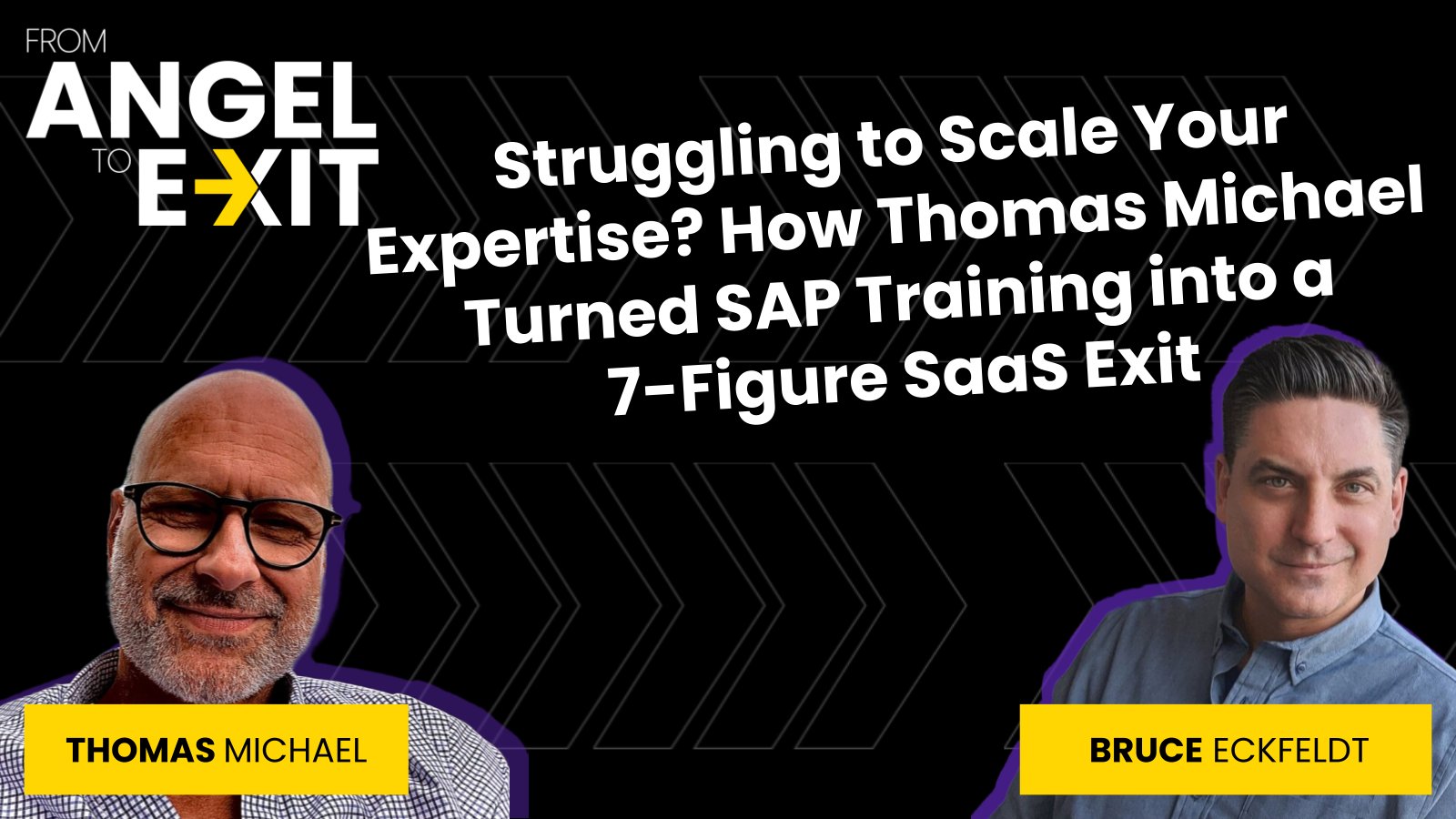
Struggling to Scale Your Expertise? How Thomas Michael Turned SAP Training into a 7-Figure SaaS Exit
Thomas Michael
Listen to the Episode.
Play the full conversation right here, or pick a chapter to jump straight to that moment. Prefer your own app? Every episode is on Spotify, Apple Podcasts, and the rest.
About This Episode.
Start with the key takeaways, the ideas worth bringing back to your leadership team. Then read the full story of the conversation, or use the chapters above to jump straight to the moment that matters most to you.
- Switching to SaaS doubled the exit multiple through recurring revenue.
- Preparing for an exit can take 1, 2 years, start early and organize everything.
- Making yourself unimportant in the business is key to a clean transition.
- Culture by design significantly improves team morale and buyer appeal.
- A good advisory board can add millions in value pre-exit.
- Many buyers will lowball; knowing industry multiples is essential.
- Post-exit identity loss is real, plan ahead for your next chapter.
- Don't underestimate the power of financial and operational clarity in due diligence.
What happens after you sell your company for millions and walk away with no earnout? In this episode, Bruce Eckfeldt sits down with Thomas Michael, a former SAP consultant turned founder who scaled an online training company and exited with a clean deal. Thomas shares how he transformed his business into a subscription model, prepared for acquisition with precision, and what surprised him most after the sale. A must-listen for founders planning their own exits.
Watch the Video.
Prefer to see the conversation? The full episode plays right here on the page, so you can watch while you follow the takeaways or read along with the transcript. Every episode of From Angel to Exit is also on my YouTube channel, along with short clips from each conversation.
About the Guest.
The background behind the conversation, and where to find this guest online.
Thomas Michael
Thomas Michael is a former SAP consultant who built an online training company, moved it to a subscription model, and sold it in a clean deal with no earnout.
- linkedin.com/in/thomasmichael1
Full Transcript.
The complete conversation, lightly edited for readability. Open it to read along, or search the page for a topic or a name.
Read the full transcript
Bruce EckfeldtWelcome, everyone, to From Angel to Exit. I'm Bruce Eckfeldt, I'm your host. Our guest today is Thomas Michael. Thomas and I are going to talk about a whole bunch of things. I'll introduce him by his line on LinkedIn: "I sold my company, started six new ones." I'm excited for this, not only because of his exit story and the great insights I know we'll get from the experiences he went through and the strategy and success he had, but also because of what he did next: how he figured out the next phase of his career and his life, how things fit together, and what he's learned there too. A lot of great insights are going to come out of that. So with all that, Thomas, welcome to the program.
Thomas MichaelHowdy. Thanks, Bruce, for having me. Good seeing you again.
Bruce EckfeldtIt's a pleasure to have you on, as always. Before we get into what you're doing today and the six companies, let's do the backstory. Let's talk about the business and about you professionally. How did you get into your company? What was that process like? And then we can talk a little about the growth and the exit.
Thomas MichaelI originally worked with a software called SAP. A lot of people have heard of it, but they may not know what it is. Suffice it to say, 80% or 90% of the Fortune 500 run SAP software to run their business. It's very complicated, very complex. I was an SAP consultant, helping companies implement SAP software, and I did it for many years as a freelancer. It worked well. I made a lot of money and was very successful. I traveled a lot, though, and at some point I didn't want to travel anymore.
I thought, "What could I do to stay at home more?" And I had this idea of online training. Today you'd say, "Okay, sure," but 20 years ago that was a big deal.
Bruce EckfeldtExactly. Fire was novel when it first came out.
Thomas MichaelExactly. So I literally started by creating one course just to see how it would work. It was the time when the first good-looking authoring tools came out, and SAP didn't even have online training yet. This was the early 2000s. I created one course, and it sold, and I thought, "How neat. Let me create another one." I was personally creating these. I created a few more, and they started selling really well, so I knew there was something there. I probably created the first 20 or 30 courses all by myself.
That got me to a point where it made enough income for me to stay at home rather than go on the road and do more consulting. That was also when I had just moved to New York City from San Diego. I found myself making a lot of money, and the company was growing. Suddenly I needed to think about customer service and hiring people. I knew me creating these courses wasn't scalable, and I needed to find somebody who could sell this to companies and individuals. So I had a lot more questions than answers.
Luckily, I found Vistage, a great organization. I was in there for three years or so and learned a lot, and that really helped me grow the company significantly, so that it became a real company with a real team, payroll, staff meetings, and all that. It ran really nicely. After about three years, my coach at Vistage left, and a bunch of people went over to EO and said, "Tom, you really should come over too." So I did. I went to EO and stayed there for three years and loved it too. It was a different vibe from Vistage but still very good. And the company kept growing and growing.
Along the way I had two minority partners in the business. We had started a little side business, and at some point we knew this had to end somehow. My partners were a little older than me. One guy was in his early 70s, the other in his mid-60s. I was in my late 40s, around 50. We asked, "How does this end? What are we going to do?" Anybody who's been in Vistage or EO knows we talk about this all the time: how do you prepare a company for exit? It's not something to take lightly. It takes literally years to get a company ready for sale.
So I knew this was coming, and I actively started working on preparing the company for an exit. The thought was that around 50, I wanted to exit. Then COVID came along, which was actually good for us, because we're in the online training business. The real world shut down, so everything moved online, and revenues increased quite a bit. At the end of COVID, we knew it was the time to sell. We had three years of great growth to show, and the private equity market was hot.
And we were ready to list. We'd done all the work and the due diligence. We had everything ready to go. I had made myself unimportant in the business. I wasn't involved in a lot of things anymore.
Bruce EckfeldtMaybe two questions about that. First, when you started thinking, "We want to exit this thing," or "We need to exit this thing," what exit options were you considering? Was it obvious? How did you navigate the potential paths? And then I want to understand more about what you actually did to prepare. But first, the options. When you realized you'd need to sell at some point, what came up?
Thomas MichaelMy first reaction was actually, "I don't want to sell. I enjoy what I'm doing. We're good at it. We're making a lot of money. We're very successful. Why would I sell it?"
Bruce EckfeldtWhy sell the cow?
Thomas MichaelExactly. But I was also thinking ahead: well, it has to end somehow. And luckily, I had my two partners, and they said, "We don't want to do this forever." I said, "Okay, I get it. You're right."
So we started thinking about who would buy this. Would we sell it to the employees? That wasn't really an option we considered, but we discussed it a little. Would we sell it to SAP? We were too small for them to even consider us. They think in terms of billions. Then we thought, "Well, we'll find an M&A broker in our space and just talk." We did. We interviewed a couple of people and had good conversations, and then we decided, "Let's do this." We signed a listing agreement, and I think it took us maybe two months to actually go to market, because we had basically everything ready to go. All the financials. We knew what was coming, so we were prepared.
Bruce EckfeldtYou were well prepared. When you first started thinking about it, did you have any expectations or bottom lines around what you wanted to get, financially or in terms? Was there anything you felt predisposed toward getting out of this process?
Thomas MichaelWe had a pretty good understanding of the multiples in our industry at that time, so we knew price-wise what we were going for. Terms were important to us. We knew we didn't want to stick around for three years, do an earnout, and work for the new owner.
Bruce EckfeldtWhy not? I can understand your older partners. They were done, tapping out, wanting to do other things. But for you, why not consider staying on for something?
Thomas MichaelIt's hard to do when you're so used to being in charge of everything, and now suddenly you have to hand in an expense report and ask if you can take next Friday off. That doesn't work. It's not going to work.
Bruce EckfeldtEnter PTO. That's fascinating, and I'd say that's very self-aware of you. A lot of entrepreneurs get into this situation and say, "Yeah, I'll do an earnout. There's a bunch more money on the table," and then they last six months. They never even contemplated having a boss again, or maybe they never had a boss.
Thomas MichaelI'll tell you the number one reason I'm in business for myself. It was never about the money. It was always about the freedom. I just can't stand having to ask somebody what I can do today or next Friday. I'm so used to doing my own thing, and I really enjoy, value, and cherish that. So it was always about freedom for me, and the money just came along.
Bruce EckfeldtDid you anticipate a big trade-off between that autonomy, not having to stay on, and valuation? How did you think that was going to play out in the sale process?
Thomas MichaelI think we were lucky, maybe, because the market was pretty hot. So there wasn't a big trade-off where if you don't want to stay on, the valuation is going to be lower. We also got offers very, very quickly. We were able to negotiate a deal where we got paid almost all of it up front. There was no earnout. We stuck around maybe two months just to transition the business, and that was fine. We enjoyed doing that part.
Bruce EckfeldtYou can do anything for two months.
Thomas MichaelExactly. And I wanted to. That was the other thing: it wasn't easy to let go. It was the thing I'd built for 20-plus years.
Bruce EckfeldtWhere did you notice the attachment to the business? Where was selling it painful?
Thomas MichaelEverybody says culture's important, right? For me, culture was really important. I worked with Fortune 500 companies, and I saw the corporate dread every time I visited a client. There's a statistic that says three out of four people hate their jobs. I'd sit in these rooms and think, "Yep. One, two, three. One, two." You can tell these people don't want to be there. They hate their jobs. And I always thought it doesn't have to be that way. I never wanted to build a company where people dread going to work.
The great Jack Daly always said you either have a culture by default or by design. And I always said I want a culture by design. I worked really hard on having a good team culture, and I think everybody who worked there really enjoyed it. It was a really nice, fun, happy team. I didn't want to just give that away to someone and say, "There you go." So it was important to me to do as much as I could during the transition.
Bruce EckfeldtYou also mentioned you were well prepared for the sale. What do you feel you intentionally did well, or were fortunate in, in the nature of the business, how it was run, or the model, that made it easy to sell or let you be prepared when you got to that point?
Thomas MichaelI credit Vistage and EO again. They really prepared us for the eventual exit with all kinds of worksheets, spreadsheets, and checklists that we had and talked about. I worked through those, and I knew what was coming. So during due diligence, when the buyer said, "Hey, I need the P&L from three years ago, but not by quarter, by month," it was not a problem. Twenty minutes later, I had it. Same with all the documents, all the attorneys, all the agreements, everything. I was really ready. But it took me a while to get there. I probably actively worked on getting the business ready for the better part of a year, maybe a year and a half.
Bruce EckfeldtI'm trying to think how to ask this. What were some of the challenges around that? It sounds like a lot of things were in place, but where did you run into trouble, or what was a big lift?
Thomas MichaelIt was a lot of detailed work, really nitty-gritty. Literally every agreement and every NDA you've ever signed: it's in this folder, and that one is in that folder, and "Yeah, I attached it to an email," and "I think I have it on some external drive." So it was a lot of legwork. It wasn't difficult work. I'm a pretty organized guy, so I knew I had all this stuff, but pulling it all together, organizing it, putting it in folders, and making it accessible to people just took time. And you're doing it while you're running the business, while you're making sure sales keep going up. You can't take your eye off the ball. So it was almost like having a second job for a year and a half.
Bruce EckfeldtBecause it is a second job. Anything about the nature of the company, like concentration, talent, or employees? Anything you did structurally or strategically prior to the sale that made it more sellable or drove valuation?
Thomas MichaelYears prior, and again, Vistage and EO were amazing, and I loved them, I felt my next iteration after I left EO was to get my own board of advisors. So I did. I created my own board of advisors, with some really heavy hitters on it. I spent a lot of money on it. But the advice I got from that board literally made me millions, so it was money well spent.
One thing we talked about a lot was how not only to prepare the company for an exit but to make it more valuable. We were in the online training business. We sold online training courses to individuals and to companies, and at that point we sold packages of training courses to companies. The board said, "Let's stop doing that. We're going to sell it as a subscription service, as SaaS."
Bruce EckfeldtSubscription. Yeah.
Thomas MichaelExactly. It took a year or two to convert all of those one-offs to recurring revenue streams. We had to rewrite all the contracts so that it was now a SaaS model, a subscription model that renews automatically until you cancel. That gave us a huge lift in revenues. It sounds obvious now, but I remember when the board said it, I thought, "Nah, our customers are not going to go for that. That's crazy." Did I lose you?
Bruce EckfeldtNo, you've got me. I'm good. What do you think the add was? If you hadn't done that, what do you think the difference in the multiple would have been?
Thomas MichaelI bet you we doubled our multiple. I bet you, because we converted literally everything to recurring revenue. We used to sell a lot of one-time courses. Somebody would come and buy a $200 or $300 course. We said, "We're going to stop doing all of this. Everything will renew automatically. Everything will be on a credit card." Corporate deals were annual payments, but everything renewed automatically until it was canceled. Just by doing that, I bet you we doubled our multiple.
Bruce EckfeldtMy credit card is full of subscriptions.
Thomas MichaelAnd the funny thing is, all the pushback I anticipated from customers never materialized. They all said, "Okay, so you're doing it like Salesforce or like SAP." And I thought, "My God, we should have done that five years ago."
Bruce EckfeldtInteresting. It actually made sense to them. I do find that as much as there are things we can do to drive valuation, a lot of it is just good business practice. How do you build a business that consistently produces good revenue and good profit? That's what drives valuation. If a particular buyer is looking for access to a market or something, you can be strategic around that, but good business practice is a lot of it.
Thomas MichaelExactly. Another thing we did: we initially built all the training courses ourselves, in-house, which gave us a lot of control over the finished product. People liked our courses a lot, but it was a very expensive and slow process. Then SAP came out with a brand-new release where everything was new, different, and changed. We thought, "Oh man, we're going to have to rebuild the entire course catalog. How are we going to do that?" It had taken us 10 years to build hundreds of courses.
So we switched to what I call a Udemy model. We said, "We're not going to create these courses ourselves. We're going to have dozens, hundreds of instructors build the courses for us, and we'll share the revenue with them in perpetuity."
Bruce EckfeldtSo more of a platform.
Thomas MichaelExactly. That's the model we switched to, and it was smart. It allowed us to have hundreds of courses on the new release in a very short amount of time.
Bruce EckfeldtLet's talk about the actual sale process. You went to market and had several offers pretty quickly. Tell us a little about that, and what the actual deal process was like. How did you come to terms? What was due diligence like? Give us some insight into the process you went through.
Thomas MichaelWe signed a listing agreement, and it took probably two months to put the package together, make it look pretty, and go to market. In the first three months we started collecting a bunch of NDAs, and then the offers started coming in, the LOIs. There were a bunch of lowballs, of course. You can tell which ones are just trying to see if you'd go for it, and you can tell which ones are serious. Again, it wasn't just about the final price. Terms were important to us. We narrowed it down to maybe three and had deep conversations with those buyers.
I remember one that was a really good offer, but the buyer had no idea about our business. None. They were in the online training world, but a totally different side of it. It had nothing to do with IT or tech or SaaS or enterprise systems. As we were talking to them, we thought, "You guys are not going to be able to run this business. You don't understand what we do." It was complex. I always said it was slightly more difficult than selling toothpaste. So even though it was a good offer, we said this was not going to be a good buyer.
Bruce EckfeldtWhy was that important to you? Was it whether they'd be able to close the deal? Was it about employees? Were you worried about your customers? What drove that?
Thomas MichaelWe weren't worried about them closing the deal. I'm sure they would have been able to. We were worried about them running the business. "I don't think you understand what this business is." And again, it was hard to let go. We wanted to make sure my baby was taken care of.
Bruce EckfeldtYou're finding a good home for your child.
Thomas MichaelExactly. So we said no, they weren't going to be the one. Then we actually took a deal and went through the whole due diligence process, which took about four or five months. Everything was fine. Great buyers. We really enjoyed working with them. But at the very last minute, their financing fell through.
Bruce EckfeldtAnd that just killed it.
Thomas MichaelWe were like, "Oh, you've got to be kidding me."
Bruce EckfeldtWhat was it? Were they leveraging with some debt?
Thomas MichaelIt was actually an SBA loan they wanted to put on. After months and months of due diligence, the SBA came through and said, "Okay, we approve it." But they couldn't come up with their end.
Bruce EckfeldtI'm curious, in retrospect, was there something you could have seen earlier?
Thomas MichaelWe did a post-mortem on it too. Could we have done anything different? Could the broker have done anything different? The thing is, you don't do that. You don't say, "Hey, show me your bank statement with the millions of dollars you're going to pump in." You don't really do that. You just take their word for it.
Bruce EckfeldtIt's kind of reverse due diligence. Show proof of source of funds. But that's a big deal, because I'm sure you spent a pretty penny on diligence and legal fees, drafting the contracts and everything. There are consequences there.
Thomas MichaelWe were bummed out, but we had other offers right behind them. So we went to the second-best offer and said, "Listen, you need to come up to this number, and then you're number one." And they did.
Then we did the whole due diligence process again. That buyer was a much larger private equity company, and their due diligence process was great. You could tell they'd done this a hundred times. It was really neat. And since we had just gone through due diligence with the other guys, we had everything ready to go. The data room was up in four hours with everything in it. They said, "My God, we've never had anything like this." And I said, "Well, there's a reason for that."
Bruce EckfeldtBecause you'd just gone through it.
Thomas MichaelExactly. So it was a great due diligence process. It was a little annoying because it was right over the Christmas holidays. We were supposed to close in January, and Bob's on vacation and Sally is still skiing. So January became February, February became March, and we finally closed on April 1st.
Bruce EckfeldtWhat was it like for you personally? It sounds like you were pretty prepared and pretty buttoned up, but was there drama? Was it stressful? What was your roller coaster like?
Thomas MichaelI talked to a bunch of friends who had sold their companies, and without fail, every one of them said, "Tom, think about what you want to do when it closes." And I said, "Get out of here. I have so many things I want to do. I have all these hobbies, and I don't have enough time for them. It would be amazing to have more time to do all those things." And they all said, "No, no, no, you don't understand. This is a big deal. You need to think this through. You're going to fall into a hole." I said, "I don't know what you're talking about."
Bruce Eckfeldt"I'll worry about it then. I'm just going to sit there and count money."
Thomas MichaelSo I was aware of it, but I didn't really understand what they meant. When the deal closed, again, I stuck around for two months, pretty much full-time, to get it all settled. Then I'd still get pings from the team on Slack or Skype: "Hey, how do you do this? Where do we keep that? How do I handle this?" I happily answered all of it, but I could tell that every week there were fewer pings. Within two months, you're unimportant. Nobody calls you. Nobody cares about you anymore. No pings, no emails.
At first you're like, "This is amazing." It's 10:30 in the morning, and you think, "I'm going to have a glass of wine." That was fun, and I did that for a month or two. Then you realize, "Okay, I've got to be a productive member of society again." And then I felt it. I really felt the hole you fall into. You're just not important. Nobody cares, you have no responsibility, you have nothing to do. And you think, "This is super weird. I haven't known anything but work for the last 25 years." And hobbies don't fill that hole.
So I thought, "Let me see what I find interesting. Let me dabble in things." Then AI came along, and I thought, "This is really interesting." Before I knew it, I thought, "I could start a business that does this with AI, and what if I did this with the other thing?" And I started six new platforms or websites, six businesses, all in various stages of development. The nice thing is I can work on all of them now because I enjoy working on them, without the pressure of having to make payroll, run team meetings, and make revenue. Even if one loses money, it's okay. I enjoy working on them. That's the stage I'm in now. But if anybody is interested in selling, this is the biggest deal: think about what you want to do afterwards.
Bruce EckfeldtWhat do you wish you had done differently? "A year before the sale, I wish I had done these things." If you could go back and do it again, how would you have prepared yourself better so you didn't fall into the hole everyone told you about?
Thomas MichaelThere are really two things. If I could go back five years, I would have worked a lot harder on generating more revenue. We did well. We grew 15%, 17%, 20% every year. It was good. But I bet you I could have done better had I worked harder on it, because at that point I didn't realize that every dollar you make that goes to the bottom line is worth 10x. So I was like, "Shoot." That's a big deal. But I don't regret it. We did fine. That's one thing I would do over if I could.
As for after the sale, I wish I had taken more time off. I only took about two months. It was summer, and it was fun. Then I went back into working and finding something else to do. I dabbled, because I didn't know any different. That's what I do. I wish I hadn't done that. I wish I had said, "You know what, I'm just going to go to some island for a year." That's what I would do over if I could. Reading, detaching, disconnecting.
Bruce EckfeldtAnd then come back and really do something, as opposed to a soft start. Interesting. Two questions about the new ventures. First, what do you feel you learned from your previous experience and business that you're carrying forward? "This served me well. I can take this approach, this knowledge, this strategy, and apply it." And second, what are you doing significantly differently? "I'm going to try something really different this time around."
Thomas MichaelOne thing I'm really good at and really enjoy is tech stuff, software stuff, IT stuff. I like tinkering with it, and AI is the perfect little toy for that, because it's developing so rapidly. At the old company, with a big team, there was a lot of day-to-day grind. There wasn't a lot of play time, where we got to play with the toys. So I enjoy that part.
I also really enjoy being a scrappy little entrepreneur again. I had this big company with a big team, lots of money, lots of resources, and now I don't. Now I have a scrappy little company with a scrappy little team, and I really enjoy really thinking, "What should we do? What could we do? We can't throw $100,000 at online marketing. Let's think this through. Where do we get the biggest bang for the buck?" That fires up my entrepreneurial senses again.
Bruce EckfeldtHaving constraints is sometimes the best source of innovation. When you can do anything, you have nothing to push back on your thinking and solve for. The other question I wanted to ask is more personal. You went from a really successful big company, which I'm sure defined your life in many respects, through the exit, to now post-exit. What changed in your relationships and how your world is structured? Not having all the people you worked with in the company, how you relate to other people who are still in their businesses, or even family. What shifted, or what did you have to change as you went through this big transformation? It's a huge thing for you, but it isn't necessarily a huge thing for everyone else. How did that play out?
Thomas MichaelI do miss the camaraderie of the old big team. We were all really close, even though it was always a remote company. I miss that part. Luckily, my wife and I were used to it. I told you I used to be a consultant, on the road all the time. For the first eight years Michelle and I were together, we only saw each other on weekends, because Monday through Friday I was gone.
Bruce EckfeldtGet on a plane on Mondays, back on Thursday night.
Thomas MichaelExactly. So once that travel schedule stopped, we became that annoying couple that literally does everything together. We worked together, live together, do everything together. And people were like, "Ugh."
I still really enjoy that part, and it's gotten even better because I don't have the stress of running a big business right now. The work I do can be done anytime from anywhere. One thing we took advantage of after the exit: we loved living in New York City, but we said, "There's a whole other world out there. We don't have to be here right now. New York will always be there. Why don't we try something else?" So for the fun of it, we moved to London. We've been here almost two years now, and we're traveling through Europe like it's our job. We're really enjoying that.
Bruce EckfeldtKind of is. Any other surprises that have come up, things you've had to navigate in life now that you're post-exit?
Thomas MichaelA lot of people suddenly reaching out wanting advice. It's not something I market or push out into the world, but people find out, they hear about it, and they call and say, "How did you do this? Can you tell me how I can do it?" I enjoy that part of my business. I have a few coaching clients who want to get their businesses ready for an exit. One of them actually just did, and I helped him for the last two years. It's fun. I enjoy that part. Having the experience and having been through the process, I think there's something I can share to make it easier for the next one.
Bruce EckfeldtAnything with your own businesses? Are you approaching these differently, to be able to exit them in a different way? How is all of this applying to the next round?
Thomas MichaelThere's one that's a support website powered by AI that I find very interesting and very promising. That's our flagship site, if you will, and it's going really well. We have a few others I'm passionate about, but they're loss leaders right now. I enjoy the work, and I think what we're doing is important or useful. I'm not thinking about exiting any of them, just because I don't have to. I can keep running them because it's fun for me.
Bruce EckfeldtIt's a good position to be in.
Thomas MichaelExactly.
Bruce EckfeldtThomas, it's been a pleasure. Thank you so much for taking the time today. Really great conversation, great insights, and I really appreciate everything you shared. If people want to get more information and get hold of you, what's the best way to do that?
Thomas MichaelMy pleasure. The easiest would be my website, thomasmichaellive.com, and they can contact me there. Or they'll find me on LinkedIn too.
Bruce EckfeldtGreat. I'll make sure those links are in the show notes so people can get them. Thanks again. It's been an absolute pleasure. Thank you for taking the time.
Thomas MichaelAll right, my friend. Thank you for having me. Bye, everyone.
Never Miss an Episode.
Know the moment a new episode goes live. Subscribers also get a say in future guests and the topics we cover.
Other Related Episodes.
More conversations that connect to this one. Or browse the full archive by topic or by guest.
Matthew Diteljan
How a $1,500 startup became a national ad platform, and the hard lessons from a buyout and burnout.
Listen and Read
Pete Martin
Lessons from four exits, including a 12x EBITDA sale to KPMG.
Listen and Read
Gregg Lederman
The emotional toll, deal setbacks, and values behind selling his SaaS company to a global buyer.
Listen and Read