From Angel to Exit Episode 12
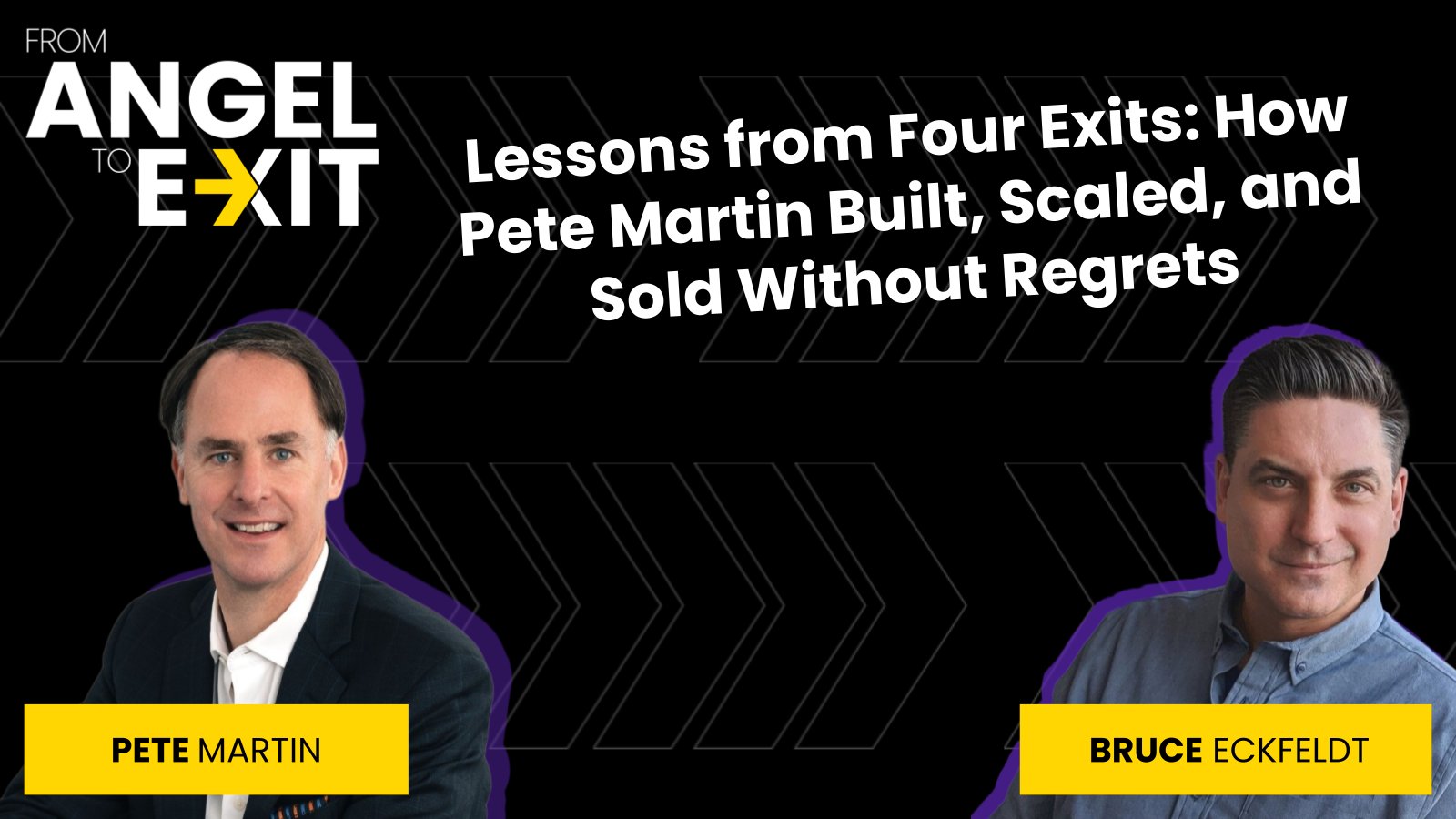
Lessons from Four Exits: How Pete Martin Built, Scaled, and Sold Without Regrets
Pete Martin
Listen to the Episode.
Play the full conversation right here, or pick a chapter to jump straight to that moment. Prefer your own app? Every episode is on Spotify, Apple Podcasts, and the rest.
About This Episode.
Start with the key takeaways, the ideas worth bringing back to your leadership team. Then read the full story of the conversation, or use the chapters above to jump straight to the moment that matters most to you.
- Design your business to function without you to enable a clean exit.
- Culture alignment with employees and clients directly impacts scalability.
- Strong financial controls are critical, reviewed and audited books build buyer confidence.
- Pre-exit partnerships with potential acquirers can significantly boost valuation.
- Declining misaligned clients reinforces culture and attracts better opportunities.
- Prepare for the worst in partnerships with clear buy-sell agreements.
- Retention plans and bonus structures smooth transitions during acquisitions.
- Non-founders driving revenue make earn-out-free deals possible.
Serial entrepreneur Pete Martin joins the show to unpack his journey across four business exits, including a standout 12x EBITDA sale to KPMG. Drawing from both personal and professional highs and lows, Pete shares powerful lessons on building scalable, values-driven companies, designing for exit, and avoiding the common pitfalls that sabotage founder success. From crafting a cultural manifesto to structuring clean financials, this episode is a masterclass in M&A readiness for founder-CEOs.
Watch the Video.
Prefer to see the conversation? The full episode plays right here on the page, so you can watch while you follow the takeaways or read along with the transcript. Every episode of From Angel to Exit is also on my YouTube channel, along with short clips from each conversation.
About the Guest.
The background behind the conversation, and where to find this guest online.
Pete Martin
Pete Martin is a serial entrepreneur with four exits, including a 12x EBITDA sale to KPMG. He helps founders build values-driven companies designed for an exit.
Full Transcript.
The complete conversation, lightly edited for readability. Open it to read along, or search the page for a topic or a name.
Read the full transcript
Bruce EckfeldtWelcome, everyone. This is From Angel to Exit. I'm Bruce Eckfeldt, I'm your host. Our guest today is Pete Martin. Pete has had several different exits, and we're going to talk to him a little about his story, what he's learned, and what he's doing today. I always love having conversations with folks who have had multiple exits, to learn what they've learned and how they've applied it going forward. There are always learnings. I always find there's something new each time. I'm excited for the conversation. Pete, welcome to the program.
Pete MartinHey, Bruce, I'm glad to be on the program, and I'd love to share all the mistakes I made with your listeners.
Bruce EckfeldtI appreciate that, because people who haven't been through this process just don't know. Until you've gone through it at least once, sometimes multiple times, there are things you reflect on and say, "I just wish I'd known." So I'm excited to get into those. Before we get into the exit stuff, I'd love to get a little background. Personally and professionally, how did you get into business? What's the backstory? Lead us up to your first company.
Pete MartinAbsolutely. Fortunately or unfortunately, I'm kind of genetically an entrepreneur. My grandfather was, my dad was, my brother was. A lot of my family have been entrepreneurs, so I don't think I really had a choice.
When I was 18, I spent one semester in college. I did very well in high school. I'm a reasonably smart guy. And I got an F and a D and something else in college, because I realized, I guess you're not supposed to party when you go to school. So I recognized that I really wasn't mature enough to do that, and I ended up starting a car leasing company.
I was a franchisee for a company that would basically sign fleet deals with all the automotive companies, and then JPMorgan Chase underwrote the leases, and I'd go out and sell these leases to small business owners. Leasing is obviously very common now, but at the time, this is 1981, people had no idea what it was. I would talk to these business owners, and they'd say, "All right, let me get this right. I pay you every month, but I don't get to keep the car? Why would I do that?" So it was totally missionary selling. I was the classic 18-year-old snot-nosed kid who thought I knew everything about business and the world, and the world just slapped me around and said, "All right, we're going to teach you some things."
I did that for three years and ended up selling my franchise rights to another guy at a slight loss. So that was technically my first exit. And if I had to do it all over again, I'd do the same thing. Then I went back to college and got my bachelor's and my MBA in three and a half years.
Then I went to the complete opposite end of the spectrum and started working for IBM. I worked for IBM for almost eight years in a bunch of different sales positions, and toward the end I was selling really big outsourcing deals. I'm proud to say I've sold more than a billion dollars' worth of software and services in my business career. Pretty cool. Then I left and went into executive management at SAP, the big software company out of Germany.
I left SAP in 2002 and went back and started my entrepreneurial career again. I started a consulting firm in and around the SAP ecosystem and built it over 14 years. Along the way, I built a business process outsourcing company: companies would basically outsource their global trade compliance department to us. We also became a software reseller as part of those different companies. And I started a software company, because we built some functionality where we saw holes in SAP.
So, my last exits. There was a point where I was just done with the SAP ecosystem. I'd been doing ERP for 22 years, and it didn't thrill me anymore. I wasn't waking up every morning going, "Yeah, let's go do this."
Bruce Eckfeldt"I can't wait to get to work."
Pete MartinRight. So I kind of knew. I sold the business process outsourcing part to my business partner. I guess it was a bit of a friends-and-family deal, but it was a very formal exit, with an advisor and all that. Then I sold the reseller piece to a competitor. And then I sold the consulting piece, which was the largest entity, to KPMG for 12 times EBITDA with no earnout. We'll talk a little about that, because that's where I took all the things I screwed up the first three times and got it right the last time, in a big way.
Bruce EckfeldtFinally got it right. I'm curious, going back to your upbringing, do you feel that having these role models around entrepreneurship in your family and your life was pressure, or opportunity? How do you think they influenced how you saw entrepreneurship, defined yourself as an entrepreneur, or set your ambitions?
Pete MartinIt's a good question. It obviously influenced me heavily. I saw that my dad had done this and supported the family. And what's interesting from an exit perspective is that watching both my dad and my brother go through this was a huge learning.
My dad was head of sales for a hand tool company, and he created a tool for that company that basically became their runaway hit. He went to the owner and said, "Hey, how about a little bit for George?" And they said, "Sorry, man, you're an employee." So he said, "I have this other idea, and I'm not going to give this idea to this guy." So he left.
I was very young at the time, and I can kind of remember some struggles. We didn't have the same kind of clothes. We didn't go out to eat, all that kind of stuff. So I felt it a little bit, but as a kid you don't know what's going on, and you don't care. He ended up patenting that idea, and it literally supported the family.
But toward the tail end of the business, when his health started to fail... And this was a huge learning for my last exit. He had the business for about 30 years, and his identity was wrapped up in it. He was the business. He was the head of sales. He'd gone through a situation where his controller embezzled 650 grand from him over a period of seven years, so that knocked him sideways a bit. A bunch of different things knocked him sideways. And when his health started failing, the business clearly started failing.
I became his sell-side advisor, if you will, and I ended up selling the business and the assets for about $100,000, for what he'd built over 30 years. And I told myself at that point, "I'll never let that happen to me." That was many, many years ago.
My brother was also an entrepreneur, and he also was the business. Sadly, he's only two years older than me, and he passed away about a year and a half ago.
Bruce EckfeldtI'm sorry.
Pete MartinThank you. He died in his sleep. He didn't have any disease or any real issues that anybody knew of. He designed very, very highly engineered products for the federal government, stuff I guess I'm not supposed to talk about.
Bruce EckfeldtIf we said, we'd have to kill everyone listening to the podcast.
Pete MartinExactly. He was so worried about security that he had encrypted his laptop with all the designs on it. He only had three or four employees, one of whom was his son, and he never wrote down the decryption key. So when he passed away, they had nothing. The business literally ceased to exist at that point.
So again, as we talk to other founders, CEOs, and entrepreneurs about their businesses, it's simple stuff like this. Write down the decryption key and give it to somebody you trust, or stick it in a vault, or whatever.
Bruce EckfeldtPut it in a box somewhere.
Pete MartinReally simple stuff. So, to your question, all of these experiences absolutely shaped my entrepreneurial experience. It's tough to start and grow a company, with all the pressures of raising a family and mortgages and payroll and all that. I've got three grown daughters, and they're like, "No way. We'll never do what you did. Too much pressure and stress." I think one of them might, because you get the good times too. The exits are great, and all that kind of stuff.
Bruce EckfeldtSo, taking those learnings, how did they shape your view of what your journey would look like in terms of having an exit? Did you think, "Okay, I'm getting into business to have an exit. This is what I want the exit to look like, and this is how I'm going to do it"? Did it give you a structured path, or how did it influence how you got into business?
Pete MartinWith the first one, the leasing company, I was just completely ignorant and naive. That exit happened because I had to get out of the business, because I was bleeding cash. And I thought, "I never want to do that again." So that shaped how I ran a business, for sure. It didn't shape how I exited.
On the next one, which was the beginning of the consulting business, the one thing my partner and I did, before we even started the company, was sit down and write a manifesto. It described the type of employees we wanted in the company, the type of culture we wanted to create, the type of customers we would and wouldn't go after, and the kind of partners we wanted to have. We made every employee sign this manifesto: "You're signing on for this. This is the culture." All of our hiring and screening and everything else about employees was about creating this culture.
I knew from the first exit, and from my brother's and my dad's perspectives, that their view of business and life was that nobody was good enough to work for them except family. Family were the only people they could trust. And then obviously my dad's controller stole 650K from him. So that definitely shaped me. A big part of success in business is about the people you surround yourself with. That's why we created the manifesto.
Five years into the business, we'd kind of put the manifesto aside. We didn't talk about it a whole lot after people had signed on to it. We were redoing our website, putting up our values, mission, vision, all that kind of stuff. So we just randomly asked all the employees, "Tell us what you think the values of the company are." And it matched the manifesto exactly. That truly was my proudest moment, even more so than the exit. We said we wanted to create this culture, and we did in fact create it.
And we did things like this. I was telling the story last week. A really large company came to us and said, "We want to give you this contract. You guys have skills nobody else seems to have." It would have been about $15 million a year. I won't mention the company, but they didn't treat people right. They had a reputation in the industry: they'd have 90-day payment terms, but they'd actually pay in 120 days. They just ground people up.
We literally turned them down, because in the manifesto we'd said, "These are the kinds of clients we want: ones who respect our people." I tell founders and CEOs that people watch that stuff. They watch the decisions you make as an owner and as a CEO. Our people thought we were crazy: "You just turned down a $15 million contract. That would add 60 or 80 people to the company." And we said, "We know these guys. They treat people like crap." And they were like, "Wow." And we hit our next trajectory of growth, because they saw, "These guys are serious about walking the walk and talking the talk."
Bruce EckfeldtI'm curious how you came up with the manifesto. Had you seen something like it before? What was the model, or what inspired you to actually put pen to paper?
Pete MartinHonestly, I don't remember. Like you, we're huge fans of Verne and Scaling Up and all these books, Good to Great and whatever. I don't even remember if Scaling Up was out at that point, or whether I'd connected with Verne yet. So it could have been something there about culture.
I think it was probably also inspired by IBM and SAP, which both had great performance management and professional development cultures, very strong cultures. I tell a lot of entrepreneurs to go work for a big company for a while, because there are so many things you can learn. So it was probably all of that. Not that I wanted to be IBM or SAP. There's obviously a lot of crap with all that stuff. But they had solid cultures, whether you like them or not. So: let's go figure out what our culture is going to be.
Bruce EckfeldtTell me a little more about the decision not to take on that client. I see a lot of companies espouse values. They go to these sessions and write down values, and then either they never look at them again, or they paint them on the wall, but their actions never really align with them. How did you realize this was a decisive moment for you as leaders, to decide whether you were going to live these values or not? Was that difficult? What was that decision actually like?
Pete MartinI'll tell you about two seminal moments in the history of the company. That was one of them. And it was really, really hard to turn that down. $15 million a year is really hard to turn down.
But, as you and I both know, growth also consumes cash. A lot of consulting companies hire independent consultants and pay them after they get paid by the client, so you can manage cash that way. But we were an employee-based company. We were not what we used to call a federation of independents. Because we were an employee-based company, that $15 million-a-year contract would have just absolutely sucked up cash. We would have had to do a capital round through a bank or an investor or something, and we did not want to give up control. It was just my partner and me who owned the business.
So it was a combination: we knew they were going to treat people poorly, we knew it would suck up cash, and it was only tangentially strategic to us, not directly strategic. Looking back on it, maybe it was a good decision. I don't know. We were assuming they'd treat people like crap. Maybe they wouldn't have. I don't know. But that was really tough.
The other seminal moment that people really watched was about two and a half years into the business. We had a very large contract with a company in Chicago, 14 people on it. Unbeknownst to us, the project manager was going through a lot of personal issues. And unbeknownst to us, because frankly we weren't checking in, she wasn't showing up to meetings or showing up on the account at all. She'd fly to Chicago and disappear for a week, because she was going through some medical issues and personal issues.
About a month goes by, and I get this call. It was our Black Friday, not in a good way, our Red Friday, from the CIO, who said, "Hey, do you know what's going on with this person?" I said, "No." He said, "She says she's on site. She's not. We can't find her. We try to call her. The team doesn't know where she is," blah, blah, blah. "We've lost a ton of progress on this project. So you guys are out. And by the way, we're probably not going to pay any of your billings from the last month." That was a million and a half, $2 million hit to us. I think that's probably a bit too much, but it was a huge hit.
So I hung up the phone and said, "I'll get back to you." I called my partner and said, "What are we going to do?" And I said, "Look, we're two and a half years into this business, and most industry ecosystems are pretty small. People talk. The decision we make right now is going to have a long-term ripple effect on the company forever."
We had every legal right to go collect those dollars. But here's what we decided to do. I called the CIO the next Monday and said, "We get it. We apologize. We're going to pull the team out today. Not only do you not have to pay the last two invoices we sent you, we're going to go back one more invoice, based on some activity sheets we've seen. And we'll be done. Here's the letter terminating the contract."
The CIO was blown away. He said, "Pete, I have to tell you, this phone call went in a totally different direction than I thought it would. I'm telling you right now, I can't bring you back in and give you any more business for a little while. But the way you guys acted and treated us, I guarantee you we'll do business sometime in the future."
Fast forward a year and a half, and that client became one of our biggest accounts. He also referred us to about six other clients, and collectively that was probably another $10 million to us, just from that action. Again, those are the things people watch to see what you do. And that was defining for the culture and for what we said we would do in the manifesto.
Bruce EckfeldtI'm curious about the partnership. Was having or finding a partner necessary? Was that something you wanted to do? And how did you stay aligned? I see so many businesses with partners where things start out great, and then the business evolves and things change. Some of them drift out of alignment, and some end up in conflict. I'd love some insight into the partnership side of your business.
Pete MartinThis was really interesting, and I'll just say I got really, really, really lucky. It's my business partner's birthday today, so I just texted him this morning. My business partner had run another company. He grew it through the '90s, took it public, took it private again. He's got this crazy story. And he basically said, "I want one more bite of the apple, but I don't want to run the company. So I'll be your silent partner. I'll put some money in, you put some money in, and let's go do this." He wasn't totally silent, but I was still pretty much running the company.
Bruce EckfeldtQuiet, but not silent.
Pete MartinRight. And I didn't really know this guy. I knew his business partner, and I was not a fan of his business partner. This was after I'd left SAP. I didn't want to go back and do the SAP thing. I went to work for a company in DC for a little while and then quit that company. And he kept chasing me, if you will. So I said, "All right, I'm going to do a bunch of due diligence." I called 14 people, ex-employees, ex-customers, some other business partners, and just said, "Tell me about this guy." And I got pretty good vibes.
I always say a good partnership means that if you're both given the same problem or challenge, you basically make the same decision, or pretty close. I got really, really fortunate, in that in virtually every situation, we made exactly the same decision. In those two scenarios I told you about, there was a conversation, clearly, but we made the same decision. I just got really fortunate, because I know a lot of business owners who have partners, and it does not go like that. I'd known of this guy for many years, but I didn't really know him, and again, I got super fortunate that we got together.
Then I ended up buying him out six years into the business. It was right before the 2008 financial crisis. I always tell him, "Man, you got out right at the top. You could not have timed that better." The economy was just roaring, and literally about three months later the whole thing started collapsing. I'm like, "Holy crap, man, you got a good deal."
Bruce EckfeldtAny advice for folks who are starting businesses and putting partnerships together, or who are already in partnerships? Anything you'd suggest they do to make that choice, stay aligned, or maintain the quality of the partnership?
Pete MartinIt's so easy to dream and envision and talk about how big it's going to be and get excited. But you don't talk about the bad stuff. So I think you sit down with your partner and say, "Let's think of the worst-case scenarios. We have no cash. You have to fire me. I have to fire you. You get sick. I get sick." Think of all the bad stuff, and ask, "How would you make that decision? What would you do?"
Very few people ever do that, because it sucks. You don't want to talk about the bad stuff when you're starting a company. But that's where the rubber meets the road. That's where true character comes into play. You just have to do it. Best case, you get an attorney, because that's all they do. They talk about the bad stuff all the time. Or maybe get a third party, an attorney or somebody who's been through the ropes, and say, "What about this situation, this scenario? What would you guys do?" When it actually comes to that, it may be a little different, because then it's real. But at least sit down, talk about that stuff, and see if the values are aligned.
Bruce EckfeldtTell me about the buyout. How did that conversation begin? What was driving it? How did you resolve the buyout process, the valuation, the payout? That can be a pretty complicated process, depending on cash positions and things like that. How did you navigate it?
Pete MartinIt was actually super easy, because within the first six months after we got together, we created an operating agreement with a buy-sell in it. Again, that's very unusual, but he was a tenured executive and I was a tenured executive. It's a lot easier to have that conversation at that point than when you're in the moment.
We changed some stuff based on the realities of what was going on in the business, so it deviated a teeny bit from the buy-sell, but really not a whole lot. He wanted the business to continue to be successful, and for me to be successful. He wasn't a money grabber saying, "You need to pay me out," whatever. So it was a fair deal, and it matched the buy-sell. He did his valuation, I did mine, and we had a third person look at both. We basically took the average of the two and said, "Okay, we're both good."
Bruce EckfeldtSo it wasn't onerous on you or the business. As you started these businesses, how did your thinking about the exit evolve? How did you think about when and how you were going to exit as these businesses rolled forward?
Pete MartinPost the leasing one, let's talk about the first one, which I sold to my business partner. That was the business process outsourcing part of the company, and it was incredibly successful and incredibly profitable. We had net margins of 35% to 40% in that business. It was in a space I really didn't care about, and he was very passionate about it. If I'd kept it with the company, I would have gotten a significantly higher valuation. But he was a younger entrepreneur, a younger businessperson, and I did a lot of mentoring of him. I felt it was the right thing to do to let him take this business over, because he was passionate about it and I wasn't. I wouldn't say it was a favor, but it was, "Here, take this. You're passionate about it. I'm not. Go see what you can do with it on your own." So that was a situational exit, if you will.
The next one, the reselling piece, was purely opportunistic. A competitor came to us and said, "You guys are crushing it over here. We're looking to add this to our business. Would you be interested in selling it?" And I said, "For the right price? Sure." And they paid it.
Bruce EckfeldtMake me an offer I can't refuse.
Pete MartinI didn't necessarily want to sell it, but why not at that point?
And then the biggest entity, the consulting piece, was very much a case of waking up one day and saying, "I'm done." It wasn't that I'd stopped paying attention to the business. It was, "I'm not excited about this business anymore. I'm ready for my second act." At that point it would have been my fifth act. And I'd seen in myself, when I worked at IBM and really started to hate my job, that my performance suffered. I didn't want to do that to the company, to my emotional state, to my family, or anything else. So I said, "All right, I'm going to exit in 18 months."
These are all the things I learned from the prior three. One is: don't become the business. Financial controls, financial systems. We ended up getting three years of our books reviewed and one year audited, which we hadn't done before, in preparation for an exit. And obviously I didn't tell anybody what was going on.
I was way more involved in sales than I should have been, and I knew that whoever I sold to, I did not want earnouts. So I started putting a sales program in place for the whole leadership team and all the practice leaders. I'll talk about something we did that was very unique, too. They just thought it was professional development. And one of the interesting things was that the more I pulled back, the faster we grew. It's so funny. It's a huge ego hit, but on the other hand, when you know you're going to exit, it's like, "My God, why didn't I do this five years ago?" I love sales. I love being in front of customers. So I'd just put myself there, and they'd say, "All right, go, Pete, go." And then the business literally started to grow faster.
Bruce EckfeldtA lot of these are just good business practices. It's hard.
Pete MartinAt the same time, and I ended up selling to KPMG, we started crafting partnerships with KPMG, IBM, EY, and a couple of the other big guys. I knew that if we had a partnership, my chances of selling to them went up significantly, because they'd already know us. That was all part of the process.
The other part of the process, and the reason I got 12 times EBITDA when the average is three and a half to four for a services company, was that by creating these partnerships well in advance, I got to know the way they went to market. Specifically with KPMG, they had a particular practice where they did the strategy work and we would do all the implementation work. They got very high bill rates, but they were very short engagements, a couple of months. When we started partnering on a couple of deals, even though we didn't win them, I started to understand this more.
So my pitch to them was very simple: "Hey, guys, for every dollar you're getting in strategy work, we're getting 10 in implementation work. Even though our margins are slightly lower than yours and our bill rates are slightly lower, we're still getting 10 times more revenue and profit than you are." It was a very simple pitch. Because we knew that, we could go into it, and my pitch was, "If you want to build your practice, 10x your practice, come buy my company."
It was all these pieces I had put in place well in advance of going through the exit process that enabled us to have such a phenomenal exit. Again, those were the learnings from the prior three, from making all the mistakes in the book that I could.
Bruce EckfeldtYou mentioned you had a couple of different partnerships. Was that intentional, trying to create a couple of options and get people bidding against each other? How did that process of creating options work for you?
Pete MartinExactly. It was a little bit of a sneaky Pete process. We started conversations with KPMG, IBM, and EY. For whatever reason, and I would probably not do this again, I did not hire an investment banker or M&A advisor for this one. I did it on my own. Very early on, for a bunch of strategic reasons mostly, IBM and EY bowed out. So we kept the conversations going with KPMG, and I would do sneaky things, like send a note to the guy who was sponsoring the deal with the wrong name on it, on purpose, so he'd think this was still a really competitive deal.
Bruce EckfeldtThe name from a different company. "Sorry about that."
Pete MartinSo when we closed the deal, he said, "So where did the other guys come in?" And I said, "You're going to kill me, but they were out about a year ago, man." He said, "Are you freaking kidding me?" I said, "Do you feel like you got a fair deal?" He said, "Yeah." And that's all that mattered. So there was a bunch of stuff like that.
The other interesting thing: think about going through due diligence with the fourth-largest auditing firm in the world. What I'm really proud of is that their audit team came back and basically said, particularly for the size we were at that point, "This is one of the squeaky-cleanest companies we've ever seen. Everything ticks and ties. Every contract matches a line on the balance sheet or the P&L. The data room is super clean."
Bruce EckfeldtWas that something you intentionally did? Was that a tenet for you early in the process, to have that stuff in place?
Pete MartinYes. And again, that goes back to your earlier question about how my dad's experience shaped me. His controller was really the only one he trusted besides his family members. She would never take vacation. You know where this story is going. She got sick for a week or two, and for the first time ever, he went and got the mail, saw the bank statement, opened it up, and saw a check made out to her, endorsed by her, signed by her. And he said, "I just knew."
He would always go to his accountant and say, "I do all the sales, and I think I know what my costs are. I should be making more money and more cash." And the accountant would say, "Pay for an audit." And my dad was too cheap to pay for an audit. So he knew at that point. Because of that situation, I had great financial controls. Nobody could do anything by themselves in terms of setting up vendors and paying them and all that kind of stuff. So a lot of the mistakes they made definitely informed some of what we did in my businesses.
Bruce EckfeldtYou mentioned another thing about your process: the team didn't really know what was going on. How did you make that decision? When did you have to pull them in, and how did you navigate that? What would you generally recommend to founders about who to include, when to include them, and why or why not? That's a fascinating one for me. Tell me more.
Pete MartinThis is really a cultural thing, and there's definitely no pat answer. I'll give you my answer, but I think it depends on the culture, the CEO, and the trust he or she has built with the team.
During the LOI process and starting into due diligence, we had to name the key team members who basically had to be part of the deal or the deal wouldn't happen. There were half a dozen really key team members who literally got written into the LOI: "We need these people. They're the rainmakers. If these people don't go with the deal, the deal is off." So at that point, I had to talk to them. That was three or four months into the process. That was number one. I also had to tell my controller at that point. And I had to tell my executive assistant, because she had access to my emails, so she was going to see stuff coming through. To this day, I don't think they told anybody. I never got any inkling from the broader team that they knew this was going to happen.
And my pitch to them was very simple. It wasn't about Pete's exit and making money. It was, "Look, guys, KPMG's professional development and leadership development programs are way more sophisticated and way more comprehensive than anything we could ever pay for. They have a much bigger sandbox to play in, much bigger clients," and on and on. So across the board, universally, this was a way for them to enhance their careers, do better things, and develop their skills more than they could in my company.
And they got it. Nobody had any issues with it. We also did sign-on bonuses, which KPMG put some money aside for. I gave some sign-on bonus money as well. We basically split that 50-50 between my proceeds and their money. And they also put six-month and one-year retention bonuses in place for the core team. They all got higher salaries, better benefits, professional training, lots of money, and they were super happy.
I also ended up putting the business case together for the senior partner. He personally, within KPMG, had never acquired a company. So that was a really unique position for me: advising him on how to buy my company. And he trusted me enough to let me do that. We put a three- and five-year business case together on how they were going to get a return on their investment, and I'm very proud to say they actually exceeded it. So it was a great deal for everybody.
Bruce EckfeldtI can't help but imagine that some of this was hiring the right people: people who wanted to grow, who wanted that opportunity, who were ambitious, and who didn't have reservations or concerns about taking those risks. I'm assuming that helped you. I could see it being much more difficult if you'd hired people who were a little more provincial, not as ambitious, and you couldn't tap into that with the acquisition.
Pete MartinWe did have those people. One of my guys, essentially our staffing manager, was in his early 60s at that point, I believe, and he was worried. Frankly, they were not going to hire him, but I made him part of the deal. I made everybody part of the deal, with the exception of my executive assistant, who I knew didn't want to go, and two other people who I think were looking for jobs anyway, which was fine.
But there were definitely a couple of provincial folks who would not have gone with the deal. I forced KPMG's hand to hire them, and they had to retain them for one year. And I said, "After that, you can do whatever you want, and they can do whatever they want." They're all still there. But they weren't the "Let's go charge the hill, I'm ambitious, I want to make more money" types. It was, "I just want a job. I just want to get to my retirement." And I said, "Great. I've got your back." They had my back, and I had theirs.
Bruce EckfeldtThat's right. Pete, tell me a little more about what you're doing today and how you're leveraging all this experience in the market.
Pete MartinI'm going to tell you one more story, and then I'll tell you that. We went through due diligence and came out clean, and then the deal seemed to stall. We were nine to 12 months into the deal, and I wasn't getting emails back as fast as I should have. My spidey senses started tingling. So I called my business sponsor and said, "Hey, what's going on? Are you guys not going to do the deal? Are you concerned?" We'd already signed the LOI and everything. He said, "I don't know. I'm pretty sure it's going forward. Why? What's going on?" I said, "I'm not getting emails returned at all. A week will go by. It's slowed down massively. I've been doing big company sales long enough to know something's up. What's up?"
He said, "I really don't know." I said, "Well, who ultimately signs this deal?" He said, "The vice chairman." I said, "Great. Get me a meeting." He said, "You want a meeting with the vice chairman of KPMG?" I said, "Do you want the deal?" He said, "Yeah." I said, "Then get me the meeting." So he did.
A couple of weeks later, I flew to New York and met with the vice chairman of KPMG. Super nice guy. On the flight up, I was thinking, "What's the deal? Is it price? Is it terms? Are they not going to do the deal?"
Bruce EckfeldtComing up with all the reasons.
Pete MartinI had no idea. So I met with this guy and said, "Look, everything was chugging along. We were getting ready to close. It's September now. What's up?" He said, "Look, Pete, we acquire a lot of companies every single year. We've never acquired a company where the CEO and founder did not go with the deal. Forget earnouts. On day one, you're not even a KPMG employee."
I said, "I got it. All right, here's the deal. Look, you're buying our client contracts, the team that's doing the delivery, the sales guys, all of that. Look at our book of business over the last 18 months. I can tell you who the clients are in terms of companies. I can't name one single individual there. I can see the signature line, but I have no idea who these people are. So I will add no value to the deal. That's number one. Number two, I will be a really shitty employee. I'm an entrepreneur."
Bruce Eckfeldt"I'm going to make your life miserable."
Pete Martin"I will make your life miserable. I'll be miserable, you'll be miserable. And by the way, if you make me an employee, I'm going to ask for such a high salary that it's actually going to hurt the ROI on the deal anyway. So you don't need me. If you don't believe that, you've done due diligence. Talk to the clients. Talk to the team. These people don't even know who I am. They're running the business." And he said, "Good." We closed the deal three weeks later.
I tell that story to reinforce the point that so many CEOs and founders you and I know are the business, and they want to be at the center of the business. If you want to exit, that's going to be a big deal, because you're either going to sign up for many years of earnouts, maybe performance-based, maybe not, or you're going to go be part of the business. And most of us who are entrepreneurs are not good employees.
Bruce EckfeldtI like to say you're unemployable.
Pete MartinExactly. So after that exit, which was obviously a very good exit, a lot of people reached out and said, "How'd you do that, dude? 12 times EBITDA? That's pretty phenomenal. Will you help me?" So we do two things now. We do sell-side advisory for B2B services and tech companies. That's it. I spent 30 years of my professional career in that space, and I know it really, really well.
And I have a growth coaching and consulting business. I wrote a book called Scale Up Faster, which Verne Harnish wrote the foreword for. I studied the top 1% of the Inc. 5000, found out how they were able to bootstrap that growth, and wrote a book. We built a whole program called BootScaling around the lessons from the book, and we work with business owners who want to grow faster without having to raise growth capital or take bank loans or whatever to scale. So that's the second part of the business. That's what I do now.
Bruce EckfeldtSounds great. If people want to find out more about you and that business, what's the best way to get that information?
Pete MartinProbably send me an email at pmartin@askmyboard.com, or go to scaleupfaster.com, or they can find me on LinkedIn. I think it's Pete G. Martin on LinkedIn, because there are a lot of Pete Martins.
Bruce EckfeldtI'll make sure the links are in the show notes so people can get them. Pete, thank you so much for taking the time today. It's been a pleasure.
Pete MartinAwesome. Thanks, Bruce. It was a lot of fun. I appreciate it.
Never Miss an Episode.
Know the moment a new episode goes live. Subscribers also get a say in future guests and the topics we cover.
Other Related Episodes.
More conversations that connect to this one. Or browse the full archive by topic or by guest.
Thomas Michael
How he scaled an online training company, sold it with no earnout, and what came after.
Listen and Read
Matthew Diteljan
How a $1,500 startup became a national ad platform, and the hard lessons from a buyout and burnout.
Listen and Read
Darren Mass
His path from launch to acquisition, and what life looks like after the sale.
Listen and Read