From Angel to Exit Episode 1
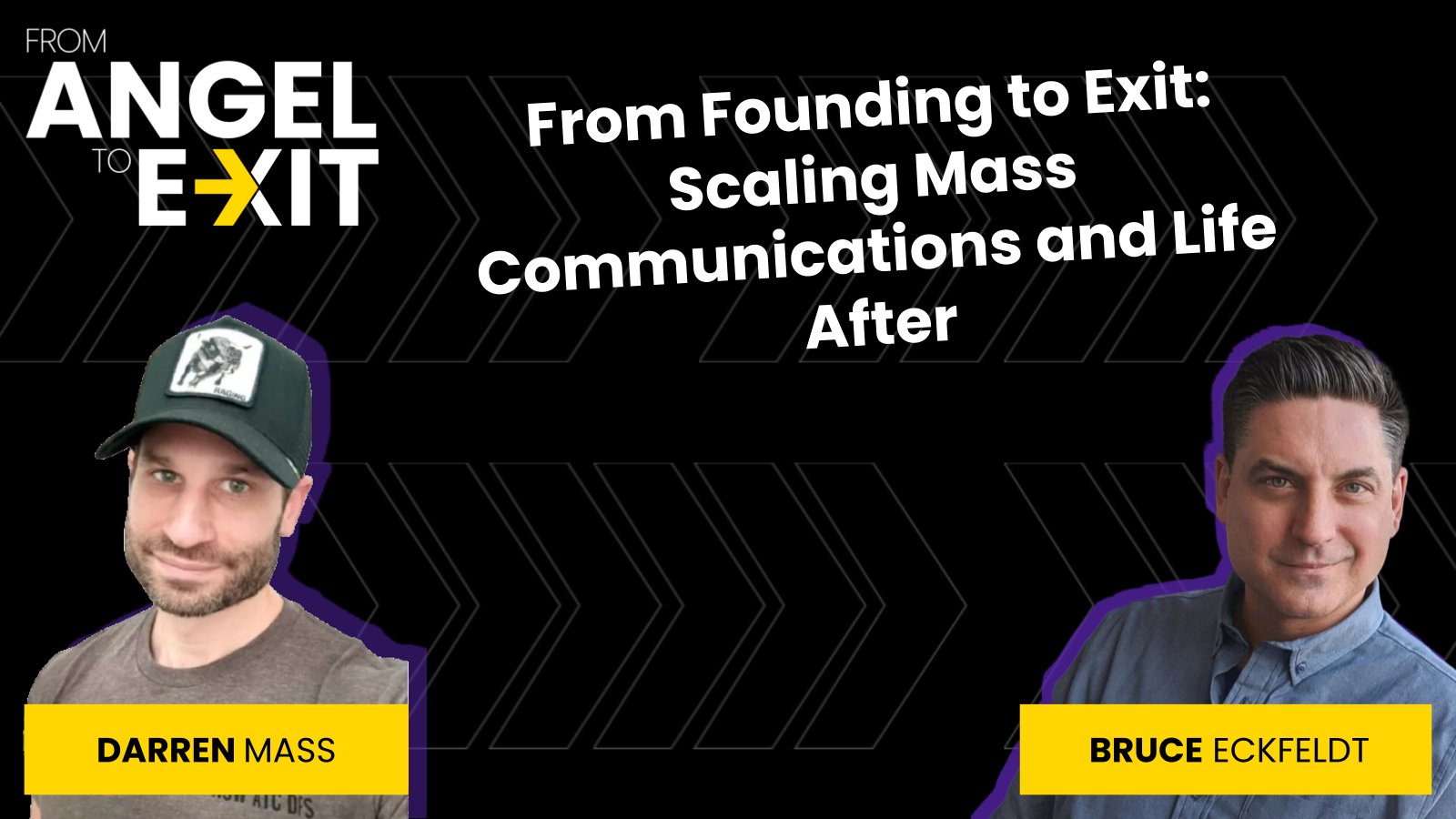
From Founding to Exit: Scaling Mass Communications and Life After
Darren MassFounder, Mass Communications
Listen to the Episode.
Play the full conversation right here, or pick a chapter to jump straight to that moment. Prefer your own app? Every episode is on Spotify, Apple Podcasts, and the rest.
About This Episode.
Start with the key takeaways, the ideas worth bringing back to your leadership team. Then read the full story of the conversation, or use the chapters above to jump straight to the moment that matters most to you.
- Scale your company by thinking and acting like the CEO of a $10M+ business from the start.
- Prioritize teamwork and avoid CEO ego, build a strong team that drives success.
- Always be open to discussing an exit, but ensure the timing and valuation align with your goals.
- Identify early warning signs of burnout or stagnation to determine the right time to sell.
- An exit is just the beginning, have a plan for your next move before the deal closes.
- Money alone doesn’t create happiness; purpose and relevance post-exit are crucial.
- Entrepreneurs should define whether they’re running a lifestyle or growth business early on.
- Use LinkedIn strategically, it’s a vital platform for networking, brand-building, and business growth.
In this episode of From Angel to Exit, host Bruce Eckfeldt sits down with Darren Mass, the founder of Mass Communications, to discuss his entrepreneurial journey from launch to acquisition. Darren shares how his early fascination with engineering led him to build a successful telecom company, the strategies he used to scale, and the key decision points that led to a $40 million exit. He also reflects on life post-sale, the challenges of transitioning from CEO to employee, and his new mission helping entrepreneurs navigate growth and exit planning.
Watch the Video.
Prefer to see the conversation? The full episode plays right here on the page, so you can watch while you follow the takeaways or read along with the transcript. Every episode of From Angel to Exit is also on my YouTube channel, along with short clips from each conversation.
About the Guest.
The background behind the conversation, and where to find this guest online.
Darren Mass
Founder, Mass Communications
Darren Mass founded Mass Communications and built it into a successful telecom company that sold for $40 million. He now helps entrepreneurs navigate growth and exit planning.
- linkedin.com/in/darrenmass
Full Transcript.
The complete conversation, lightly edited for readability. Open it to read along, or search the page for a topic or a name.
Read the full transcript
Bruce EckfeldtWelcome, everyone. This is From Angel to Exit. I'm Bruce Eckfeldt, I'm your host. Our guest today is Darren Mass. Darren was founder of Mass Communications, and we're going to hear about that story. He's also doing some really interesting things since then, so I want to make sure we have some time to dig into that: the work he's doing with entrepreneurs and helping people grow their businesses. It's a really interesting story and really interesting work, and I think a great example of what you can do and what opportunities are afforded to you once you've had a successful exit. So with all that, Darren, welcome to the program.
Darren MassThank you so much, Bruce. Happy to be here.
Bruce EckfeldtIt's great to have you. Before we dig into the exit story and what you're doing today, we'd love to get a little background. How did you decide to become an entrepreneur? How did you start your company? What was the backstory? Give us a little insight.
Darren MassSure. I grew up on Long Island, and I was always the ADHD kid that broke stuff, in my parents' eyes. I couldn't sit still. Really what I was doing was taking things apart to put them back together. I always had an interest in what is inside of things. So naturally, after a string of really bad grades throughout grade school and high school, I went to community college.
My brother said, "Why don't you try telecommunications engineering? It's this awesome new industry. You like breaking things and putting them back together. You like math and science, and you could make a lot of money since it's the hot industry." So I said, "Okay, fine." I went to Nassau Community College and sat in my first class. It was an engineering class, and within 15 minutes, I fell in love with it.
I transferred out after getting 4.0s to Rochester Institute of Technology. There, I was in love with telecom engineering, electrical engineering, and computer engineering. I always knew I was going to do something bigger, and I started a business with a couple of friends while in college. It failed. I learned a very quick and easy lesson: if you're not all in, then you're all out. That didn't work for all three of us. At this point I'm the technical guru behind the business, but I also have class for four to six hours a day. That doesn't really work out in business.
Anyway, I got an internship, or what they call a co-op, in Rochester, New York, at this awesome telecom company. I stayed there for eight years. I was their first intern. I moved down to New York City and was a senior manager in that business. And one day I woke up, it was December 19th, 2007, at 2:19 a.m., and said, "Mass Communications. That's a great name for a telecom company, and it's my last name." And that was it. I didn't look back. I wrote the business plan.
The words that came out of my mouth, in this cliche entrepreneurial spark, were, "I've got the business name. I've been talking about this forever. I can't go back." So I gave six months' notice, because, good human stuff, and I knew I needed some runway to build up capital reserves and get my planning in order. I stayed there for about six months, moonlighting a little, but they allowed me to do it. And on March 8th, 2008, I started my first day in the office at Mass Communications.
Bruce EckfeldtThat's amazing. I'm curious, when did you decide or realize you really wanted to be an entrepreneur? What was that moment?
Darren MassMy grandfather was an entrepreneur. In his 40s, he was an accountant, and he decided he wanted to be in his own business. I never really had that close a relationship with him until my grandma passed away. Driving him home to his village in Florida, I turned to him and said, "Poppy, what made you start your own business?" I'm going to paraphrase here. He looked at me and said, "Because I couldn't stand working for fucking morons."
Bruce EckfeldtExactly.
Darren MassIt was at that moment that I realized where I got it. He was a really strict human being: the Depression era, the wars, all of that. Not that I felt that way about the people I worked with, but I always felt that sitting at a desk, putting in my 60-plus hours a week, I had this disgruntled feeling. "I'm working so hard, but they're making all the money, and I have to ask for a raise, and I have to ask for a promotion, and this doesn't feel right." I always knew something was missing, and I got it from my grandpa. My dad has owned a few businesses. My uncle had a few businesses. So I learned from example.
The final push for me, I remember calling my uncle, telling him this great telecom idea, and giving him the name. He said, "Well, you have to do it." I said, "Why?" He said, "Because you're not married. You don't have children. You rent an apartment in New York City. You can always get a new job if it doesn't work, but by the time you turn 30, you're going to wonder why and have regrets. You can't do that. So now you have to do it."
That was the final "All right, I'm doing this. I'm going out on my own." The fear of the unknown. Everything I'm saying is extremely cliche, right? There are no original business books out there. We just say it in a different way. But that fear is what drives you. That fear of starvation. For me, the biggest fear was moving home with my parents.
Bruce EckfeldtRyo talks about sleeping under a bridge in a box, right? And yours was moving home with your parents.
Darren MassI'd rather take the bridge. My mom didn't understand this. The job I had, an engineering job in senior management, I was doing very well. A deep six-figure salary, right? But that didn't make me happy. Money wasn't making me happy. What made me happy was doing something on my own, proving that I could do something on my own, proving the guidance counselor wrong when they said I should go to BOCES and fix cars. Nothing wrong with that, but I knew that wasn't my path.
Bruce EckfeldtInteresting. So you landed on the name Mass Communications. What was the first move? Tell us about the early days.
Darren MassThe first days, I remember writing tariffs. As a regulated industry, you have to apply with the governments, the local state jurisdictions, the PUCs and PSCs, and you have to get approval. These are really long documents. I didn't know very much, other than that one of my classes was on tariff writing. And the one thing I learned most in my life was work smarter, not harder. So I ended up taking Verizon's tariff, putting it in Microsoft Word, and replacing Verizon with Mass Communications everywhere. And it was good. They approved it. They accepted it. I don't know if that's right or wrong, but our legal people said it was good. That's what lawyers do, right?
So we filed these big 400-page packets and got approval from New York, New Jersey, and a couple of other states that we were going to sell in. The first few months, nothing. Twiddling your thumbs, finding busy work, wondering, "Is this going to work?" Wondering if I was going to starve. I moved to a much lower-cost neighborhood and a much lower-cost apartment. I stopped eating dinner. You have to sacrifice, right? The only thing I was passionate about was making this successful. Proving me wrong, proving others wrong. It's that cliche. I ate a single Lean Pocket for dinner every single night. That's it.
The A&P across the street from my Batteries Not Included cheap apartment was selling six boxes of Lean Pockets for $10. That's what I ate for 12 months straight. I had met a girl, I had a girlfriend, so check, no worries there. I'm taken care of in that sense, right? Occasionally we would use my soon-to-be father-in-law's credit card to go to a movie or to Boston Market. That was a reward for us. But yeah, the first few months were kind of daunting.
Bruce EckfeldtWhen did things turn for you? When did you know you were out of the early struggle and thought, "Okay, I've got something here. We've got some momentum going"?
Darren MassOur fifth sale. I had hired our first person. She was our office manager and receptionist. I had two great business partners, and one of them said, "We need you to be the engineer, not picking up the phones when they do ring, and not ordering the copy paper. We need someone else to do that. And we need to treat this like a real business. If you want to be a $10 million business, you have to think like the CEO of a $10 million business." So that was a bleeding hole right there, right? Her salary was roughly $35,000 a year in 2008. It's a good salary, I guess. But I wasn't paying myself anything.
I remember we got our first client because I answered a question on LinkedIn. Someone who had known me throughout the years needed something done in a pinch. They trusted me already because of the history, and they gave us the order. We got our second client because they knew our name.
One of the people who ultimately became an agent representing my brand called me up in a pinch. "Hey, Darren, I know you're no longer working at so-and-so, but would you mind helping me? No one can figure this out, and I know you can. Just come to this client with me." So I went out there and introduced myself. "Hi, I'm Darren Mass, CEO of Mass Communications." And the person turned to me and said, "I've heard of you guys."
Bruce EckfeldtFrom where?
Darren MassThat was the face I gave her. "You have? Of course you have, right?" Then, walking back to the office, I remember thinking, "My God, every college has a mass communications department." By happenstance, the name was familiar. Within 30 days, they signed an agreement for a voice and data circuit.
So that was two, and then three, four, and five. Around our fourth client, I would walk up to our receptionist, and I was walking around the office without shoes on. I don't know why. But I remember it vividly: blue carpet, blue walls, blue everything. And I remember saying, "Marla, when we get to our fifth customer, I'll know we made it. I'll know we're onto something." The reason I thought that way is that the revenue was good enough to feel like a real company at that time, and the profit was enough to pay my rent, in the event I had to pay my rent. So that's when I knew I'd made it.
After that, it was all about reputation. Always saying yes, putting yourself in opportunities, networking like crazy, calling on your resources, asking existing clients for recommendations and referrals, being on LinkedIn. Doing all the things that a business owner needs to do that sometimes they don't want to do, but have to do anyway. And it worked.
Bruce EckfeldtAny other keys to scaling the business? You got things started, you had your first couple of clients, you knew you had a business going. Once you were in the "How do I grow this?" mode, what was the focus? What did you learn?
Darren MassI learned so many failure lessons, so many. I was fortunate enough to have one of the smartest people I know as my business partner, David Schwed. He was my childhood friend and just a brilliant guy, so he was always my consigliere. He was always looking out. And my other partner, Mark Gold, had already run a business. He was the older, more mature one. There were a lot of small, stupid mistakes that business owners make where he said, "No, we don't have to do that," or "We don't have to invest in that," or "We don't have to spend our budget on this marketing. It won't work."
But there were also CEO ego things that I hadn't learned. I've learned time and time again that you don't put your ego out there. It's we, not I. I didn't build a company that sold. I built a team that built a company. And it's that mentality that changes everything about how you lead and manage people and how you hold them accountable. People don't want to work for you. They want to work with you. And it took a while to learn that.
I had one learning lesson that really hurt. We were having an outage with one of our vendors. They were a trusted vendor, and I was getting annoyed. The CEO wasn't responding to me. We were a fairly large customer at this time, and I said to the person who introduced me to that company, "This guy doesn't know how to be a CEO. How do you not call back one of your largest clients?"
Well, that got back to him, and I'm sure it wasn't taken nicely. He said, "Really? Okay. Well, you're going to have to pay this bill right now. I'm not turning your services back on." And he held us hostage. I told my partners, and they both looked at me in disbelief. "You're running your mouth. You shouldn't have done that." So we had to pay to get back in service.
You learn that lesson once. Especially during heated scenarios, outages, or tough situations that are emotional, you don't fan the fire. You check your ego at the door. What I learned is that instead of insulting and throwing shade, I should have messaged that CEO, or the agent, and said, "If there's anything I can do to help you resolve the condition or fix it faster, let me know." That would have gotten the job done.
Bruce EckfeldtIt's interesting. I talk a lot about that, the transition from founder to CEO: going from being the person who starts a company to being the person who really scales and exits a company. What else do you feel like you had to transition, evolve, or learn in that process?
Darren MassI had to learn that I'm not the smartest guy in the room. I never will be. Your job as a great leader is to surround yourself with smart people and empower them. I also learned to listen to other people's opinions and, frankly, to shut up and listen. And I learned the power of education. Here I am, an engineer. Engineers aren't CEOs, right? But I think it was a great thing for me. I was able to see the black and white, problem and solution, but I wasn't able to see the gray, and business is peppered with gray. So I sent myself to business school, because I had to admit to myself that I'm not the smartest, I don't know everything, and I need to learn.
Bruce EckfeldtAny good tools there? I had a similar situation. I was originally trained as an architect, then got into software, so I had no formal business training. Similarly, coming from an engineering background, you have a lot of amazing skills and capabilities you can apply to business. But not having the core business education was both practically hard and something that plays with your mind. You always have a little bit of an imposter syndrome complex when you don't have that business education. What did you do to feel like you understood the mechanics and fundamentals of business better?
Darren MassSo I should just start calling you Art Vandelay. My father was an architect, so we're in good company. He always told me, "Don't be an architect." I think the money is way at the top. You have to really get up there. It's the creatives, but now that everything is done in CAD, the old school isn't valued the same way.
For me, I always had this understanding of business, this intuition that you've got to sell high, make a profit, run a business, and invest wisely. But I didn't understand the machinations of how to invest back in your business. I remember a scenario where we had won this really nice deal. It was maybe customer 15. We were reselling another company's services and putting our own brand on it. We were invoicing it, providing all the service, the support, everything. So for all intents and purposes, the customer was buying services from me, and I supported it.
The company that was losing the business was the very same company I was buying services from. In telecom, it's incestuous. That happens all the time. You can't go from New York to LA without riding multiple telecom carriers' services. So there's supposed to be this wall between the resale wholesale division and the direct channel. But in this case that wall broke down. It's not a literal wall. It's a phone call: "Hey, did you know you're losing a customer?" There are regulations that prevent that, and it is unlawful, but it happened. I found out that the customer who signed with us had canceled our agreement and decided to stay with the provider we were taking them from. The reason why is that the provider instantly offered them a much cheaper rate. They didn't want to lose the business.
It happened to be the company I came from, so I already knew the players who needed to be involved. I reached out to the COO and said, "This is not okay. This is supposed to be an unwritten rule. I didn't purposely go after your customer. That's not our intent. But the agent had a customer that didn't like your service and wanted to switch, and they came to us." The COO understood. He said, "All right, Darren, here's what we're going to do. What's your SG&A on the deal? I'll make it right."
I had no idea what SG&A meant. My reaction was, "Strong to very strong." That's what I said to him. It's a line. And he said, "Okay." He clearly knew I had no idea what I was talking about. He said, "All right, Darren, go talk to your partner. Figure out what your SG&A is and get back to me." So I hung up the phone, went back to my partner Mark, and said, "So-and-so asked me what our SG&A is." He said, "What'd you tell him?" I said, "Strong to very strong." He burst out laughing. One of those gut laughs. We lost it.
Then I asked, "What does it mean?" He said, "Selling, general, and administrative. What's our real profit on this after you take out everything it costs to acquire the sale?" So we came up with a number, which we also made up off the top of our heads. I told the COO, and he said, "Okay, I'm going to give you three months' worth of SG&A, and I'm going to give you a 10% discount on everything you order through us for the next year. But you're not going to win the customer back." It worked out perfectly, because I got a quick cash infusion, and that discount built brand loyalty and kept me going back. It was a smart move on his part and a smart move on my part, and it gave us an upper hand.
Bruce EckfeldtI have a similar story about a company that was copying our job postings. They were trying to hire people just like ours, and they literally copied the postings word for word. Our HR person came to me saying, "I can't believe they're doing this. I'm going to sue them." I said, "Let's think about this." I called them and basically said, "Hey, it looks like you're looking for people we already have. What do you think about doing a contract?" It ended up being a $3 million deal over the next three years.
I think that's a great example. As leaders, we need to check our initial reaction to a lot of this stuff and ask, "What's really going on here? Where is the opportunity? What are the forces at play? How do I think about the bigger picture, rather than just getting pissed off?"
Darren MassYou nailed that. I think that's the biggest lesson I've learned all these years, and I deal with similar situations with my current business partner. You can get aggravated, pissed off, angry, all the negative emotions at first. That's a visceral human emotion. We react. It's fight or flight, and if you're an entrepreneur, you probably want to fight. There are very few flight moments. But if you learn over time and recognize the pattern that your initial negative emotion is typically wrong, you take a step back and breathe, or whatever works for you, and you start realizing that every situation has an opportunity.
You interviewed the most perfect candidate and he says, "I'm sorry, I'm going to take a job somewhere else." Well, you know what? You could have dodged a bullet. He could have been the worst employee in the world. He could have been the one who never showed up and took all this time from you. So there's an opportunity there. You could have lost a deal, but it turned out that deal might not have had creditworthiness. There's always a positive way of thinking about things. I've learned time and time again that if you move past the negative very quickly, or don't even allow yourself to go there, you can find solutions to everything, it doesn't drag you down, and you're more open to real opportunities when they do happen.
Bruce EckfeldtGood advice. Let's talk about the exit a little bit. When did you first think seriously that you were going to exit your company? When did that thought cross your mind, or when did you start grappling with it?
Darren MassDecember 19th, 2007, at 2:21 a.m. It was two minutes after I came up with the name. It was as serious as it needed to be. I had no experience writing a business plan, no business acumen at all. I did what most entrepreneurs do: I bought the URL immediately, because that's what we all do.
Then I wrote the business plan. It started with the cover page: Mass Communications, "More than just talk." It's a great slogan. I put the date, and then for some reason I started with the exit strategy. I don't know why, I just did. It was top of mind. I wrote, "Sell to PAETEC Communications in 10 years for $40 million." Period.
Then I went on to what products we offer, what we need, who's on the team. It was the silliest thing, right? Well, as luck would have it, we sold to Windstream Enterprise, the company that acquired PAETEC Communications, for $40 million on December 19th, 2017, exactly 10 years to the date. They picked the date. I had no involvement in the date. I just remember that once they picked the date, my jaw dropped.
I ran to my partner Dave and said, "Dude, find the business plan. Find it." He found it, read the first page, and said, "What? My God, you predicted this." I just put it down. I had no thought behind it, right?
Bruce EckfeldtThat's crazy. So why do you think you put it down? Was it because that was your intention? Was it to help guide your decision-making?
Darren MassI never put thought into it, but here's the first thing that comes to mind. It's because of my mom. She taught me to do mazes backwards.
Bruce EckfeldtFascinating.
Darren MassWe were at Friendly's. If you know what that is... All right, good, I don't have to explain Friendly's. I was at Friendly's with the little kids' menu and the crayons. I was struggling, and I remember her turning to me as I was gnawing on my chicken nuggets and saying, "Do the maze backwards. It's easier." So that's probably why I did the maze backwards. Business was a challenge to me. It was a maze.
Bruce EckfeldtThat's an amazing engineering solution, too. What do we want at the end? What are my success criteria, my exit criteria, for this project or initiative? Now, what do I need to do to get there? How do I back into that solution?
Darren MassThat's right. And now I think about when we did labs in school. You would always start with your purpose. What's your conclusion? What are you trying to find? Granted, it leads to confirmation bias, but that was my confirmation bias. My purpose was to sell this thing. I didn't want to make a lifestyle company. I was too young. I was 28 years old. I just wanted to sell this thing one day and have a growth company. I at least understood that.
Now, when it came to the exit, it was literally an overnight situation. A year prior, I had asked one of my business mentors, "Hey, Raul, as a CEO, what should I be doing?" Here's a guy who has sold multiple businesses, many successful exits, a PE type of guy. He said, "Darren, my best advice: always be talking about your business if you're in the right audience. And then talk about selling it."
So the very next day, I called up one person who I thought could buy my business and said, "Hey, would you be interested in buying?" He said, "Yeah, absolutely. I'll get you an NDA tomorrow." We went through a little bit of that, and then when I looked at my numbers, I realized I wasn't going to get what I wanted. I knew I wanted the $40 million. So I called this gentleman and said, "Listen, I'm not going to waste your time. After doing my own due diligence, you're not going to buy me for what I need you to buy me for. Why don't we just keep the dialogue open?"
He was so appreciative. He said, "You know what? No one does that." This guy bought businesses left and right for a huge telecom company. "No one does that. I respect the hell out of you. Let's stay in touch." Well, a year later, he landed at Windstream. I sent him a text message: "I'm ready. Let's have lunch." We sat down at lunch, I laid out the plan for him, and he turned to me and said, "Let's do it."
So I went back to my business partners and said, "If I can get an offer for $40 million, would you sell the business?" Mark was the practical, pragmatic one. He said, "No one's going to offer us $40 million, but sure, you do that." Well, two days later, I had an offer.
This was right place, right time. When we dissect it, they had no choice. They had to buy us. This gentleman needed a win, and what greater win is there than an acquisition for your publicly traded company in your first week on the job? He'd been seeing us as a target for a while. And when we win, all the losers lose their revenue, which means all his competition loses their revenue. From a board level, I'm sure they thought he was nuts, but it came down to one statement: if we don't buy them, we're going to lose so much revenue year over year when they sell to someone else, so we must buy them.
Bruce EckfeldtIt's as much a defensive as an offensive tactic.
Darren MassYeah. So now, when I train clients, I teach them a lot of these factors, removing the head trash, the emotions of business. But the first thing I do when I meet a client is ask, "What's your exit strategy?" Half of them have no concept, no thought behind it. Are you running a lifestyle business? Does Section 179 mean anything to you? Is that G-Wagon you're driving over 6,000 pounds? Or are you running a growth business for exit? Once we can define which style of business it is, I can help you to the end, to the exit. You don't run a race unless you know where the finish line is. That's very important for all business owners. What are you racing towards?
Bruce EckfeldtAny reflections on things you wish you had done differently at any point in the business that would have helped the exit process?
Darren MassI'm going to say no, without it sounding arrogant. The only reason I'll say no is that we sold in 2018. I completely avoided COVID. Had I worked harder, sold more business, hired 10 more people, done this, this, and this, it might have yielded more success, and we might not have sold the business. And for anyone who ran, or is still running, a business that went through COVID, that sucked across the board. There's no playbook in any business school that says, "In the event of global catastrophe and meltdown, do this, this, and this."
We were a regulated utility. The majority of our business was in the Northeast, the tri-state area. We had international business, but the majority was in New York City, New Jersey, and Connecticut, heavily populated and heavily affected areas. Most of our customers probably would not have been so timely on their bills. Most of them would have requested a reprieve because of the economic downturn, knowing that as a regulated utility, you cannot turn off their service. So I wouldn't have the "or else" mechanism, but the providers I was buying services from could turn off our services. There's a little nuance in there. I probably would have had to furlough or lay off the majority of the staff, and we would not have had enough capital to survive. I don't know if PPP would have been enough. I'm very thankful in hindsight for everything that occurred.
Bruce EckfeldtDoes that lead you to any advice or general heuristics you give business owners around when to sell? Is there a practical sign, or a gut feeling, or a frame that tells someone, "You know what? This is the right deal at the right time"?
Darren MassYeah, there are these intuitional signs. Let's presume that by the time you're ready to sell your business, you're either old, sick of the business, complacent, sickly, or just ready. None of those is meant to be insulting or careless in any way, but you just know. For me, I knew. With my business partner Dave, I could see it on his face. It was nearly 10 years. He was sick of some of the nuances of a utility business.
We had over 50 employees. Anyone who has employees knows you can empower, promote, motivate, inspire, and do everything for a great culture, but there are still those moments where the hand is out, and it weighs on you. It's a lot.
We were also going to lose one of our largest customers to a competitor. I'm a big believer in being friends with your competitors. Be very friendly. There are plenty of fish out there. One of my friends, who was one of my competitors, called me up and said, "Hey, isn't this your customer? I got an RFP." Well, I didn't get the RFP. What ended up happening was that PE came in and acquired the majority share of this large, 80-plus-location business, and they had their own vendor list. I wasn't on that vendor list. So what does PE do? Reduce costs, send out an RFP to whoever's on their list, and that's it.
There was some luck in that, though. Our master services agreement with that customer said the effective date of the contract didn't start until the last service on the contract was turned up. They had been delaying a location for years, so it never hit its effective date, and legally they had to stay a customer. But I knew I was going to lose this account, and we had hired four staff just to support all these locations. Knowing that, and knowing I had one partner who was a little disenfranchised and I couldn't motivate him more, I felt it.
I also started doing things that were very different from my character. Ego, once again. I started working from home one or two days a week. I was always the first one to clock in and the last to leave. Thank you, Big Smo. It's a great lyric, right? I never worked from home. I was against working from home. But all of a sudden, I was working from home. I had this conversation with one of our business consultants and said, "You know what? I can't get motivated to come back in. I'm a threat to the business right now."
So the thoughts were, do I hire a CEO and replace myself? Do we make an acquisition? Making acquisitions in haste is probably not a good idea. What do I do? That was above my education and pay grade, and there was too much at risk to lose it all. I knew that by being complacent and less motivated, I was a risk to my business. Add that to the realization that we were probably going to lose this big client, and the fact that we were managing 50-plus people who all want more and more. The writing was on the wall, and the stars had lined up perfectly.
The way I look at it, every business owner should have a number. For me, it was an after-tax number. If I sell my business and get this after tax, I can invest it, live a nice, happy life, and not be so pressured. I found out later that's not correct. But once I had that number, the conversations in my head and with my family and my wife were, "Why would I wait?" You never know if that number will be achieved later. It could be more, sure. But why not do this now? I have plenty of years to work and grow something else and do something that excites me later on.
Bruce EckfeldtOverall, would you say you're happy with your exit?
Darren MassYes, unequivocally. I'm happy. I'm not in telecommunications anymore. I didn't go through COVID running a big business. Absolutely. Where I wasn't happy was the thing I didn't know, because, as G.I. Joe says, knowing is half the battle, and I don't know what I don't know.
Right after the exit, I elected to stay on as an employee. I was the president of this Fortune 500, publicly traded company. Awesome. I wanted to do that. I was 38, too young to be retired in my mind. I also didn't want to see it fall apart. I wanted control over it.
One of our requirements was that all employees of my company remain hired or hireable and keep their jobs. That was always my promise to my employees. I promised them, "One day we'll sell the company. You will not be rich because of it. But I promise you that you will be better off personally and professionally, because we will put you through training. I promise that every year we will pay 100% of your health care. I promise that every single year you will do better than the last, monetarily, provided the business is doing well. And I promise you that when we do exit the business, you will be employed."
We kept that promise for all but six people. Six people were truly redundant. But before we called those six people into the conference room, we already had jobs lined up for them at my friends' companies, my competitors. So I upheld my promise. My other promise was to my customers and the agents: "I will never leave you high and dry." So I stayed on. I wanted to. And it was great for the first two days.
Bruce EckfeldtI thought you were going to say two months or something like that.
Darren MassNo, two days. The first two days, there was a big industry trade conference. I went, and everyone knew who I was. There had been a very big public press release announcement. People knew me as the CEO of my company. The reputation was stellar. We always took the moral high ground and did the ethical thing. But the first time I had to introduce myself as president of... Ugh. I had joined forces.
Bruce EckfeldtThe dark side.
Darren MassAnd the next thing out of that person's mouth was, "You guys suck. Big bad telecom company." I remember calling Christie and saying, "This doesn't feel right. I'm going to stay for the year I promised, and then I'm out of here." It just didn't feel good. I used to say, "I'm Darren Mass, CEO of Mass Communications," and hold my head high. Now I'm Darren Mass, president of "you guys suck."
Fast forward a little. First board meeting. I'm a culture person. I believe in people. People get you to your goals. No one does it alone. My first board meeting was an all-hands board meeting, 60-plus people in the room. Apparently you spend a month creating a report, which, corporate America, yay, it's a lot of wasted time. Not my style. So I had a speech prepared, and my speech was "1% more."
It was based on this. If the NOC, the network operations center, closes 1% more tickets and they stay closed; if account management makes 1% more phone calls into their customer base every single week; if we make 1% more sales; if we try 1% more; if we wake up 1% happier. I didn't make the concept up. I borrowed it. But I wrote this great speech. After about three minutes of speaking, I heard one clap. And I saw the CEO say something to another board member. This was back when the phrase "mic drop" was big, so I said, "Mic drop?" And everyone laughed. I'm not embarrassed, because I know who I am.
Afterwards, the guy who acquired my company, he's from Texas, came over and said, "Darren, what the hell was that?" I said, "It's how I roll, man. I'm a culture person, and I believe every word I said." He said, "Yeah. Just focus on the report." My friend was now my colleague, right? Every bit of it ate away at me.
Anyway, unlucky or lucky, whichever direction you want to look at it, they had been poking this financial bear for quite a while. They poked the wrong bear and shouted way too loud, and this financial bear ended up suing them. The company lost the lawsuit, to the tune of $310 million to be paid immediately. The bear also shorted the hell out of the stock and did a whole bunch of other things, so either way they won. I was the only person who spoke up and said, "You guys keep poking this bear, but this bear never loses. Look at the track record. They're at a 100% win rate. They don't invest $50-plus million in vulture-backed lawsuits because they want to. They do it because they win."
It forced a restructuring bankruptcy. I was out after that. I said, "Listen, I'm not destroying my reputation for this. I'm out." And that's it. The very next day, I started a company. I created a business therapy group and became a business therapist.
Bruce EckfeldtTell me a little bit about what you're doing today and how it's extended your professional goals.
Darren MassI help small business owners and founders clear the head trash, the positive and the negative that weighs on them. The partnership and relationship issues, where they can't celebrate the wins for fear of people being jealous or envious, or they can't figure out how to get rid of the emotions from all the negatives. They stop trusting their people.
But my main focus right now, indefinitely, is what I do for my retirement. I used to joke that I was retired after the exit. Well, that left me really depressed, floating around and realizing that money's not a goal. It's part of a goal, but happiness and health are the goal. Money doesn't complete you. When they get that gold medal, most Olympians get depressed. What's next?
For me, where I really find passion is in teaching, inspiring, and educating others: solopreneurs, who have the loneliest and worst culture on the planet. One person dictates the culture, and it changes every day, multiple times a day. There's no coffee station. There's no water cooler. There are no lunches. There are no happy hours. There's just one person who has to wallow and get through the day.
So we created a culture machine called BrandBuilt. I have an awesome partner, and we focus on business coaching. We have meetings every week, networking opportunities, and a heavy dose of LinkedIn education, because LinkedIn is the best opportunity for every business, B2B or B2C. Every business. LinkedIn is the street that prospects walk along. It's up to us to dress up our windows and invite them in. LinkedIn and profile optimization, that's where it's at. That's what we focus on. As you can tell, I'm really passionate about this. I love this stuff. It gave me purpose and relevancy again.
Bruce EckfeldtAwesome. I think that's a great point. At the end of the day, we need some kind of purpose and mission and drive, whether it's financially motivated or impact motivated or helping communities. You need something. So when you're figuring out your exit, knowing what that next thing is going to be is super important.
Darren MassThat's great advice. For me, the exit happened so fast. Boom, exit. I didn't have time to think about what's next. I barely had the chance to ask my accountant, "Well, what if I moved to Florida?" I had that conversation. My accountant said, "No, no. You need 181 days, and you needed to do that two years ago. Jersey's coming after you." It happened so fast I couldn't pivot. And this is not a "woe is me." This is a learning for me.
If you are seriously running a growth company, plan your exit now. What does it look like? Realize you will become depressed like every other founder. Don't make the mistakes of building the dream house, buying the boat, buying the car, doing the fancy things. Sit on it. It's just money. Don't change your life, because your normal life will always resurface. Your routines will always come back, but you won't like the person who just bought the fancy things.
Bruce EckfeldtTrying to fill it with stuff.
Darren MassBecause that's ego. And those are the mistakes I made until I realized that this is not fun. It's not exciting. Purpose: what's my purpose? What's my relevance?
Bruce EckfeldtDarren, this has been a pleasure. If people want to find out more about you and the work you're doing now, what's the best way to get that information?
Darren MassFind me on LinkedIn, good old LinkedIn. Darren Mass, that's my name. So there, or BrandBuilt, at mybrandbuilt.com. Either way.
Bruce EckfeldtCool. I'll make sure those are in the show notes so people can find them. It's been a pleasure. Thank you so much for taking the time today.
Darren MassThank you for letting me speak way too much, because I have ADHD.
Bruce EckfeldtI appreciate it. That was great. Take care.
Never Miss an Episode.
Know the moment a new episode goes live. Subscribers also get a say in future guests and the topics we cover.
Other Related Episodes.
More conversations that connect to this one. Or browse the full archive by topic or by guest.
Pete Martin
Lessons from four exits, including a 12x EBITDA sale to KPMG.
Listen and Read
Thomas Michael
How he scaled an online training company, sold it with no earnout, and what came after.
Listen and Read
Matthew Diteljan
How a $1,500 startup became a national ad platform, and the hard lessons from a buyout and burnout.
Listen and Read