From Angel to Exit Episode 22
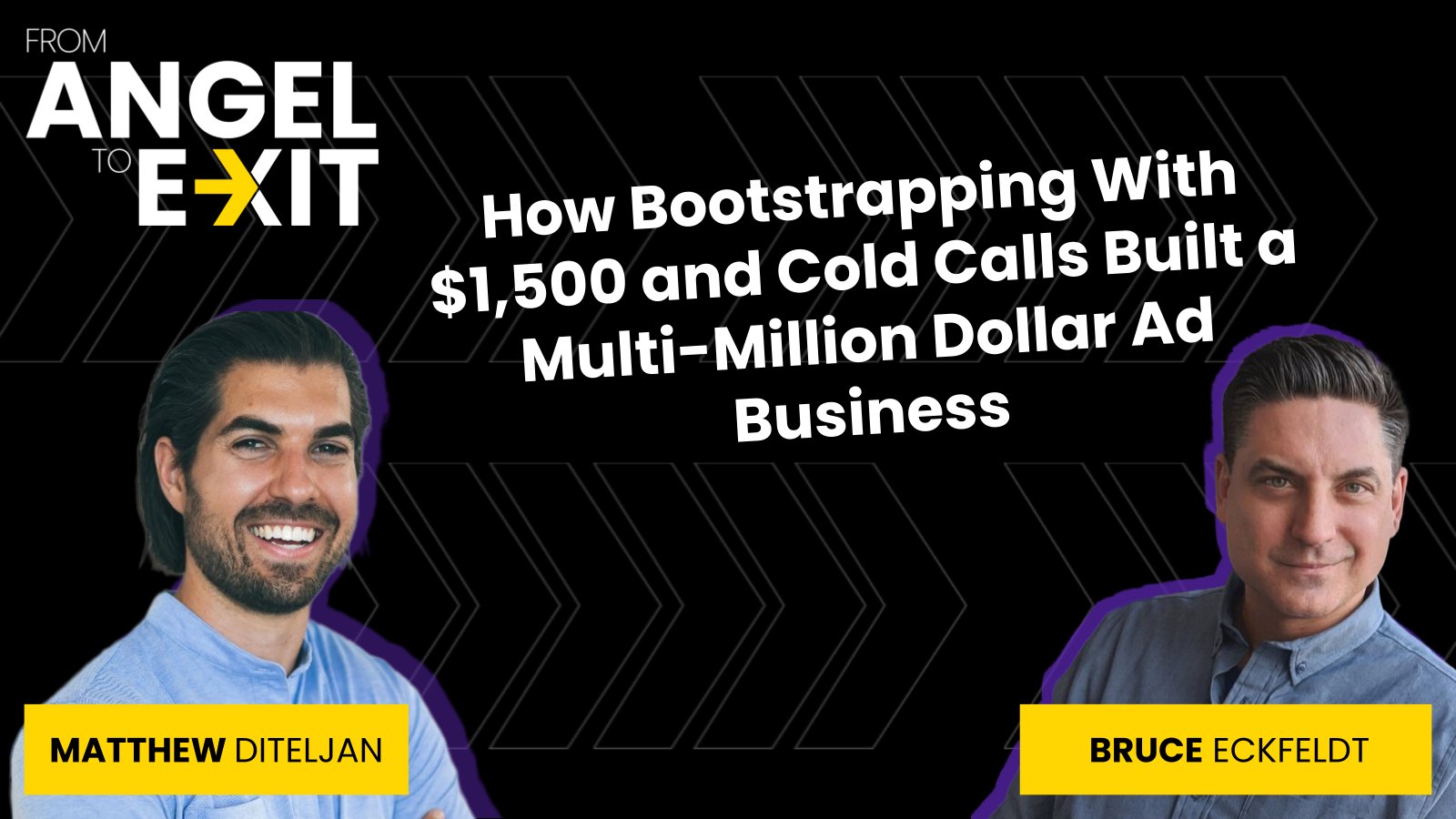
How Bootstrapping With $1,500 and Cold Calls Built a Multi-Million Dollar Ad Business
Matthew Diteljan
Listen to the Episode.
Play the full conversation right here, or pick a chapter to jump straight to that moment. Prefer your own app? Every episode is on Spotify, Apple Podcasts, and the rest.
About This Episode.
Start with the key takeaways, the ideas worth bringing back to your leadership team. Then read the full story of the conversation, or use the chapters above to jump straight to the moment that matters most to you.
- Starting with constraints forces creativity and sharpens focus.
- Bootstrapping helps you stay lean, but can limit scale if you resist outside capital.
- Partner alignment is critical; buyouts can get messy without strong communication.
- Abdicating leadership too early can trigger chaos; train successors with care.
- Walking away from a subpar offer can bring stronger, unexpected buyers.
- Your investment banker works for the deal, stay in control of your own vision.
- Financial freedom doesn’t guarantee peace, post-sale fallout can be brutal.
- Think beyond the exit: what kind of life and legacy do you really want?
Matthew Diteljan co-founded a startup with just $1,500 and scaled it into a national advertising platform targeting high schools. After a partner buyout and burnout, he exited the company, but not without hard lessons. In this raw, honest conversation, Matthew shares how his dream exit turned into unexpected post-sale turmoil, what he’d do differently, and what every founder should consider before pulling the trigger on a deal.
Watch the Video.
Prefer to see the conversation? The full episode plays right here on the page, so you can watch while you follow the takeaways or read along with the transcript. Every episode of From Angel to Exit is also on my YouTube channel, along with short clips from each conversation.
About the Guest.
The background behind the conversation, and where to find this guest online.
Matthew Diteljan
Matthew Diteljan co-founded a startup with $1,500 and built it into a national advertising platform for high schools. After a partner buyout and burnout he sold the company, and he shares the hard lessons that followed.
- linkedin.com/in/diteljan
- instagram.com/mattditeljan
Full Transcript.
The complete conversation, lightly edited for readability. Open it to read along, or search the page for a topic or a name.
Read the full transcript
Bruce EckfeldtWelcome, everyone, to From Angel to Exit. I'm Bruce Eckfeldt, I'm your host. Our guest today is Matthew Diteljan. He is a founder, an exited founder. We're going to talk to him about the company he scaled and exited and what he's doing now. He's got some really interesting insights and a really great story, and hopefully some takeaways for folks listening in terms of what they can think about earlier in the process. So with all that, Matt, welcome to the program.
Matthew DiteljanBruce, glad to be here.
Bruce EckfeldtIt's a pleasure. Before we get into everything you're doing today and the exit itself, I'd love to get a little backstory on you professionally. How did you get into your business? What led up to the company? And then a bit about the growth process. I'm always curious how things grew, because I find that informs how people end up deciding to exit and what the exit process is like. So what was the backstory for you?
Matthew DiteljanIt all started in university, actually. One of my best friends and I were in university at the time. We had a lot of history together. We ran in student government together and got elected, and we were best friends. We quickly realized how unemployable we were. No one would probably hire us, and we didn't really want to get a job. So we got together and said, "Okay, let's start a business together. Let's go for it."
We laid out a whole list of ideas and picked the one we could start with $1,500 that would have the greatest chance of success, the fastest break-even, all those kinds of things. We landed on an idea for an out-of-home advertising business where we'd put ads on our university campus. We'd build it while we were still students, then scale it across Canada and have this big, valuable company. That was the dream.
Through our network, we landed a contract with the University of Calgary, where we were students at the time. One of our mentors, a wonderful man, gave us our first kick at the can at the university, and we got an advertising contract. We were hustling in between classes, cold-calling local businesses, trying to sell ads. And we realized how much of a grind it was. It doesn't matter if you build a better mousetrap; the world's not going to beat a path to your door, which is what we thought would happen.
Then we started selling some ads and making some real money, which was amazing. We were able to start paying our tuition and whatever else while we were still in school. But we quickly realized we weren't going to be able to scale this thing. So many contracts were tied up at different campuses across Canada. So we went back to the drawing board and said, "We don't want to just have this small part-time business. We want to make this into something."
That's when my partner, I think, had the idea: "Why don't we try advertising in high schools? No one's ever done it before." It was kind of a blue ocean in that sense. So we started cold-calling high schools. The idea was very simple: we want to advertise universities and colleges on your walls, to give kids a better sense of what the options are and put more university messaging in front of them.
We got a few high schools that said yes to the idea, and we got a university or college. This was always the funny thing: it was a two-sided market. You had to have the high school to get the university, and you had to have the university to get the high school.
Bruce EckfeldtExactly. It's two-sided marketing. You have to convince one before you convince the other.
Matthew DiteljanSo we'd always be very strategic. "Hey, this university wants to advertise on your campus," having never spoken to the university. And the high school would say, "Wow, okay, great." Then we'd take the high schools to the university: "Hey, we've got these high schools that want your advertising." "Amazing." That's the genesis of the idea.
It went really well. The initial pilot projects went really well, and that's when we decided to try to scale it. We had guidance counselors calling us from all over the province of Alberta wanting us to advertise in their high schools, and that's when we knew we had something.
Bruce EckfeldtIt's interesting, because both sides had a need to connect, and you were plugging the wires together to make it happen.
Matthew DiteljanAnd again, we started the company with $1,500, so we were super lean. We'd buy these ads, which were basically a big sticker, a big three-foot-by-four-foot sticker, and go put them up in a high school. We had no expenses. It was really just us and these stickers, making cold calls from our cell phones like crazy. And we got some traction and started scaling it.
Bruce EckfeldtCool. I have a couple of questions. Growing up, or before you launched this, did you know you wanted to be an entrepreneur? Did you have influences or mentors going into this?
Matthew DiteljanI've always been a builder. I've always loved building stuff. When I was about 10 years old, I started a football tournament at my elementary school, got all the kids to bring candy, and it became the Candy Cup. Whoever won the tournament got the candy. I was doing that kind of stuff.
In junior high, I got big into sports. I was an athlete for the majority of my late teenage years. Then in university I got back into it. I started a fitness club in university, and my partner, the guy I started the company with, and I started a dodgeball tournament. It was like a Halloween party meets dodgeball tournament. There were DJs and all kinds of alcohol. We're lucky we didn't get kicked out of school for that one. We broke a lot of rules. So I've always had that entrepreneurial bent: "That'd be a cool idea. What if we did that?" And then actually working toward executing on it. That's always been part of my DNA.
Bruce EckfeldtThat's what I typically find. There's usually some thread of previous ventures and previous interest. You mentioned you started with $1,500. Do you feel that constraint helped you be more focused and efficient? Or do you think if you'd had more capital you could have investigated different models or accelerated faster? I'm curious how that monetary constraint helped or hindered your business.
Matthew DiteljanI'd say probably both. In the early days, I really do believe creativity flourishes under constraints, so sometimes it can be a really good thing. For us it was great, because it honed in on an idea we could actually execute. So early on it was a good thing. But later on it hindered us, because we bootstrapped the whole thing.
I always knew early on that probably the most valuable model, and what would make the most sense for this business, was to start buying digital screens and putting them in schools. But it always seemed like too risky a play, and we didn't want to take on that much personal risk. The group we ended up selling to was very well funded. After seeing what's happened with them, throwing money at digital screens, and that's how you get the greater-than-10x EBITDA multiple, I thought, "Damn, why didn't we do that?" It would have been so easy for us to raise money at some point along the way and do it ourselves, while we still had the gusto and the passion for it. So early on it was a wonderful constraint, but I think if we'd let go of some control and given up some equity to get growth capital and execute on a much bigger vision, it would have helped us.
Bruce EckfeldtDo you think that's why you didn't do it? Not wanting to lose control, or not wanting too many cooks in the kitchen in terms of ownership and decision-making? What do you think really stopped you?
Matthew DiteljanWhen we were first starting out, I don't think we even knew it was an option. We didn't even realize there was such a thing as other people's money. We talked to the bank, and the bank said, "Absolutely not. We're not giving you guys any money."
Bruce EckfeldtI wouldn't give you money as a bank.
Matthew DiteljanFor good reason. I wouldn't have given us money. But the concept of other people's money, or private equity, just wasn't on our radar at the time, until later in the business. And then later on, I just didn't really want to give up equity. With hindsight, what I wish I'd done is sell a piece of it so I could still have a controlling interest, bring in a financial partner, and then scale and grow this thing so much more, so much faster.
Bruce EckfeldtLet's talk about the exit. When you started the company, did you have ambitions to sell it? When did it come up for you that you needed to think about exiting at some point and how that was going to work? How did that play out?
Matthew DiteljanMy partner and I always wanted an exit. It was always on the horizon. We wanted to turn this into a multimillion-dollar company, then sell and ride off into the sunset, or so we thought. So it was always on the radar, but I don't think we really started thinking about it until much later.
There came a time when my partner and I started diverging in our visions of the future for the business. I wanted to scale and grow it, and I don't think he really wanted to grow it much more. The company was at a size he was pleased with. I think he was going through some of his own personal stuff in his life. So we decided it made the most sense for me to buy him out. That would have been around year five, six, or seven in the business. So he exited at that time.
I can go into that in more detail if you want, because I've had the benefit of multiple years of hindsight now, and if I could go back, I certainly would have done things quite a bit differently with how I exited my partner.
Bruce EckfeldtLet's talk about it briefly. Did you have an operating agreement or anything in place that supported that well? What tools did you have at the time? How complicated was it, and how did you navigate it? I've talked to several folks who have had to deal with a changing partner, and it can get really complicated.
Matthew DiteljanWe were lucky that we had a unanimous shareholders' agreement with a shotgun clause, which protected both of us. Luckily we never had to use it.
I did have a mentor at the time. He was a real hard-nosed guy. I'll never forget our first meeting. Within half an hour he said, "I'm not going to meet with you again until you buy out your partner." I had just laid out the situation, and he may have been right. Looking back, it's all worked out since.
He was so hard-nosed. He was giving me advice about holding back a dividend to force my partner to take a better deal. That's when I thought, "I'm going to stop listening to this mentor, because that's going to ruin my friendship." And I'm really glad I did. My partner and I had both lawyered up, and we were about to go to war.
When I decided to stop listening to that mentor, I had coffee with my friend and said, "Dude, I know we talked about this dividend. I'm just going to give it to you, because you earned it. This is yours." And immediately things softened, and we were friends again. Then we were working on exiting him together. It was him and me versus this thing, and it was so much better.
So we did have a unanimous shareholders' agreement, but luckily we didn't need it. We basically had a coffee and talked about what number made the most sense. A big part of that was what bank financing I could get to buy him out, because I got a pretty big loan to do it. We came up with a price, shook hands on it, and went through the process. We closed the deal in about six weeks, and it went quite well. Having mentors and the right legal team made a world of difference. But knowing what to listen to and what not to listen to from a mentor also made a huge difference.
Bruce EckfeldtI appreciate that. At the end of the day, not only do you want to keep the friendship, you have to live with yourself. If you feel you're not acting with personal integrity, that can haunt you for years.
And I think the biggest challenge in most of these cases, where you can get to agreement on the numbers, is that you have to get financing. If there's no cash in the business and no good cash flow, or you can't get money to buy the partner out, it doesn't matter how well you agree on the value and a reasonable payout schedule. You have to have the cash. That's often the challenge: being able to finance it.
Take me from buying out the partner to doing the exit. At that point, did buying out your partner put you in a position of "I really need to focus on getting to an exit"? How did you get there?
Matthew DiteljanI'd say I probably jumped a few steps at that point and went straight to abdication. We had a general manager at the time, and after my partner's exit I said, "All right, general manager, you run the thing now. I'm going." I bought an old Volkswagen Eurovan with my girlfriend at the time, who's now my wife, and we traveled down the California coast for a long time. Then we went to the Philippines and spent a lot of time there. So it was very much, "General manager, you take the company and run with it, and I'm going to go gallivant around in a van."
Bruce EckfeldtWas that because you just needed a break? These things can be horribly stressful. What caused you to want to take that trip, or to move into that lifestyle? And did it work?
Matthew DiteljanLooking back on those times, I'd say what instigated it was probably the stress. There was quite a bit of stress. At the time I took out a seven-figure loan to buy out my partner, which was way more than my personal assets, so I basically put everything on the line. I don't think I really understood the toll that took on my psyche. After the buyout, my partner and I didn't have a very strong relationship. We were at odds with each other. So there was quite a bit of stress there, and wanting a break was probably part of it.
And just wanting a mix-up. We'd been at it for about seven years, and he and I went into it never thinking we'd be in this company that long. We thought it would be three years, we'd sell it and move on to the next thing. This was just our "What can we start with $1,500?" experiment.
Bruce EckfeldtYour starter business.
Matthew DiteljanIt was our starter business. We never imagined it would take seven years to get to where we got to. So at that point I thought the grass was greener on the other side. "I want to go traveling. I want to do these things." So I flipped the keys to the general manager, the closest person there to take them, didn't really give him any training, set off into the unknown, and let him run with things.
Bruce EckfeldtSo how did that go? What pulled you back in, and once you were back, what was your mindset and focus?
Matthew DiteljanYou can imagine how that went. What pulled me back in was a call from another member of the leadership team, basically telling me, "Hey, this guy has been talking about increasing his equity stake in the company at executive meetings. What's going on here? Is he going to get more of a controlling interest?" And I thought, "Whoa, what is going on? This is not cool." Him talking about equity with the other leaders without me present.
At the time I felt extremely betrayed and got very angry with him. Then we talked about it, and it became clear that the position had really gone to his head. I had promoted him from GM to CEO, so he was CEO of the company, and he was extremely entitled. He thought this was his company. He was basically trying to squeeze me out, which is kind of funny looking back. I think he had 10% of the company, and there was no chance he could have done it. But to his credit, I had left, flipped him the keys, and said, "Figure it out." So for him to think that wasn't unfounded or unreasonable. But it was beyond the point of being able to reconcile, and I realized I had to let him go.
The leadership lesson for me there was abdication. I should have dug in at the beginning and done the work necessary to find the right person, train them, and have a strong GM or CEO in that seat, so I could go live the life I wanted to live. It would have taken a year and a half, and I probably could have done it. Instead of doing the heavy lifting up front, I decided not to. Then I had to make one massive course correction rather than a hundred small course corrections over time. So it didn't work out.
I was in the airport on the way to the Philippines when I decided, "Okay, I'm going to have to let this guy go, unfortunately." So I came back from the Philippines, let him go, and walked back into the office after a year of not seeing any of the employees. "Ta-da, I'm back. Hopefully you still respect me. Hopefully you like me, because here I am."
Bruce Eckfeldt"I'm back," like it or not.
Matthew DiteljanIt turned out a lot of people were pretty pleased to have me back, so that worked out great. Then for about two months I was learning the job again. It's crazy how, after a year, you jump back in and it's like learning a whole new company. And things were not going well. Our revenue was going down, because I had abdicated the company, so of course it was nosediving. Two months in, I was starting to get the feel of it again, and then, boom, COVID.
Looking back, that was a blessing in disguise, because if the other guy had been CEO while COVID was going down, there's just no way the company would have made it. I was back there when COVID happened. And luckily, the COO I had hired years before, who had left, came back to cover a mat leave. He and I just loved working together, and we were able to pull the company through COVID together.
I think it was around then, once I was back in the company in the middle of COVID, that I thought, "You know, I really liked that life of traveling around the world in a van. I think I'm done with being in the company." So I decided to do this in a way that there'd be no chance I'd get pulled back into the company again. That's when I made the decision: "I'm going to sell. After we get through COVID and have maybe a year, a year and a half, two years of good financials showing the upward trajectory out of COVID, I'll put the company up for sale." Then I could move on with my life and find the next thing after this starter company, which had become a 10-year adventure.
Bruce EckfeldtOnce you made that decision, how did you consider the options and start sorting through what the process would be like and what you needed to do to make an exit possible?
Matthew DiteljanI was part of the Entrepreneurs' Organization, so I knew quite a few people who had been through the exit process. I had as many coffees and phone calls as I could and learned everything I could about it. Then I talked to different mentors and advisors to figure out who was going to be on my team. I needed a team to get me through this. Who did I need? An investment banker, a lawyer, and an accountant.
So I started looking for my team. I got a great lawyer, and then I found this investment banker. I probably talked to 20 different investment bankers before I found the right guy, who had a lot of experience in my industry and for whom my deal would be meaningful. That was something I learned pretty early on: you don't want an investment banker where your deal is their smallest deal, because they just won't give a shit.
So I found a guy where I was on the smaller end of his clients, but not the smallest, and he had tons of experience. My mentor had actually been on the other side of the table from him and really respected how he managed the process. I thought, "Okay, that's probably a good sign." He was a hard-driving all-American guy. He was probably captain of his football team in high school. He was a beast, and I was so glad to have him on my side, because he was so hard-nosed. We played good cop, bad cop the whole way through the deal. Getting the right investment banker was a key piece of the puzzle, and I'm really pleased with the one I found.
Bruce EckfeldtWalk us through the process. You put together the deal team: the investment banker, the lawyer, the accountant. What was the plan at that point? What time frame did they give you? How did they lay out the process, how long it would take, and the stages? What did that roadmap look like?
Matthew DiteljanMy investment banker said it could take anywhere from six to 12 months, it was going to be extremely uncertain and a roller coaster, so buckle up. I was thinking maybe it would take eight or nine months.
This is where I'm glad I had advisors and mentors, and I did a lot of reading, because one of the things everyone told me was that you're paying the investment banker, but they're ultimately a servant to the deal. Once you get them on board, they get a success fee when the deal closes. So they care about the deal. They'll still try to represent you and do their best for you, but at the end of the day, they want to close a deal.
There were a few times in the process where I really had to push back and say, "No, we're not doing it that way." Initially he said, "I've got this other group. I know they're a perfect fit. Let's just talk to them, hash out a deal, and it'll be great." And I said, "No, no, no. I've heard about this. I want a competitive process. I want multiple bids. If you're not going to be the guy to do it, that's fine, but I'll find somebody else." And he said, "Okay." I think, with his experience and me being a younger guy, he figured he might as well try.
Bruce EckfeldtIt was worth a shot.
Matthew DiteljanExactly. And sure enough, I had two groups bidding each other up. It took three or four months to get there, with these two groups bidding each other up, and then we got to a final offer. I remember calling their CEO and saying, "We're going to go with your offer. I'll sign it tomorrow. Let's do this thing."
That night I had a dream, and the dream basically communicated an emotion: if I do this deal, I'm going to regret it. I woke up in the morning and thought, "What am I missing here? I'm definitely taking the best deal." I looked through the numbers again. Then I looked at what happens if I don't sell the company, because I'd gotten so wrapped up in the deal. And I realized it was a way better option for me not to sell.
At this point I had put the time in, and I had a good president. He'd been running the business for a year and a half and doing a good job. I was spending two hours a week in the company, and the company was producing a million in EBITDA without me there. So I thought, "Okay, things are going well. I don't need to sell. If these guys aren't going to come in higher, I'm done. I'm going to walk away."
So I went back to my investment banker and said, "Hey, you're going to really hate me."
Bruce EckfeldtThat was a fun conversation.
Matthew DiteljanI think he did a great job of biting his lip. "Are you kidding me? After five months of all this work, you're going to walk away?" I said, "Yeah, man, I'm sorry." He said, "Well, you have to at least give me a counter number. If you're going to walk away, you have to give me something." So I gave him a number that was 40% higher, with very different deal terms. Their deal was a little up front, tons of earnout, and a big loan. I said, "No, this is going to be a huge amount up front, a little earnout, and a little loan."
He went back to them and said, "My client's going to walk away unless you do X." And they came back with a way higher offer. It was funny to see: wow, walking away and not caring if the deal closes gives you so much more power. They increased their offer by probably 20% to 30%. But it still wasn't where I wanted to be, so I said, "No, sorry, guys. You can walk away."
I'll never forget that day, because it was like a weight off my shoulders. Going through a deal is so stressful, as I'm sure you know. I tell people it's like going to a roulette table, putting your entire life savings on red, and watching the wheel turn for six months.
So I walked away, and I was happy to keep the company. I called the president and said, "Hey, we should do a retreat this spring." We booked the retreat that day, and it was going to be great. And then, literally the next day, I got a call from the investment banker: "You're never going to believe this. This group came out of left field. They weren't even involved in the process at all, and they said they'll give you everything you want." I said, "No freaking way."
So I had the call with them, and it went really well. They were a much more strategic buyer. We went through the process, and that was a bumpy process as well. They were basically a startup with a large family office backing them. We agreed on all the deal terms, then we went to close the deal, and the wealthy family office turned out to be the sharkiest shark ever, with ridiculous terms. I said, "No, I'm not doing this." So they went and got another family office on board, and that again took a long time.
Fast-forward, it was 14 months from the time I decided to sell the company to the time we actually closed the deal. It was an absolute roller coaster up until the last two weeks. I wasn't sure the deal was going to close. Every week it was, "The deal's going to close. It's not going to close." And I couldn't be away from my phone for more than 10 minutes that entire time, because you have to be on call all the time.
Bruce EckfeldtSuper stressful. I want to hear how it all played out. But what I found really interesting there, beyond having the right team, was getting clear with yourself that "I can keep the company." What I've seen in a lot of situations is that someone is so invested in or determined to sell that they've painted themselves into a corner and have to take the deal. This philosophy of being willing to operate the company forever, and also willing to sell it at any time, being able to hold both of those, is probably one of the most important strategic positions to be in, because then you have options. You have your BATNA, the thing you can always do if you don't like the terms.
In retrospect, if you were going through this process again, what would you do earlier to reinforce for yourself that you could always keep the company, that you don't have to sell? Is there a way you would have set things up so that was more apparent? It sounds like it came to you late in the process. Would having that up front have changed things, and how would you have done it?
Matthew DiteljanIf I could go back and do this all over again, I probably wouldn't have sold the company, quite honestly. Some of the counsel I'd gotten from peers and mentors who'd gone through this process was that whether you want to sell or not, your moves should be the same. You should try to maximize the value of the company and remove yourself from operations as much as possible, because that increases the value of the company. And selling a business is a full-time effort, so you need a team running the company so you can focus on the sale. I've heard of people who get so focused on the sale that the company starts to fall apart and the deal falls through. So I knew that early on.
If I could do it all over again, I think I was just so focused on not getting sucked back into the business. I had in my mind, "I just don't ever want to get sucked back into the business and be in the weeds again." That's why I wanted to sell. But it was the same problematic thinking I had before: abdication, just getting out. Whereas if I had continued owning the business and been more on guard and more engaged, I probably could have owned that business, gotten some investment, scaled it, kept my two-hour-a-week job, grown it massively, not lost control, and done everything I wanted to do with it. Instead I was so caught up in protecting the downside of getting sucked back in.
Bruce EckfeldtI talk a lot about push and pull. Are you pushing yourself into the deal, meaning you're trying to avoid something, or it's an external factor? Or is it pull: "I'm doing this because I want to, and doing the deal gets me to something better and bigger"? I talk about springboards, using the deal as a springboard to something else. A lot of times people sell because they're trying to get out of or avoid something, rather than seeing it as a tool to get to their next thing and achieve what they want in life, professionally or personally.
I think that's a really good takeaway for folks. I get it: there are always undesirable things about a business. But I'd rather fix those things and go into a deal in a much more positive way than feel I have to do the deal because I don't want something to happen, like getting sucked back into the business. So how have things played out? You did the deal, and this group gave you the terms and valuation you wanted. Tell me a little about the actual transaction and what has happened since.
Matthew DiteljanThere were some bumps along the way with the transaction, and there were probably some red flags I should have seen. But I didn't see them, because I was excited to get out of the company, and the check size was what I wanted. My family would be financially secure. We wouldn't have to really worry about money again.
After the deal closed, it was one of the most ecstatic moments of my life, getting that email from the lawyer saying, "Consider this transaction closed." I was riding an absolute high for a week and a half. It was unbelievable, such an incredible experience. My family had moved at the time to a spot in the Kootenays here in Canada. We live in the mountains on a lake, and it's beautiful. So I was skiing a bunch, relaxing, riding the wave, seeing friends.
Then I thought, "Okay, it's about time we make this announcement to the team." I can't remember why we hadn't announced it yet. Somebody, one of the leaders, was on vacation or something. So I called the new CEO and said, "Hey, when are we going to make this announcement to the team? I'd be happy to come to the office, whatever." And he just lost it on me. Obviously he had built up a lot of resentment through the deal. He said some very choice words. By the end of the call I realized, "Huh, this is not going to go how I was expecting." I'd been thinking I'd be happy to stay on and help in an advisory capacity, whatever they needed. It became very clear that's not how it was going to go. He really just wanted me out of the way, and he didn't have a lot of respect for me.
Unfortunately, that was the night before I was supposed to address the team about the new owners coming in. So I had that experience with him, and then I had to go address the team, thinking, "What the hell do I say after this?" It was a challenging time. Then he completely cut me out of the operations, and every board meeting after that was very contentious, very conflict-laden.
I think I took about 80%, maybe 75%, off the table up front. Then I had a loan, and also equity remaining in the business, and a salary being paid out as well.
Bruce EckfeldtSo you had follow-on equity, and you were on the board with your remaining equity stake.
Matthew DiteljanI still had a vested interest in the company. I was on the board, and it was a high-conflict, quite toxic environment at the board level. Then all the resentment he'd built up toward me, he also had toward the company, and he started to resent all the employees. Then he claimed I had misrepresented stuff in the deal and tried to sue me. It was not a very pretty picture.
Then I started hearing from the president of the company I'd sold that things were just not going well. I tried to bring it up with the board and make that present. Eventually I think the president just had enough, and he and the employees ended up quitting. They started their own competing company and took a whole bunch of the clients. So now there are lawsuits happening between the companies, and it's a super messy situation. As far as deals go, it's gone pretty south.
Bruce EckfeldtI have two questions. One, how is that landing for you at this point? Have you come to terms with it? Is it still something you're grappling with? Where are you in terms of reconciling it and figuring out how to move forward?
Matthew DiteljanUp until now, I've still been quite invested, emotionally and financially. It's not just the financial piece. It's feeling responsible for contributing to this mess in some way, even though after I sold the company I had very little to do with what ended up happening. I still feel the responsibility to try to right the ship and make things better.
Ultimately, when I sold the company, I wanted three things. I wanted financial freedom for my family. I wanted the buyers to succeed and do well. And I wanted the Glacier employees to succeed and do well. The last two haven't happened, and it pains me to see it. It has caused a lot of stress in my life, and it's been really unfortunate.
And this is the funny thing: I sold the company so I wouldn't have this stress, and I've probably had more stress about it since I sold it, quite honestly. The number of sleepless nights I've had because of how this has gone down. It's been unfortunate. But I'm getting to the point now where I think I just need to emotionally disconnect. I've tried saying, "This is what I think the company needs to do. This is what I think we should do." But I have such a minority interest that nobody really listens to me anymore.
Bruce EckfeldtYou're inconsequential on the cap table at this point.
Matthew DiteljanExactly. So I think at this point I just have to emotionally disconnect, and whatever happens happens.
Bruce EckfeldtIt's that Serenity Prayer: God grant me the serenity to accept the things I cannot change, the courage to change the things I can, and the wisdom to know the difference. Looking back, hindsight is always 20/20, and I'm always careful about "could have, would have, should have." But given that situation again, or one like it, is there anything you'd remind yourself of, or focus on differently, in navigating some of those issues and working through those decisions? What reflections have you had? It sounds like it's still pretty fresh, but is anything coming up for you?
Matthew DiteljanYou mean how I navigated the whole sale process? As I alluded to earlier, at this stage of the game I probably wouldn't have sold the company. If I could do it all over again, I would probably have hired a full leadership team, raised some private equity, taken some chips off the table, and let the leadership team run the company. I'd still be able to do all the things I'm doing now. I'd probably have to go to a once-a-quarter strategy meeting. I would have turned it into a, quote-unquote, real sustaining company with a lot more depth on the leadership team, and a much larger company.
This is the crazy thing that just keeps me shaking my head. This company can be a large thing. And I think there's still a good chance it will be. But it's such a shame there's been so much infighting when the opportunity is just sitting there. That's been frustrating.
So if I could do it all over again, I would have done it on my own. I wouldn't have had to sell the whole thing. I could have sold a small piece of the company, had all or most of the upside, had a good, strong financial partner on the cap table who would take on some of the risk, and built it into a wonderful, thriving business.
Bruce EckfeldtAny big future plans at this point? What are you focused on next, whether in business or otherwise? How does this set you up to focus on other things personally and professionally?
Matthew DiteljanNothing is ever all bad or all good. One of the blessings is that we have a seven-month-old baby, and being able to be in her life to the extent I am now is such a blessing. If we'd had her while I was running the company, there's no way I could have been around as much. So that's been a huge focus of our life right now.
Bruce EckfeldtCongratulations.
Matthew DiteljanI've also been doing advisory work, which I've really been enjoying. It's been a ton of fun. I'm looking at some other projects, a couple of real estate deals, nothing overwhelmingly full-time at this stage. I'm in this phase now where, once the financial goal is off the table, what's the next goal? There have been moments of trying to figure out what the purpose is. Life is very comfortable right now, and startups are hard. I find myself going back and forth between, "Oh yeah, I want to sink my teeth into something again, get something going, and get back into it," and then looking at my life and thinking, "Well, life's pretty great right now. Do I really want to change up that much?" There's not a whole lot I would necessarily need to change to bring much more fulfillment.
Bruce EckfeldtThat's good. I always find these things are journeys. Life is a journey, and these things are journeys too. You never know how they're going to play out or where the opportunities are. A lot of it is seeing them and navigating yourself toward positive outcomes. All the deals I've been involved in, and all the deals I talk to people about, are complicated. There's always hair on them, there are always challenges, and they're never exactly what people expect. There are no Cinderella stories in this process. But there's great learning and great insight, and I really appreciate everything you shared today. I think it's going to be super helpful for folks earlier in the process who are thinking it through, and I really appreciate the vulnerability and the insights.
Matthew DiteljanYou betcha, Bruce. Thanks for having me. It's been a lot of fun.
Bruce EckfeldtIf people want to get hold of you or find out more, what's the best way to contact you?
Matthew DiteljanThe best way would probably be to add me on Instagram. It's just matt.diteljan. That'd be the best way.
Bruce EckfeldtAll right, I'll make sure that's in the show notes so people can get it. It's been a pleasure. I look forward to catching up with you at some point and hearing how things play out. Thank you again for being on the program. I appreciate it.
Matthew DiteljanThanks, Bruce.
Never Miss an Episode.
Know the moment a new episode goes live. Subscribers also get a say in future guests and the topics we cover.
Other Related Episodes.
More conversations that connect to this one. Or browse the full archive by topic or by guest.
Thomas Michael
How he scaled an online training company, sold it with no earnout, and what came after.
Listen and Read
Gregg Lederman
The emotional toll, deal setbacks, and values behind selling his SaaS company to a global buyer.
Listen and Read
Pete Martin
Lessons from four exits, including a 12x EBITDA sale to KPMG.
Listen and Read