From Angel to Exit Episode 13
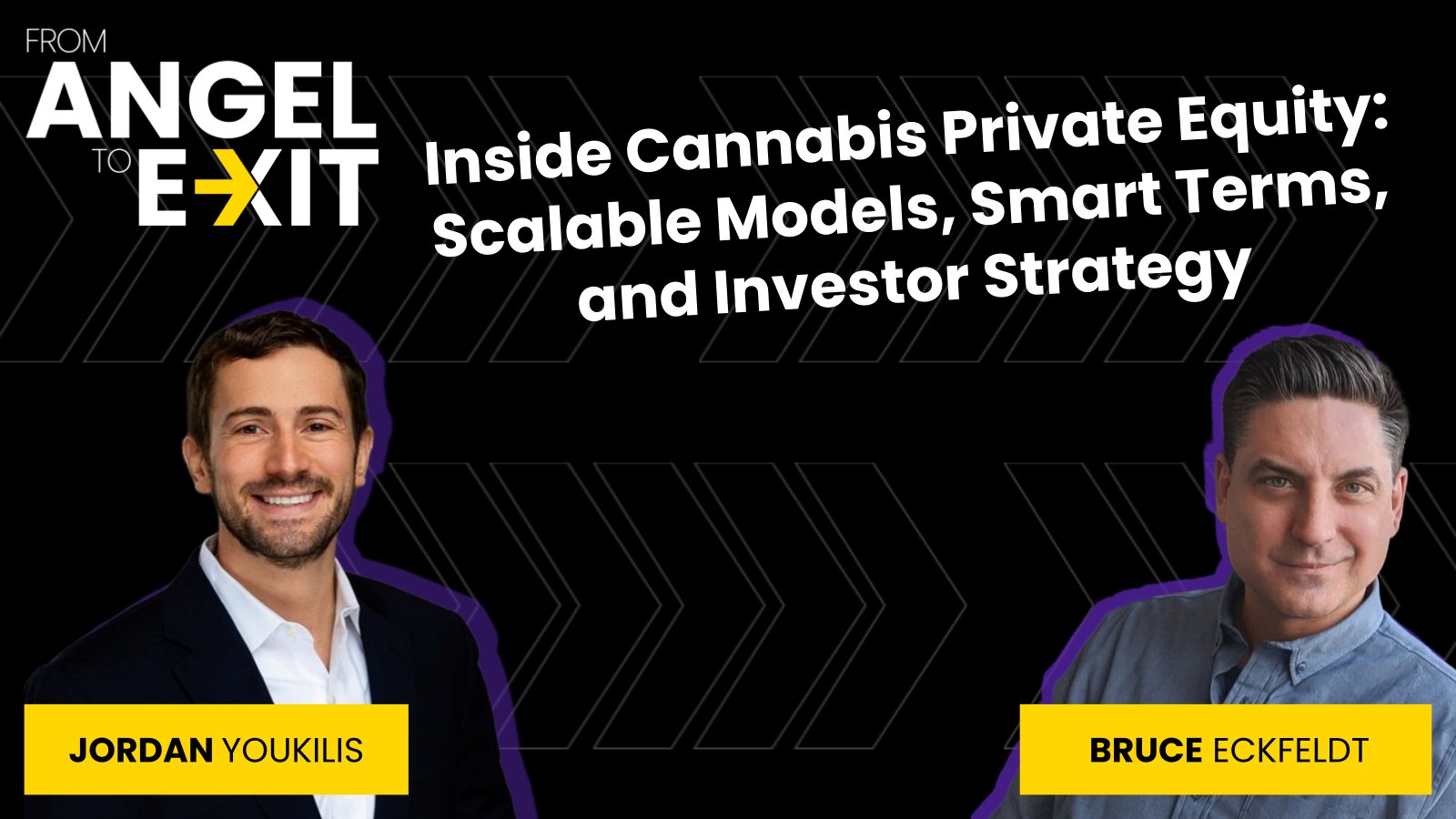
Inside Cannabis Private Equity: Scalable Models, Smart Terms, and Investor Strategy
Jordan YoukilisFounding Partner, Key Investment Partners
Listen to the Episode.
Play the full conversation right here, or pick a chapter to jump straight to that moment. Prefer your own app? Every episode is on Spotify, Apple Podcasts, and the rest.
About This Episode.
Start with the key takeaways, the ideas worth bringing back to your leadership team. Then read the full story of the conversation, or use the chapters above to jump straight to the moment that matters most to you.
- Profitable, cash-flow-positive cannabis businesses attract more investor interest than high-growth, unprofitable ones
- Capital scarcity in cannabis allows investors to negotiate better terms and lower valuations
- Section 280E taxes heavily penalize cannabis businesses, affecting valuation and deal viability
- Strong due diligence processes and institutional-grade practices enhance investor confidence
- Founders must plan capital raises 12, 18 months in advance, especially in tight funding markets
- Misjudging market cycles and over-raising can lead to damaging down rounds
- Understanding investor fund cycles helps founders better tailor pitches and timing
- Warm introductions and strategic networking greatly improve investment access
In this episode, Bruce Eckfeldt interviews Jordan Youkilis, founding partner of Key Investment Partners, to explore how cannabis investing offers unique challenges and opportunities for founders. Jordan shares his journey from traditional finance to cannabis private equity, highlighting lessons in capital deployment, deal structuring, and scaling businesses in tightly regulated environments.
Watch the Video.
Prefer to see the conversation? The full episode plays right here on the page, so you can watch while you follow the takeaways or read along with the transcript. Every episode of From Angel to Exit is also on my YouTube channel, along with short clips from each conversation.
About the Guest.
The background behind the conversation, and where to find this guest online.
Jordan Youkilis
Founding Partner, Key Investment Partners
Jordan Youkilis is a founding partner of Key Investment Partners. He moved from traditional finance into cannabis private equity and invests in businesses operating in tightly regulated markets.
- Website
- keyinvestmentpartners.com
Full Transcript.
The complete conversation, lightly edited for readability. Open it to read along, or search the page for a topic or a name.
Read the full transcript
Bruce EckfeldtWelcome, everyone. This is From Angel to Exit. I'm Bruce Eckfeldt, I'm your host. Our guest today is Jordan Youkilis. He is a founding partner at Key Investment Partners. We're going to talk about the world of investing, really the other side of the equation. I think this is an important one. A lot of founders and CEOs go through this process once, maybe two or three times if they're lucky. It's a really unique event for them. For investors on the other side, it's Tuesday. So it's really interesting to see it from the other side, from someone who has gone through this process a lot, and Jordan's got a lot of experience here. I'm excited for the insights, excited for the conversation, and to see what we learn. So with all that, Jordan, welcome to the program.
Jordan YoukilisThanks so much, Bruce. I really appreciate you having me on. I'm excited to talk about exits and investing today.
Bruce EckfeldtPerfect. Before we get into all that and everything that's going on today, we'd love to get a little background. Give us a sense of your personal and professional background. How did you get into this space? What was the story? Give us the journey you've been on.
Jordan YoukilisAbsolutely. I'm a Cincinnati guy originally. I started my career in traditional finance after getting my undergrad from Indiana University. I began at GE Capital in a financial management program and did a number of different rotations in that function, and then rolled off the program into GE Antares Capital, which was their leveraged finance group. From there, I moved from leveraged finance to the buy side, joining the private equity team of a firm called Partners Group. I started in their New York office, then moved to their San Francisco office, and then in about 2016 they opened a new North American headquarters here in Denver. That brought me to the city, along with the two gentlemen who eventually became my co-founders at Key Investment Partners.
So we moved to Denver, and we were still working in traditional private equity. But living in Colorado, which was the first state to legalize adult-use cannabis, we naturally saw the massive growth of the industry all around us. Then, in late 2017, I came across a Business Insider article about how there was very limited venture capital financing for the cannabis industry. That was driven by a variety of factors. Number one, the fact that it's still federally illegal. Number two, the fact that traditional banks wouldn't touch it. And number three, the fact that most institutional investors still considered it a vice and had certain restrictions on putting money to work in it.
So we found ourselves at a really fortuitous moment in time, living in the epicenter of this emerging industry, which had huge tailwinds of growth and demand for capital on one hand, and a very constrained supply of capital on the other. The more we researched it, the more it seemed to fit my partners' and my skill set. We ultimately decided to break off from Partners Group and form Key Investment Partners, and the rest is history.
Since then, we've raised over $50 million of assets under management, and we've deployed that across 17 different cannabis investments, across equity and credit. And we're rocking and rolling. It's been a great experience. Like you said, I've had the experience as an investor, and I've also had the experience as a founder, so I can talk about both sides of the coin.
Bruce EckfeldtThat's great. From an investor's point of view, as professional investors, when you chose to go into cannabis and saw it as this opportunistic industry, what really made it an opportunity for you? How do you go about developing a focus or a thesis around how you're going to approach a market from an investor's point of view? I think it would be helpful for folks to understand the mindset of an investor.
Jordan YoukilisSure. For us, before we started putting any money to work, we spent over a year getting to know the market: meeting with different investors, sourcing all kinds of different deal opportunities, and seeing what was working and what wasn't. I would definitely recommend that for anyone getting into a new market.
I'll also say that when we started, the 2018 to 2019 time frame was really a gangbusters period of growth for the cannabis industry. In 2018, Constellation Brands, the giant multinational alcohol company, put $5 billion to work in Canopy Growth up in Canada, because at that time Canada had just legalized adult use at the federal level. That really set the market on fire. That $5 billion investment was more than the entire cannabis industry had raised up to that point. Then later in 2018, the Farm Bill was passed here in the US, which legalized hemp nationwide.
So it was great times. The market was going gangbusters. A lot of the bigger US operators had figured out a loophole that let them go public on the Canadian Securities Exchange. Frankly, it seemed like it was going to be smooth sailing for the industry. And I think in a lot of ways it's more challenging to invest in an up market like that, because people can mask growth with overexuberance. Money's flowing easily, so it's a little harder to separate the wheat from the chaff.
The silver lining with cannabis is that since things started to cool off around 2019, it's very much been a down market for most of that time, and raising capital has been extremely challenging. But like I said, that's helped separate the stronger investments from the weaker ones.
To get to the point of your question, some of the things we really look for are cash flow positive businesses, and groups that are able to minimize their tax burden, because, and we can get into this further, cannabis has some very punitive, antiquated restrictions in the IRS code that make it very difficult to operate profitably. So running a successful business despite that is certainly a challenge. We look for business models that are very scalable. We look for management teams with a track record of success. And when you look for all those factors in our industry in particular, your investment pool is relatively small.
Bruce EckfeldtHow do you decide where to invest? I know some investors say, "We want to get in early and have a lot of upside," and others say, "We want to be in the third or fourth round," or, "We want to follow on. We don't want to lead." I'm assuming this is about your ability to assess and balance risk and reward. In general, how does a fund or investment group decide where to play in the stack, and how did you decide?
Jordan YoukilisThat's a great question. With our first fund, we had more of a venture growth strategy, where the core of the portfolio was growth investments: later stage for an emerging industry, but still early compared to our past lives in upper middle market private equity. There we were looking for the core businesses we invested in to have $50 million-plus of revenue and be cash flow positive, and then we'd sprinkle venture around that, with maybe 30% allocated to earlier-stage, higher-yield opportunities.
With our current fund, Fund II, the benefit of cannabis having crashed over the last several years, with capital so scarce in the industry, is that the valuations and terms we're seeing today are better than in any industry I've ever participated in, by far. So you can have your cake and eat it too on the buy side. We're now focused exclusively on cash flow positive businesses where we have strong liquidation preferences and get current income, either in the form of cash or accrued interest, and we're also able to get really low valuations, because again, there's just so little capital to finance this industry.
Bruce EckfeldtWas that a strategic decision you made as an investment group? "If we can figure out how to get capital into this market, we'll be at an advantage, because so few firms are actually providing capital to the cannabis industry"?
Jordan YoukilisAbsolutely. That was our thesis when we got in, in early or mid 2018. I'd say we thought federal legalization was going to happen sooner than it has. We thought capital was going to become more readily available, and we were wondering, "Are we even too late getting in?" In fact, the opposite has happened. You saw a big spike in the public stocks after the blue wave in early 2021, when folks thought things were going to move really quickly. But then the administration just took its foot off the gas, and the publics have really declined ever since.
You still have the tax issue I mentioned. Inflation has been rolling through and hitting people. And I think investors over the last several years have just been more risk averse in general and have preferred to avoid anything that's long dated. So we've actually seen the opposite: capital has really dried up. When we got into the space, I'd say we were probably one of two dozen dedicated cannabis private equity funds, and there were another dozen or so deploying that had a very significant allocation to cannabis. Now there are maybe five cannabis private equity funds. So the cost of capital has just gone up for operators in this space, unfortunately.
Bruce EckfeldtTell us about the other side of the equation. Where do you source your money? Who is typically interested in this, and why do they want to get involved with you? What's your value proposition on the investor side?
Jordan YoukilisThat's definitely the double-edged sword of the cannabis capital markets. As I mentioned, the buy side is fantastic, and the fundraising side is the opposite. The main reason is what we talked about: firms like my old firm, Partners Group, just won't invest in the space yet. There are too many regulatory issues, and that's the case for most institutional LPs. You are starting to see certain pension funds trickle in, so I think that's a trend that will continue to heat up. But as of today, the vast majority of capital deployed into the sector comes from family offices and high-net-worth individuals, and that's certainly the case for our LP base.
So we've had to get really creative. We've had to hit the ground running, turn over every stone we can, and milk our networks, both professionally and personally. I think the strongest LP source is your existing investors, because people like to invest in groups, and they want to know that if you're recommending someone deploy their capital, you're putting your money where your mouth is. But I can't overemphasize the challenges that cannabis operators and funds face in raising capital today. It certainly is not easy.
Bruce EckfeldtWhen you're looking at deals, other than the fundamentals and the management team, what are some of the things that really drive valuation and deal terms when you're getting into a particular opportunity and working with a founder and leadership team, either investing capital or, in a private equity case, taking a majority stake? What actually happens on the ground when you're looking at a deal?
Jordan YoukilisMaybe I can talk a little about the types of investments we're targeting for our current fund. We think about the industry as plant-touching versus ancillary, and our fund is targeting about 50% allocated to each of those pools. On the plant-touching side, that's anything that requires a cannabis license to operate: dispensaries, grows, vertically integrated operators, brands, and distributors.
On the ancillary side, we're targeting companies that support the cannabis ecosystem but don't require a license to operate, so they don't face the same tax restrictions we were talking about. There we're predominantly focusing on software, business services, and specialty finance. So the fund we're deploying will be about a 50-50 split between those two buckets.
On the plant-touching side, I'd say we're generally skeptical of cultivation-only opportunities. As more states legalize, it becomes much more of a commoditized product. You also see that the longer states have been open, the more licenses they tend to issue, so the price per pound certainly comes down. So we're really looking for vertically integrated operators that have cultivation as well as dispensaries, or that have been successful with a retail-forward strategy in more competitive markets like Colorado, California, and Oregon, places that are at a more mature steady state.
For vertically integrated opportunities, we really like looking at states that are earlier on the adoption curve. By that, I mean you typically see a state go from fully illegal, to legalizing medical, to ultimately legalizing adult use. If a state is both limited-license and medical-only today, it's probably going to be a really strong market both now and when adult use gets legalized. When adult-use sales start to really flow through the numbers, that's when valuations are at a max. So with those earlier-state opportunities, we like to exit once adult-use sales come through, and that's when we can capitalize on the IRR opportunity.
From that perspective, we're looking at opportunities in states like Pennsylvania, Hawaii, North Dakota, and Florida, which are right at that inflection point of legalization. Ohio as well. They just turned on adult use, and that market is growing gangbusters right now.
And then branded products. As I mentioned, that's where we think the industry is going to be long term. With Fund I, we came in expecting that to be a core part of our thesis, and ultimately we didn't make any brand-specific investments in Fund I. We realized the industry was a little too nascent, and frankly, at that point it was more about just getting product on the shelf. Now you're really starting to see, as the industry matures and a lot of the weaker operators haven't been able to sustain themselves, that brand is becoming more and more important. So that continues to be an area of focus for us, for sure.
Bruce EckfeldtCan you walk us through the mechanics of doing a deal? What are the phases? What does it look like from your side, and what does it look like for the company in terms of gathering information, level of commitment, due diligence, the actual transaction? Give us the model you use to organize that process.
Jordan YoukilisSure. It's definitely case by case, investor by investor. For us, I'd say we have one of the more rigorous, and you could say challenging, diligence processes for our portfolio companies to get through. But I think they appreciate the work we do, and they recognize we're not asking for unnecessary, extraneous stuff. It's really the stuff that matters in making an investment.
We talked about the fact that today our investors are high-net-worth folks and family offices. But we want to set ourselves up for long-term success, recognizing that institutional investors will come to the space eventually. So we've really tried to replicate the same investment committee processes we learned at Partners Group and our prior firms. I think that's something that has really separated us, both from an LP sourcing perspective and from a track record perspective: that diligence process.
We have a four-stage due diligence process, and we meet after each phase as an investment committee to really tease out the assumptions, have the full team poke holes and ask questions, and maybe help the deal lead think through scenarios they hadn't already considered.
We call the first phase our teaser phase. That's typically a seven- to 10-page document focused more thematically. Do we like the subsector? Do we like the geography they're in? Let's look at the financial profile. Let's look at the management team and their backgrounds. Then we have a go/no-go decision from there. I'd say probably 90% to 95% of the deals we see never make it past phase one of investment committee, or never even make it to phase one.
Bruce EckfeldtI'm curious, is this a gut call? Or do you have a scoring algorithm with points, where you have to get at least 82 points to keep it alive? How formal is it, and what do the mechanics look like for you?
Jordan YoukilisIt is formal, but it's not a graded rubric to that point. The investment committee is me and my two partners, Pete Karabas and Tiby Erdely. "KEY" is an acronym of our last names. We each have an investment committee vote. A vote of three is pass, a vote of two is neutral, and a vote of one is decline. If any of us votes one on a given deal, it doesn't make it through. And you need at least two of the three to vote three. You can have one two and still pass to the next phase.
Bruce EckfeldtGot it. So you can have one abstention as long as you get two yeses. I'm curious what typically drives the score, for you, or what you've seen your partners score on. Is it holistic? Or are you looking for a blocker, where generally you assume yes unless you find a blocker? Or does it have to meet certain thresholds? I'm fascinated by what actually drives these decisions on the investor side.
Jordan YoukilisIt's definitely holistic. But if there's a specific red flag on a deal, that can be enough to decline it. Usually it's: does the financial profile fit what we're looking for, is the management team solid, and is it a subsector or geography where we already have conviction? That's the benefit of having been in cannabis for the last six years and being one of the few to survive throughout that time. We know the market like the back of our hand, so we have a much shorter learning curve to come up to speed on any given opportunity.
So it's really about analyzing those metrics I talked about and looking for large red flags. If there aren't any, are there enough yellow flags that we say, "Hey, it's not worth our time"? But assuming neither of those is the case, and it hits the other metrics we're looking for, then we'll approve it, and that's when we get into phases two and three, where we do the vast majority of our heavy commercial due diligence and really pull the opportunity apart.
Bruce EckfeldtTalk about phases two and three. What's the difference between them? What do you do first, and what do you leave for phase three?
Jordan YoukilisPhases two and three can be a little fluid. Typically, phase two is when we really start to get to know the management team. We start to pick apart their model, ask a bunch of questions, do a lot of competitive analysis, and set up reference calls, both with their customers and with folks in our network who have expertise in whatever it is they're doing.
If it gets past phase two, that's when we really build out our model. We typically run four different scenarios to stress test it: a home run case, a base case, a downside case, and a low case. That's also typically when we refine the terms, if we're leading the transaction, and really start to put pen to paper on that front. And that's when we go visit the management team in person, check out their facilities, and do the boots-on-the-ground diligence.
Assuming it passes both phase two and phase three, we get into phase four, which is really where we cross the T's and dot the I's: completing our legal and tax due diligence and doing background checks on the management team. Assuming it gets past all that, that's when we deploy the capital.
Bruce EckfeldtAre the deals you're doing mostly majority stakes? What control structure are you typically operating within?
Jordan YoukilisToday we're typically doing significant minority investments. We're looking to get board seats or board observer seats in about two-thirds of the investments we make out of our current fund. We are starting to look at more control buyout transactions, given the limited access to capital, but there aren't a ton of successful operators looking to sell their businesses today. There's not a huge opportunity set on that front. But that's certainly the direction we're moving: from venture growth in Fund I, to more growth in Fund II, and ultimately to a traditional private equity LBO model.
The other thing I'd mention, which I touched on earlier, is that given what the cost of debt is today, you're typically looking at a 15%-plus all-in yield. So the benefit of doing an LBO today, given the added risk of putting leverage on it, isn't as strong as it is in traditional sectors.
Bruce EckfeldtInteresting. Looking at the companies you've gone through this process with, what are the things internal to the company that the founder or leadership team just didn't do right, or could have avoided, that killed a deal, changed the terms of a deal, or made it more complex? I get that there are always going to be market externalities and federal regulation things. But what missteps or obstacles have you seen where, if leaders had just done something a little better, either at the beginning or leading up to the discussion, they could have avoided them? What patterns or scenarios do you see?
Jordan YoukilisI think the biggest mistake, and this is especially true for cannabis, where capital is so tight, but I think it extends to all venture capital over the last several years, because capital markets have tightened up broadly, is this. A lot of folks, when they raise money in a good environment, operate under the mistaken belief that it's always going to be that easy to raise. So they grow too quickly. They focus on growth at all costs instead of on getting to profitability.
Then things start to tighten up, or they miss their projections, as almost all startups do, and they go back out to market and realize, "Crap, it's not going to be as easy this go-round. We missed our projections. There are fewer investors out there, and maybe we even need to accept a down round." Getting over that cognitive dissonance can be tough for a lot of founders, recognizing, "Hey, we need to pull back now. We overbuilt. The market's just not there. We've got to cut costs." I think that's where we've certainly seen some founders get caught with their pants down in the cannabis sector.
Bruce EckfeldtAnything around financial protocols, or just good business operations, that you've seen gum up deals?
Jordan YoukilisWhat gums up deals, I'd say, mostly comes down to mismatched expectations on valuation. Especially if it's a founder who has come from a non-cannabis sector and is used to tech-type, Silicon Valley VC valuations, where you're getting 15 times forward revenue. That's just not going to happen, especially in our sector.
Operationally, I think where we've seen folks struggle is on working capital management, for sure. In cannabis, as the market has tightened, a lot of the smaller operators simply stopped paying their accounts payable, and that really screwed over a lot of folks.
And I mentioned the tax issue that cannabis faces earlier. It's called Section 280E. It's this crazy, antiquated piece of the IRS tax code that dates from a 1970s court case, where a guy who was literally trafficking heavy narcotics was deducting his travel expenses from his taxable income. He actually won the case against the IRS and didn't have to pay. So the IRS then put in this 280E provision, which says that if you're moving Schedule I or Schedule II substances, you can't deduct anything below your cost of goods sold.
Fast forward to today, and because cannabis is still Schedule I, crazy enough, it's just destroyed all these legal state operators, because they're effectively getting taxed on gross profit. So I'd say that's another operational mistake we've seen folks run into: they just weren't managing that 280E tax liability, or they had big tax payments outstanding, where we just said, "Guys, this is too big of a liability. We've got to walk away."
Bruce EckfeldtToo much hair on that deal. For founders, how do they learn about this? I think it's always a challenge for founders to find opportunities and understand which investment partners they should really be talking to. Everyone's got their thesis. Everyone wants a different part of the market, certain types of deals and not others. How would you recommend a founder strategize: figure out what they want and who might be able to give it to them? How do they find these people? What does the outreach look like? Give some advice to these folks.
Jordan YoukilisIt's a great question. There are a couple of paths I'd recommend. I think doing your research and reading from successful venture capital investors and groups is really helpful for understanding their side of the coin. Venture Deals, for example, is one of the best books I've read in the space. It really outlines how to think about the most important terms that go into getting any venture capital deal transacted. Books written by the big Silicon Valley guys, like Peter Thiel's Zero to One, are great. I listened to a lot of Tim Ferriss's stuff when I was starting out.
What he does a really good job of is helping people parse out, "Is this the type of company where I should be seeking venture capital? Is it going to be the next Uber, or is it really more of a lifestyle business?" And if it's a lifestyle business, that's great. But if you're starting a business whose total addressable market is geared more toward a lifestyle business, and you try to go out and raise venture capital money, you're naturally going to have a mismatch.
So if you have a niche segment where you can earn a great salary for you and your family and run a small business, just think about the terms differently, and think about the types of investors you go after. That's maybe more of a friends-and-family type of investment. Maybe you structure the deal more like you would a restaurant, where people get some type of preferred return, things like that. So that's more on the intellectual side of things.
On the more pragmatic side, I'd say go to trade shows. Depending on what type of industry you're going into, just go meet with people. You don't know what you don't know. So go listen to what everyone who's smart on that sector, and who's been in it for years, is saying about it.
And I'd also say, don't commit to your strategy too early. In cannabis, for example, I think a lot of investors in particular started deploying into the first deal they saw that they thought was going to be the next sliced bread, and they just didn't understand the industry well enough to know it was never going to be a successful opportunity. So be patient, really figure it out, think through the logistics, and manage your burn, especially in those early days. If you don't have much burn before you actually decide, "All right, this is the MVP we're going with, let's go all in," then you can set yourself up for success.
Bruce EckfeldtIn your own experience as a founder, and as you've worked with these companies, is there anything you'd suggest in terms of time frame? If you want to do some kind of deal at time X, how far in advance should you do what? If you were to give them a roadmap, "This many months out, start focusing on these things, then do this, then do this," how would you map that out for folks?
Jordan YoukilisCash is king. Manage your cash flow. Know what your burn looks like. Sensitize your burn: what if you lose X percent of your revenue, or you lose your top customer, or whatever it may be? And always start the fundraising process before you need to. In good markets, they typically recommend starting at least 12 months out. I'd say today it's got to be at least 18 months out, because it's so difficult to raise venture today. Folks like us don't necessarily move quickly. We can if we need to, but we prefer not to have to.
Bruce EckfeldtYou move on your terms, not the company's terms.
Jordan YoukilisExactly. Especially in a tight market like this, where we have our pick of which companies we want to invest in. We don't need to deploy. We can be patient. So if you need the capital or else you're going to run out of cash, get on it. Start planning well in advance.
Bruce EckfeldtI always say you want to raise capital when you don't absolutely need it. If you absolutely need the capital, that's a tough position.
Jordan YoukilisExactly. That's a great point. Venture capital folks are savvy investors. They're going to look at your burn too. The closer you are to running out of cash, the more they'll recognize that they have all the leverage. So your terms and valuation are going to be that much tougher if you're about to hit a wall in two months.
Bruce EckfeldtI'm curious what your recommendation would be for founders on this. On one hand, I think it's great: when you have the opportunity, raise capital. It gives you runway and resources. On the other hand, there's this: "I have to raise at my current valuation. If I over-raise at that valuation... I could have raised less, gotten bigger, hopefully gotten to a better valuation, and then raised the rest of it on better terms." How would you suggest companies balance getting capital in the bank and getting resources against not over-raising at a lower valuation?
Jordan YoukilisThat's definitely something we see a lot. Generally, especially in a tight market like today, I'd say just get the capital in the door. A bird in the hand is worth two in the bush.
On the flip side, we've also seen folks make the mistake of getting a term sheet at a valuation that makes no sense, way too high, frankly. They think, "This is great. I don't have to give them much of my company. Free money, easy money." And then, again, projections don't pan out, they need to raise again, and people say, "What the heck is this valuation? You're not just in need of a down round. You're not worth a tenth of what you raised at last round."
As a founder, are you really going to say no to a big, huge valuation and limited dilution? Probably not. But I'd just say, look, that's a very real issue folks have run into. We've seen it, and it can hurt you just as much. Whereas, to your point, if you had raised a little less, managed the capital better, and made sure you got to cash flow positive, then you'd have all the leverage.
Bruce EckfeldtI don't want to give away too many of your secrets, but in terms of things founders can understand about the pressures on the investment side: like understanding where you are in the fund. You said you have a 50-50 split. If you're low on one side, there's a bit more pressure on your side to make a deal there, so maybe I fit that and have a little advantage. What can founders and teams do to understand the investment dynamics in a way that might help them find the right investment partner, negotiate the right deal, or understand timing and things like that? Give us some insights.
Jordan YoukilisThat's a great question. Some venture capital funds like to play their cards really close to the vest, but a lot of them, like us, publish a whole bunch of blog posts and white papers and do interviews like this. We have our own podcast. So if you can get smart on the investor you're about to pitch and really understand what they're looking for, that's going to really help set you up for success.
I'd also say that getting a warm introduction from someone they already know is very helpful. As you can imagine, we see a whole bunch of cold outreach and blind emails in the inbox. We'll still take a look if it's interesting, but generally we put a lot more emphasis on evaluating an opportunity if it comes from someone we already know and respect in the industry, who says, "These are real guys. You should take a look here."
Bruce EckfeldtWould that be finding other companies I know that have raised money from these folks? Is it leveraging my network? What would you recommend?
Jordan YoukilisI think that's a great way. Also other investors we know. I always like to offer this: if a deal we connect with just isn't the right fit for us, because maybe it's too early, or our fund is at a different place in its life cycle, closing in on the end of our investment period, so we're looking for a shorter-duration investment, something like that, I still like to say, "Here are other folks you should connect with, whom I know," because we know all the other investors deploying into cannabis. So getting mentors among other institutional investors goes a long way as well. And check out folks' LinkedIn profiles. That's a great resource, for sure.
Bruce EckfeldtAny other suggestions for early-stage companies, structurally or strategically, to put them in a better position to take investment and do transactions?
Jordan YoukilisOn the capital raising front, I think raising from friends and family initially is the smart way to go. You're going to have the easiest access to capital, and those folks are usually more lenient on the terms they offer. And then, and I know I keep emphasizing this, in a tight capital markets environment like this, really show that you have a business with product-market fit that you can operate profitably. That's going to go a long way. If you're cash flow positive today... I'd rather look at a company doing $5 million of revenue with a million of positive cash flow than one doing $50 million of revenue but burning $10 million of cash.
Bruce EckfeldtExactly. You want to scale success, not problems. Jordan, this has been perfect. Thank you so much for taking the time today. If people want to find out more about you and about Key Investment Partners, what's the best way to get that information?
Jordan YoukilisAbsolutely. keyinvestmentpartners.com is our website. We've got a whole bunch of great resources on there. I'm very active on LinkedIn, Jordan Youkilis, as are the rest of the firm, my partners and our colleagues. So check us out on any of those. And Cannabis Unlocked is the name of our podcast.
Bruce EckfeldtPerfect. I'll make sure all of those are in the show notes so people can get them. Jordan, thank you so much for taking the time today.
Jordan YoukilisThanks, Bruce. This has been a blast.
Never Miss an Episode.
Know the moment a new episode goes live. Subscribers also get a say in future guests and the topics we cover.
Other Related Episodes.
More conversations that connect to this one. Or browse the full archive by topic or by guest.

David Turner
What a buyer behind 47 acquisitions looks for, and what really drives a successful exit.
Listen and Read
Todd Taskey
How to structure cash, equity, and earnouts, and get a second bite with private equity.
Listen and Read
Lee Minkoff
How private equity looks at founder-led service businesses that seem too small to sell.
Listen and Read