From Angel to Exit Episode 16
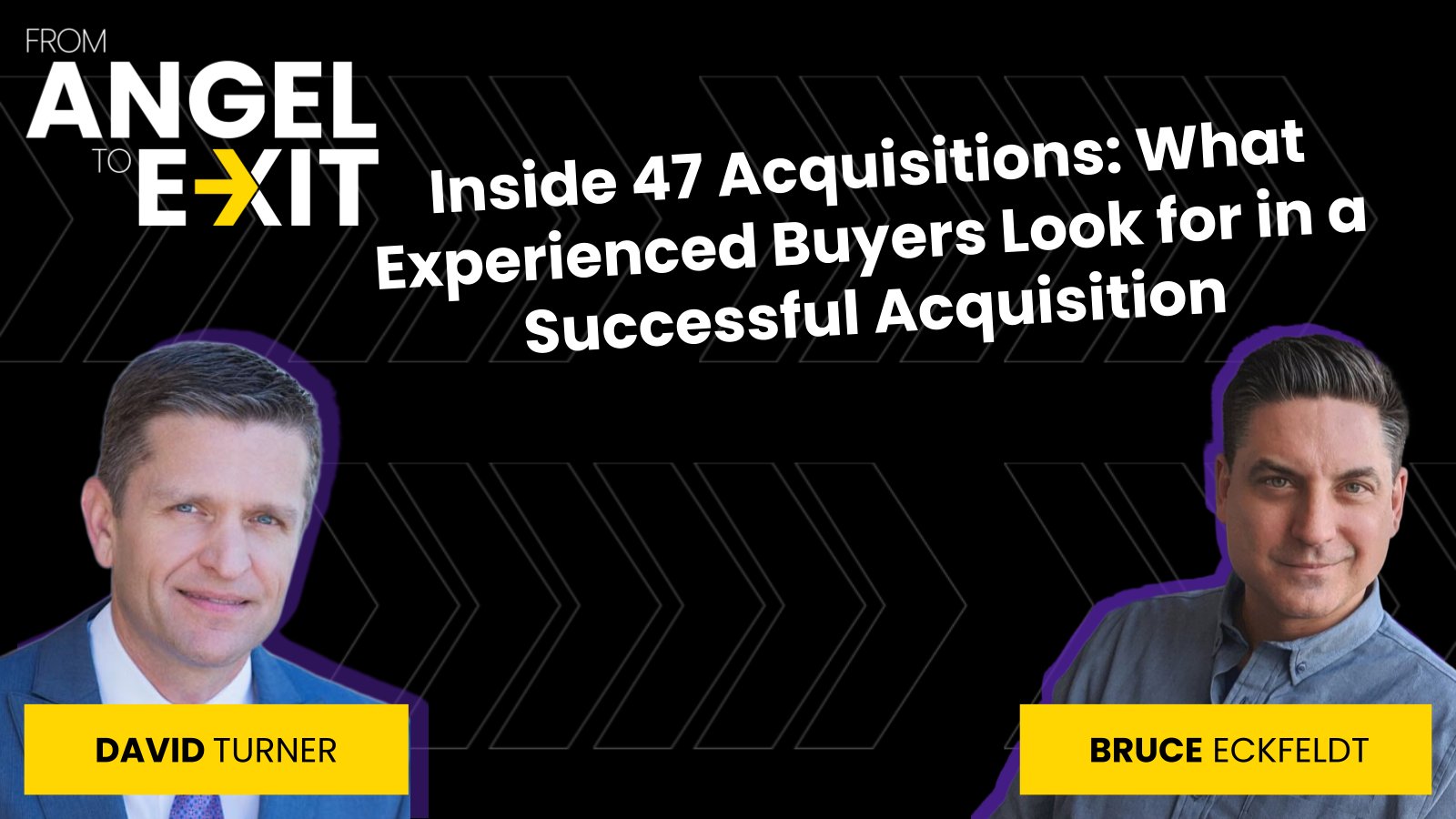
Inside 47 Acquisitions: What Experienced Buyers Look for in a Successful Acquisition
David TurnerCEO, Velocity Now
Listen to the Episode.
Play the full conversation right here, or pick a chapter to jump straight to that moment. Prefer your own app? Every episode is on Spotify, Apple Podcasts, and the rest.
About This Episode.
Start with the key takeaways, the ideas worth bringing back to your leadership team. Then read the full story of the conversation, or use the chapters above to jump straight to the moment that matters most to you.
- Acquirers often buy because they’re struggling with organic growth.
- Private equity buyers face increasing pressure from extended fund cycles.
- Founders must dilute their own delusion about earn-outs and post-sale roles.
- Most successful acquisitions start with strong personal rapport at the leadership level.
- Presenting all risks upfront builds credibility and avoids downstream surprises.
- Tell your company story consistently, long before you plan to sell.
- Time kills deals; speed and decisiveness are critical on both sides.
- Due diligence always finds skeletons; buyers care more about how you handle them.
David Turner, CEO of Velocity Now and former CRO at IHS, joins the show to unpack what truly drives successful business exits. With firsthand experience leading 47 acquisitions and scaling IHS from $320M to $1.8B, David offers rare insight into the buyer’s mindset. Founders will gain actionable strategies to prepare for sale, avoid common missteps, and understand how to position their company for maximum value.
Watch the Video.
Prefer to see the conversation? The full episode plays right here on the page, so you can watch while you follow the takeaways or read along with the transcript. Every episode of From Angel to Exit is also on my YouTube channel, along with short clips from each conversation.
About the Guest.
The background behind the conversation, and where to find this guest online.
David Turner
CEO, Velocity Now
David Turner is CEO of Velocity Now and the former CRO of IHS, where he led 47 acquisitions and helped scale the company from $320M to $1.8B. He brings a buyer's view to what makes an exit succeed.
- Website
- velocitynowllc.com
Full Transcript.
The complete conversation, lightly edited for readability. Open it to read along, or search the page for a topic or a name.
Read the full transcript
Bruce EckfeldtWelcome, everyone, to From Angel to Exit. I'm Bruce Eckfeldt, I'm your host. Our guest today, David Turner, is CEO of Velocity Now. We're going to talk about his experience in the exit world, having worked with many, many companies and founders through the exit process. He has a really interesting background working with companies on value and culture, and how that drives growth and performance. I'm excited for this conversation and excited to hear his insights. So with all that, David, welcome to the program.
David TurnerThank you, Bruce. Thanks for having me.
Bruce EckfeldtIt's a pleasure. Before we dive into all things exits and valuation, we'd love to get a little personal and professional background. How did you start in this world? What were the experiences you had? Give us the story.
David TurnerGreat. I won't bore you with the nitty-gritty details from second grade, but I started in the software space many moons ago. I really got started in the experience I use today when we sold a company in 2003 to a then privately held company called IHS. It was an incredibly acquisitive company. From 2003 to 2012, we did 47 acquisitions, and we went public in 2006. So it was hyperscale growth, organic of course, but also inorganic through the volume of acquisitions. We went from $320 million during that time to $1.8 billion. It continued after I left in 2012, with more acquisitions. I think they ended up doing about 180 before they sold to S&P Global a couple of years ago for $44 billion. So just massive shareholder value.
Bruce EckfeldtThose are amazing numbers.
David TurnerIt's one of the unknown, quote-unquote, unicorns of the last couple of decades. It was international, we did business all over the world, which was incredibly fun and educational, and I had a great time doing it. And of course, through the acquisitions, you got to see a huge volume of $10, $15, $20 million companies and their journey from startup until they exited. I did due diligence on 120 or 130 companies during that time and executed on 47 of those.
After IHS in 2012, I became the CRO at another publicly traded company, DigitalGlobe, a satellite company that at the time, and still today, is the largest owner and operator of high-resolution Earth observation satellites, the highest resolution in the commercial space. They were the first company to launch a commercial satellite that took incredibly high-resolution pictures of the Earth's surface and did a digital inventory of it, with billions and billions of pixels and square miles of how the Earth's landscape changes. We did that for companies like Google and Apple that were developing maps around the world. We also did it for defense purposes, to help our allies spy on their neighbors. During that time, we did a handful of acquisitions there as well and doubled the revenue of that company.
Then I left to get back into a CEO role, which I'd had before IHS, and did a roll-up in the private equity space. We acquired five companies and put them together, and I exited that in 2019. Then I formally started my executive coaching practice, which I'd been doing informally for a handful of years before that.
So, to fast-forward to today, I've got almost 11,000 hours of C-level coaching. My model is to coach CEOs and his or her direct reports. That's most of my clients, and it's a mix of private equity-backed and publicly traded companies ranging from $5 million in revenue to $14 billion in revenue. So it really runs the gamut: small, midsize, and some large publicly traded companies.
Bruce EckfeldtThat's a range. There are a lot of things we can dive into here. I think some grounding discussion would be helpful for folks. How do you segment the world of M&A in terms of size of company or type of acquisition? What are some variables you use to take this very large world and bucket it?
David TurnerIt's very time dependent, isn't it? M&A in 2024 is not M&A in 2019, and not even M&A in 2015. I feel like every year that whole world changes. And it's actually becoming more and more narrow, with capital markets and a lot of gun-shy private equity investors.
I think it's a little bit under the radar, not rumor mill, but based on a lot of fact, that private equity companies are struggling more than they're willing to say with turning returns on their investment within the normal four- to five-year hold cycle. A lot of private equity companies are getting to six, seven, eight years, a little long for the fund, because it's more and more challenging to grow. Competition and buying cycles have changed.
Bruce EckfeldtGenerally they want roughly a five-year return. They take investors' money with some kind of commitment: you're going to get this back with your returns in five years. So they're stretching this out. Is that because there's more competition for companies? Fewer companies to actually acquire? What makes it challenging?
David TurnerWell, one thing for sure: private equity is now buying from private equity. So they've kind of doubled the risk and the tolerance for trying to get the return. It's a more crowded landscape. Fewer companies are growing at the rates private equity wants. There are a lot of nail-biters and a lot of competition, and selling in 2024 is way harder than it was three, four, five, six years ago. Companies buy differently, so companies have to sell differently, and they're not adapting quickly enough. So you're seeing slower growth rates on average. There's a lot of dry powder sitting on the sidelines, but I'm just not seeing the volume I would expect. I think that's what you hear as well.
Bruce EckfeldtI'm curious, when you first started in business, was this something you wanted to do? Did you know you were going to be in corporate development and on the M&A side? How did this come to you? What was the story there?
David TurnerIt's a good question, because I was a lost kid in college. I didn't have any career plans except to be really good at the social aspect of college. I'm not saying I was dumb, but I definitely wasn't very studious, and I was not going to go to the Deloittes or the Arthur Andersens. And I wasn't going to get my MBA, because I wanted to get out and make money. I started on the sales side.
I think the real turning point in my career was at IHS. I'd been running a small business unit for a few years, and then we went public. So we had this new currency. Instead of doing two or three acquisitions a year, we were going to start doing two or three a quarter. It was really ramping up.
The CEO came to me and said, "You're running a good business unit. You're doing well. You're kind of the jack of all trades. You've got sales, operations, partnerships, the international angle. But you really need some help. You're not quite there." Of course, I was young in my career, and I said, "You're right, I do." So he hired an executive coach for me. For the next nine years, four hours a month, like clockwork, I got executive coaching from a very successful ex-GE executive who had been president and CEO of a bunch of GE businesses. I just got so lucky. I absorbed everything, and that's when I started to expand, getting ready for my next big CEO role.
And then the acquisitions were coming. I happened to be there at that time, and I was tasked with going out and finding those companies, doing the due diligence, closing them, and integrating them into our business. So I probably lucked into it more than anything, to be honest. Then you gravitate to what you know and your strengths. Now I do a lot of M&A advisory work through my coaching, but my passion is still the core of helping executives grow, be self-aware, do self-discovery, and dilute the delusion, which is probably the number one thing, and I'm sure we'll talk a little about it today.
Bruce EckfeldtThis is a fabulous opportunity, because I think most of the folks listening are on the other side. They have companies, and they're looking to exit someday, maybe in the near future, maybe the distant future. It would be really interesting to give them an understanding of what happens on the other side of the table. When a company is out looking for acquisitions, my first question is why? Why do companies go out and look to acquire companies? What's the strategic value, and what are they hoping to achieve?
David TurnerFirst, and this is maybe another tidbit people aren't willing to admit, most companies go out to acquire, whether you're a strategic or a platform within a private equity firm, because they're struggling with organic growth. Let's just be honest. So they're looking to supplement with inorganic growth. The hope and the vision is that if we can get more of this inorganic growth in, then we can either arbitrage or figure out how to lay in our shared services efficiencies.
I think the number one reason is that people are looking for a different lever. If you're public, of course you can buy shares back. That's an option. Public or private, you can reinvest cash, capital, or debt into product. But the sexier thing to do is M&A, and I think people get roped into thinking that's the cool thing to do. It's the thing you want to talk about: you've done all this M&A work, which is way more exciting than saying you did some share buybacks. That's just not very fun. So I think what drives a lot of it is the search for accelerated organic growth, or inorganic growth that you try to turn into organic within a few years.
Bruce EckfeldtI'm curious what kind of results companies are looking for. In some cases it's purely financial: "We have to deploy some capital. We can boost our balance sheet. We can look at revenue." In other cases it's more strategic: "We've got a gap in capabilities or technology or geography or segments or industries." How do you organize the types of M&A from the buy side? And how does it change when you're going out for pure financials versus augmenting or filling in gaps?
David TurnerIf you're private equity, that's what you do for a living, and you've got a platform company and you're rolling up companies under it, then you know there's potentially a volume game with the roll-up. That's one angle. Don't just go out and do little acquisitions here and there over a four- or five-year period, because that really doesn't work. It's too hard. It's way more of a lift than people think. You don't get the synergies you think you will. A $5 million acquisition is the same lift as a $50 million acquisition, though the capital is easier on a smaller deal, a tuck-in.
I think companies really struggle with understanding the difference with a volume roll-up, like what I've done in the past. To be honest, you get on the treadmill, and if you do the volume, you can start to hide some of the shortfalls in some of the acquisitions. I don't mean in an unethical way, or against GAAP principles or anything.
Bruce EckfeldtYou just smooth it out.
David TurnerYes, you just smooth it out. So either you're really trying to find that one strategic adjacency you're missing, to get more wallet share or market share in, like you said, a geography or a customer base, or you're playing the arbitrage game against the cost synergies and trying to do the volume.
Believe it or not, I actually think it's easier to do the volume, but you have to know what you're doing. The problem with most of these companies on the buy side is they think they know what they're doing because they've done one or two, or they have private equity guys behind them who have done a bunch. But when they get into it, including us at IHS, it's hard. We were doing three a quarter, and let me tell you, it was not easy, and we were doing huge volumes. What I always tell people is that in the first 20 I did, I learned an enormous amount about what not to do. In the next 30, I started to develop a playbook of what to do. But it took 20 to get there.
Bruce EckfeldtFew companies actually get that kind of volume of M&A.
David TurnerFew companies and few executives. You look at a startup that's trying to get acquired, or has some capital to do little tuck-ins. They just don't have the experience. This is where experience does pay off, because the number of lessons learned on the negative side is way more than on the positive side until you get to volume.
Bruce EckfeldtHow does this work internally for the buying company? Is there a strategic planning session where they say, "This is what we're going after. In these segments, we want to do X number of transactions at this dollar volume"? Do they give you a war chest? I'm fascinated by how a company approaches this mechanically from a business point of view.
David TurnerOkay, another truth about what really happens. Maybe this is a story about the myths out there, and I can say the myths are not true because I see it and live it every day. You start out with the criteria: "We want to buy X dollars of EBITDA, in these segments or sectors, with this type of business model, SaaS or recurring or whatever." Then you go out and spend a year, and trust me, I've seen countless companies do this. They try to find a company that fits the criteria, which may be a range. Then they realize the companies aren't actionable, or they get to the finish line and there's a skeleton in the closet, and they say, "That's not right." Then they go two years and they've had a big whiff. They just haven't been able to close. Then they go back and say, "Okay, we just need to go out, see what's actionable, and make it work."
We did that even at IHS. We had strict criteria, and we stayed pretty good at it. The thing is, once you get a reputation and you've got the stock price, and we went from $16 to $142, people are coming in at an $80 stock price, and they see it came from 16, and they say, "Okay, I'll ride that wave." They're willing to take a little less, and they become actionable. But I do think it's a needle in a haystack for a lot of companies. Even if you have all the dry powder and all the green in the world, when you go out and start knocking on doors, the pool is not as big as people think until you start moving into adjacencies that are probably one or two removed from where you thought you were going to be.
Bruce EckfeldtHow does that work? How do you actually find companies? Are you picking up the phone and dialing numbers? Is it partnerships? Once you have this investment thesis or plan, what does the process of engaging the market, uncovering opportunities, and starting the conversations look like?
David TurnerI think that's a good story for the listeners today. You cannot say, "On January 1st of 2025, I'm going to go out to market," and think you're going to find the perfect match. You use the investment bankers, don't get me wrong. That's the shortcut. It's an expensive route, and sometimes you have to have it. But you have to develop relationships over a period of years, really. Start knocking on the doors of strategics, and of the private equity firms that are in that space or industry, and develop those relationships way before you actually want to go to market.
The sourcing is hard. When you're in an industry, it's easier. I've got a client in the insurance industry, and they know the space incredibly well. They've already knocked on those doors and have those relationships, so there are a lot of warm leads out there. Otherwise, you go the shortcut route: pay the money and have the investment bankers bang the phones for sourcing.
Bruce EckfeldtIs that what they do? I'm always curious. It's a rough business.
David TurnerIt's a rough business, and there are a bunch of green beans dialing for dollars. Dialing for acquisitions. If you take the small to midsize range, I don't know how many companies in the US are between $1 and $100 million, but there are a lot. So it ends up being the new guys at either the investment bank or the private equity firm, early in their careers, banging the phones until they can get somebody.
Granted, I think that's a bit of a long shot. You really have to start to target, and as a buyer or a platform company, talk to customers to see who else they're using that might be that adjacency you may or may not know about. Then go try to find a warm lead versus just cold calls.
Bruce EckfeldtOn the sell side, the ideal scenario is that you present yourself, create a bit of a market, filter that market down to a set of interested buyers, do LOIs, and get it done. You want some type of competitive bidding, or at least multiple interested parties. What is it like on the other side? From the buy side, what does this process look like? How do you align things, or what's the best scenario for getting the best deal or finding the right opportunity?
David TurnerOn the buy side, I think answering blind requests for LOIs is a bit of a long shot. The way the process works, you get a CIM, the deck. You read through it, and then you throw out a number. It's a blind number. You don't know what your competitors are bidding. I've been on boards, and you get anywhere between, I think the last one I did was between 275 and 450 or something.
Then what do you do? You go to the 400 to 450 bidders and say, "Okay, you made it to the next round of the process." But the buyer still doesn't know that much about the company. So on the sell side, we got away from doing auctions or bids, and we took a targeted approach.
What we did on the buy side was say, "Okay, we want to get into the chemical information business." We did the research, either paid or in-house, to find the top three companies in the chemical information space. We had a phenomenal story, and we would call the CEO and say, "Here's the story for joining IHS." And it worked very well. But that was an advantage, because we were the 800-pound gorilla in the information space.
Bruce EckfeldtInteresting. When you're actually looking at companies, how do you evaluate them? How much is strategic, "Is this the right fit based on what we're trying to do?", and how much is fundamentals, "We're looking for good leadership, good management, good financials, processes"? How do you evaluate and prioritize those things?
David TurnerIt's a good question. From my point of view, it becomes more of an art than a science. Granted, the science gets you to the plate with them: the models, the CIM deck, the growth rates, the EBITDA, the operating levers. That gets you to what I'd call the dinner table the night before the first round of due diligence, or the fireside chats.
I remember so many times going to dinner with the CEO or the owners. By the end, I could predict with high accuracy whether we were going to do the deal just based on the dinner, much less the financials and the Excel spreadsheets. You get a feel for whether they're a fit culturally. Do they know the business? Do they have conviction on the upside? Or are they trying to leave the business and just get into a better home? You suss that out at dinner, not at the boardroom table.
Bruce EckfeldtIt reminds me of the Gottman Institute and relationships and couples. Gottman could watch a couple talk for 15 minutes and predict with 90% accuracy whether they'd be divorced in three years, just because of these fundamental dynamics you see at the table.
David TurnerExactly. It's true. And I'll give you another prediction. I don't have quite the volume Gottman had, but I know that study is phenomenal. Generally speaking, when we acquired companies, and when my clients acquire companies, they try to keep the CEO or founder in some sort of role, either to lead the business unit or a P&L. With a high degree of accuracy, I could predict whether that person would still be there in one year. And I'll tell you, of the 47 acquisitions we made, we kept a lot of the founders and CEOs, and after more than a year, there were only one or two left.
Bruce EckfeldtI think it's interesting. We've had a lot of conversations around staying on, whether there's an earnout or you're keeping equity in. I do find it's fundamentally different being a founder growing and scaling a company than being an executive inside a larger leadership team focused on corporate growth. I don't often suggest that founders try to stay on, because they're made from a different cloth at some level.
David TurnerListen, you should keep advising that, because statistically speaking, it's the right approach. I was the CEO of two startups over my 27 years, and I was terrible. I am not a startup CEO. Put me in as CEO of a $50 million to $1 billion company that has a decent starting point and just needs to scale. That's my specialty.
And on the flip side, the people who are really, really good at startups and entrepreneurship get into the beast, even if it's not much of a beast, maybe just twice as big, and they flounder. So probably one of the number one messages I'd give to founders looking today is: do not be delusional about earnouts. Don't be delusional about how you're going to fit into this new world. Don't be delusional that if you roll over your equity, forget an earnout, that's going to be your big upside. There's so much delusion that needs to be diluted from a founder's perspective.
Bruce EckfeldtOne of the conversations I have is we do the numbers and figure out, "Okay, what do you really want? What's going to make you happy? What are you going to do with it? What do you need?" Then I say, "Look, if you're not going to get that at signing, don't take the deal." Because anything that has to happen after signing is at risk. And if you need it, it becomes handcuffs, and you don't want to be in handcuffs. That's what founders hate being.
David TurnerAnd listen, don't get me wrong. I was one of those who rolled into a bigger company, and it worked. I'm thankful, because I got out of where I wasn't good and into where I was good. So there are situations. I don't want to say it's everybody. I'm just speaking from statistics: you're either an entrepreneurial startup-type CEO or you're a scaler of a business. Mark Zuckerberg has obviously been the poster child for crossing that, but there aren't a lot of others out there.
Bruce EckfeldtVery much so. When you're having these dinners or conversations with CEOs and thinking about an acquisition, what do you look for that tells you it's going to be a good acquisition, or that the founder is going to be an asset to the company post-transaction? Are there specific things you're noticing or looking out for?
David TurnerIt's the indirect things you gather. What they don't say more than what they do say. How they say it, the tone, when they bring it up and how, and the conviction behind it. And then the other thing: is this an opinion?
I'll give you an example. I was talking to the CEO of a startup this morning, looking at their projections, and shocker, the hockey stick happens a year from now. The question isn't whether you're excited about those projections and all the activity that's going to happen. What are the tangible, proven green shoots, investments, pipeline, partnerships that are almost at the dotted line, that justify it? Then how they describe it: "Listen, these are projections, but here are the things we're doing, here's what we feel is reasonable, and here's what's a stretch." That's a better conversation than, "I have no doubt we're going to double the revenue." That's when the red flags come up. How you tell the story as a founder selling the business to the buyer is going to matter more than you think.
I'll give you one other example. Many years ago we were looking at a very transformational acquisition that would get us into a very hot space around the environment. This was back when there was a lot of climate change M&A, not to say it's not hot now. This company was phenomenal. They were the leader. We went through all the due diligence. I knew the founder was going to be a risk, because he was very arrogant. He came across as "You're lucky to have me," versus "We're looking forward to joining you."
Everything was done, and then we had the last meeting the night before with the CEO. The minute he walked in the door and I saw how he approached our CEO, the buyer, I thought, "This deal's done." And it was done. Our CEO said, "I'm not doing that deal." It was a lesson for me. This guy was going to make a crapload of money overnight, and he lost it based on the tone, tact, and timing of how he approached the CEO.
Bruce EckfeldtI'm always impressed by how much of business, at the end of the day, is personal interaction. Everything can look amazing on paper. You can have the best spreadsheets and decks. But if you can't develop the right relationships, deals won't get done.
David TurnerOn the buyer side and the seller side. I'll give you another example, and I'll have to make sure this doesn't come back to me, so let me put it in the third person. A hired-gun operator was going to be the CEO of a roll-up for private equity. He signed on, and the private equity guy said, "We've got three deals about to close. You're going to come on, run those companies, and do more acquisitions." The CEO thought, "That's great. I don't have to do all the sourcing to get started with the platform company."
So the CEO-to-be goes with the private equity guys to meet two or three of the acquisitions. It was a great meeting. There was lots of wine. Everybody was happy. Then the CEO-to-be called the founders of the two biggest companies, and both of them said, "No way am I selling to those private equity guys." The private equity guys had said it was pretty much a done deal, but the founders just got rubbed the wrong way. That's what you also have to realize. A lot of sellers have put their heart, soul, mind, and life into it, and they want to pass it on to somebody who's going to take care of the asset, not just be a spreadsheet of arbitrage.
Bruce EckfeldtAbsolutely. I'm curious about the deals themselves. When you're going through due diligence, what typically comes up that kills a deal, makes it more complicated than it needs to be, hurts valuation, or extends the time frame? Things that people earlier in the process might be able to do something about, or at least anticipate. I'm curious what you've seen.
David TurnerFirst of all, there is no such thing as a perfect marriage, and there's no such thing as a potential acquisition without a single skeleton in the closet. As an experienced buyer, you know there are going to be some loose ends: some contracts at risk, some debt here and there, whatever. And I think a lot of sellers hesitate to go out and sell, or they're not confident in their story, because they don't want one little bruise to jump to the front.
So another message for potential sellers and entrepreneurs looking to transact: don't worry about it, because everybody has it. It's okay. Now, if it's fundamental, if you've got some sort of regulation coming down the pipe that's going to wipe out the business, that's different. On the people side, listen, if you're growing a midsize company with 300, 400, 500 people and the culture is crap and you have to completely turn it around, that's going to extend the return a bit. But it's fixable.
The big things are risk in large contracts, risk in customer concentration, and risk in competition that's going to outflank or leapfrog you. But we walked away from very few deals out of the ones where we went into deeper due diligence. We would keep finding things, but in the end, if you think it's good enough, or you can get a return that's good enough, you do the deal and try to fix it.
Bruce EckfeldtWould you recommend that sellers, and I don't want to be too leading, just get that stuff out there early? "Here are the things we have to figure out how to deal with." Be open up front. Sometimes I find the real problem is not that there are issues. It's that the issues come dripping in over time, and now the buyers are thinking, "I don't know when the next one is coming. Is that all of them or not?" Whereas if you put them all on the table and say, "Hey, look, these are the things we have to deal with. Let's talk."
David TurnerTotally. 100%. I'll add a little caveat. If you've got a very inexperienced buyer on their first deal, either as CEO of a platform company or early in their deals, I still agree with that, but you have to realize it might fall through real quick. Better to fall through quick than to take forever and then fall through.
I'm dealing with another company right now, and again, I have to be very careful with this one. When we were buying three a quarter, from the time we made the first call to the time the deal closed was anywhere between 30 and 60 days. Buyers who say, "We'll try to get that done within a six-month period," that is absolutely detrimental to the company buying, because you get distracted, and it's really, really hard on the company that's selling. If the deal doesn't go through, the problem is that all the lost time and lack of focus and the purgatory of uncertainty doesn't show up until six months later. I've seen that a million times.
So I always tell my clients who are in acquisition mode: you can get the deal done in 60 days if you're good and dedicated and you know how to run the due diligence playbook. Do not stretch it out. And on the flip side, if you're a seller, you need to force these 60- to 90-day deals, bring out the skeletons early, and put them on the table. It's the whole thing of high-probability selling: "Here's what I've got. You want it? Great. If you don't, I'm moving on."
Bruce EckfeldtExactly. Let's find someone else. I'm trying to figure out how to ask this. What insights can you give us about buyers that would help sellers do a better job or be more successful, in terms of getting the transaction done, valuation, or terms?
David TurnerListen, this is a bit of a soft thing. For some people it's hard, for some people it's easy. But you have to tell the story consistently and in a salesy kind of way. I'm not saying you rehearse it so it's robotic, but you can't develop the story a day or two before you go make the pitch. The story needs to be developed over time.
That's why I tell my clients who are looking to sell in two to three years to start crafting the story today. You need time to run the reps of telling it, until it becomes believable and credible and people buy into it. I can tell when people are fumbling through stories. It doesn't necessarily mean the business is bad. It just means they don't have a crisp, consistent way of telling the value of the company. A lot of founders wait until they're about to go to market, and that's just too late.
Bruce EckfeldtLet's talk about that. What's the time frame? A founder-owner is thinking about selling at some point. When should they really start taking action, putting together plans, doing some of this work? What kind of runway, or what phases, would you suggest they go through?
David TurnerAgain, I know it's not easy. But I've also seen it be easy if you have good buyers and good people in between, lawyers and bankers. You can grease the skids. I think a beginning-to-end target should literally be four to six months. You go out to a process and push it through, even when you're not 100% there with the deck or the data room. Push it through, because time is not on your side, on both sides.
So a four- to six-month process to either run a process and get the bids or find the likely buyers. Have the fireside chats over the course of three days, back to back every two hours, versus stretching them out over three weeks to accommodate everyone's schedule. That's why this is so distracting for a business. And then transact or don't.
And I'll tell you another secret. When I used to look at the due diligence decks, I would sit down with the CEOs the night before and say, "Did you guys go out to market three years ago?" And they'd say, "How do you see that in our financials? We don't talk about that." But it's very clear, because there's that six-month delay. People were either frozen or distracted. They weren't running the business. Then you see a little dip. That's a lot of the reason why.
Bruce EckfeldtThat's one of the biggest challenges I find. It's so distracting. You go through a deal process, then you've got a down quarter or two, and now you're trying to pretty that up. It can become a really vicious cycle.
David TurnerThat's why I say the responsibility is on both sides. I have another client right now that was going through a potential acquisition, and the seller just took forever for anything. Then at the 11th hour, they backed out. They weren't in exclusivity, so they didn't have to pay a breakup fee, but it cost the company a lot. I know that because I coach a lot of their people, and I can see it.
Bruce EckfeldtTime is the biggest cost of most deals. David, this has been a pleasure. If people want to find out more about you and the work you do, what's the best way to get that information?
David TurnerJust david@velocitynowllc.com. That's the easiest way.
Bruce EckfeldtGreat. I'll make sure that information is in the show notes. David, thank you so much for taking the time today. It's been an absolute pleasure.
David TurnerThank you, Bruce. Take care.
Never Miss an Episode.
Know the moment a new episode goes live. Subscribers also get a say in future guests and the topics we cover.
Other Related Episodes.
More conversations that connect to this one. Or browse the full archive by topic or by guest.

Jordan Youkilis
The challenges and opportunities founders face when they raise from cannabis investors.
Listen and Read
Todd Taskey
How to structure cash, equity, and earnouts, and get a second bite with private equity.
Listen and Read
Lee Minkoff
How private equity looks at founder-led service businesses that seem too small to sell.
Listen and Read