From Angel to Exit Episode 2
Unlocking the Second Bite: Maximizing Business Exits
Todd TaskeyM&A advisor and angel investor
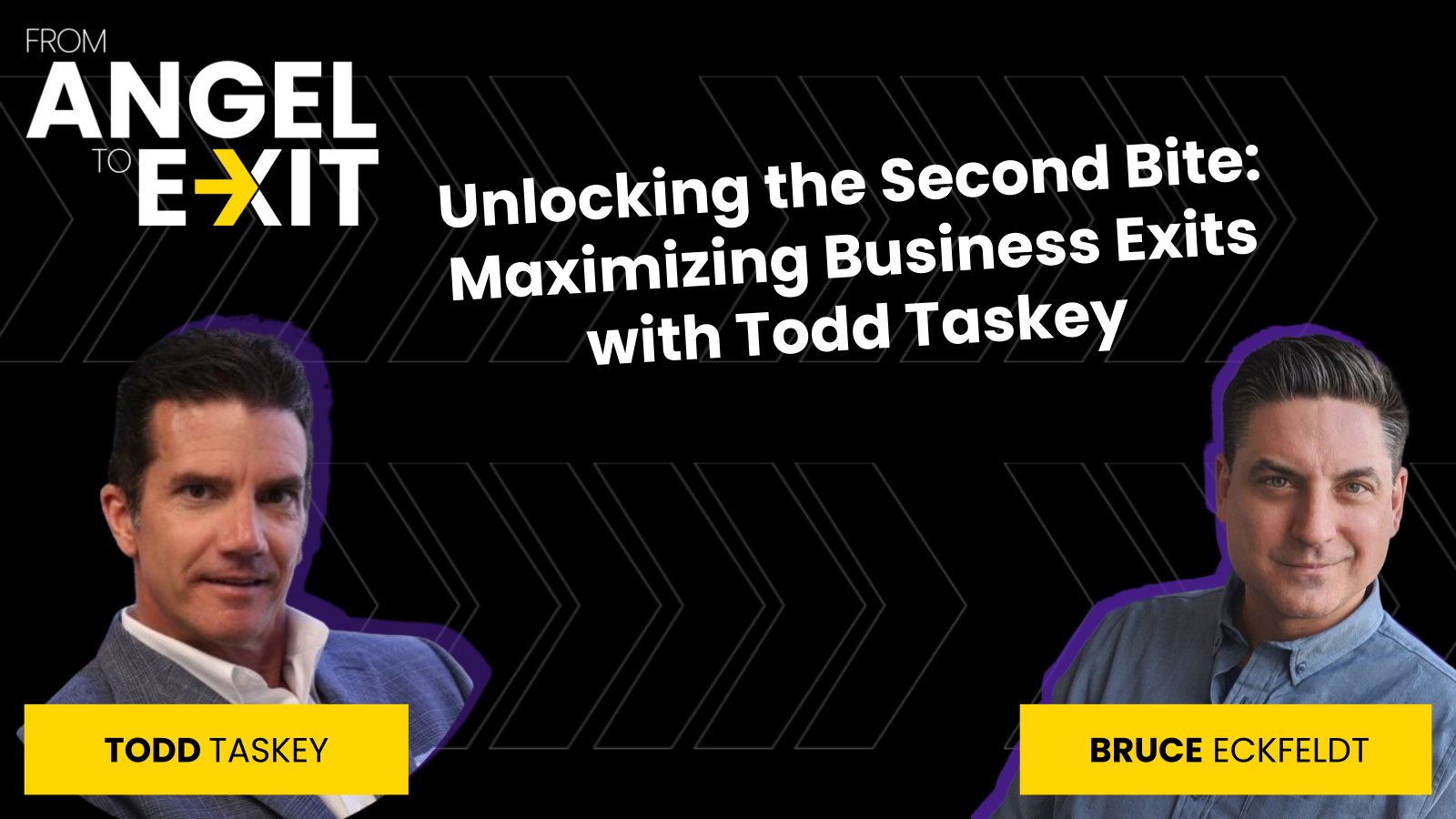
Listen to the Episode.
Play the full conversation right here, or pick a chapter to jump straight to that moment. Prefer your own app? Every episode is on Spotify, Apple Podcasts, and the rest.
About This Episode.
Start with the key takeaways, the ideas worth bringing back to your leadership team. Then read the full story of the conversation, or use the chapters above to jump straight to the moment that matters most to you.
- Founders should distinguish between exiting a business and using a sale to accelerate growth.
- The best deals balance cash, equity, and earnout structures to optimize long-term returns.
- Private equity partnerships can provide strategic advantages, but founders must ensure transparency in equity and debt arrangements.
- Overstating future projections can backfire, making it crucial to present realistic financial expectations.
- Retaining equity in a larger company can be a lucrative strategy for entrepreneurs who want to stay involved post-sale.
- The right buyer fit, culturally and strategically, is just as important as financial terms.
- Business owners should have GAP-compliant financials and proper accounting structures in place before seeking a sale.
- Understanding different private equity models helps founders negotiate better terms and avoid common pitfalls.
Todd Taskey, an M&A advisor and angel investor, joins Bruce Eckfeldt to discuss the nuances of business exits and private equity partnerships. Taskey explains the importance of structuring deals to optimize cash, equity, and earnouts. He highlights how founders can use a sale to accelerate growth rather than just exit, and shares real-world examples of successful second-bite opportunities. This episode is packed with strategic insights for founders looking to navigate the complexities of M&A and maximize the value of their business sale.
Watch the Video.
Prefer to see the conversation? The full episode plays right here on the page, so you can watch while you follow the takeaways or read along with the transcript. Every episode of From Angel to Exit is also on my YouTube channel, along with short clips from each conversation.
About the Guest.
The background behind the conversation, and where to find this guest online.
Todd Taskey
M&A advisor and angel investor
Todd Taskey is an M&A advisor and angel investor. He helps founders structure deals across cash, equity, and earnouts, and use a sale to accelerate growth.
- linkedin.com/in/toddtaskey
Full Transcript.
The complete conversation, lightly edited for readability. Open it to read along, or search the page for a topic or a name.
Read the full transcript
Bruce EckfeldtWelcome, everyone. This is From Angel to Exit. I'm Bruce Eckfeldt, I'm your host. Our guest today is Todd Taskey. He is an M&A advisor, and he's also an angel investor in many companies. I'm excited for this conversation. Todd's had a lot of experience in this space, and I'm sure he has a lot of stories and insights: things he's seen, both personally and with the companies he's worked with, around the exit process, the growth process, post-exit, and the things we can learn. So I'm excited for this. Todd, thanks for being on the program.
Todd TaskeyBruce, I'm super happy to be here. Thanks for having me.
Bruce EckfeldtIt's a pleasure. Before we get into the work you're doing today with exits and M&A, let's get a little background. How did you get into this space? What was your business background? Give us the story.
Todd TaskeyIt's not super exciting. I spent 20 years as a financial advisor. I was a certified financial planner. I built a small business. We had a hundred-and-something million of assets under management, which is relatively small. We sold it to another group that was eventually acquired by Goldman Sachs.
I had always worked with entrepreneurs, and one thing led to the other. A couple of people asked me to help them during transactions, and I learned how to do deals that way. When you do deals with individuals, with founders, it's different than doing them with a board or a bunch of investors or something of that nature. There's a little bit of art to it and a little bit of science to it. The science is the math and the numbers, and the art is all the other things that are so important to clients.
As you know, most of the transactions we do involve a client focusing on a second bite opportunity, which I'm sure we'll talk more about. So it's not just "How much cash can I get before I leave?" It's about the right amount of cash, the right amount of equity upside, the right partnership, the right alignment of personality and skill sets, and all that other stuff. That's what makes it a little more intriguing and interesting to put together.
Bruce EckfeldtI always say they're a bit of a puzzle. Can you get all the pieces to fit together to make something pretty? Let's talk a little about this world of exits, because everyone talks about exits and selling their companies, but there are so many different ways and configurations. How do you look at the landscape of M&A, or how people exit? How do you group and categorize them?
Todd TaskeyLet's take it as two sets of two groups. The first group is: in an exit, what do you want to accomplish? Do you want to leave, to exit, or do you want to accelerate? That's how we look at it. Most of our clients want to accelerate, and they use that in a couple of different ways.
The factors there delve into the second part, which is the currency a buyer will use. There are three forms of currency in a transaction. There's cash, always our favorite. There's equity, which eventually could be more valuable than the cash. And then there's earnout. The combination of those three things is the consideration a seller will focus on, and there are many things we can talk about in there.
So the question really starts with: what is it that you're trying to accomplish? I'll give you two quick vignettes. We talk about a lot of these things on our podcast, Bruce, which is called the Second Bite Podcast. I've got all these trophies over here. We did a transaction with a company called Digital Impulse. Andrew Kaleidos was the founder, CEO, and majority shareholder there.
He talks about it on our podcast. He says this was him fulfilling his growth plans: "When I sat there and looked at all the things I want to accomplish, I don't know that I was the right guy to build it all from scratch." So we found a really good fit with another company called Demand Drive, where all the pieces they had were just perfect for what Andrew was looking for.
Bruce EckfeldtInteresting.
Todd TaskeyAnd Andrew was a perfect fit for them. Shared vision, and on and on from that standpoint. He got a bunch of cash at close. He's got a bunch of equity. He had a small earnout, which he's in the process of getting now, over the summer. That worked really well for him, and now he's part of the executive team of a larger group.
We sold a company called Social SEO back in 2019. They were $2 million of EBITDA at the time on $10 million of revenue, a really well-run business, and they partnered with private equity. They got a bunch of cash as well, they had a small earnout, and they kept a bunch of equity in the business. That business today is north of $15 million in EBITDA. They've made four acquisitions, and they've built all of that business in their image and likeness, as I would say. The puzzle pieces they put together, the other capability sets they acquired, they've molded all of it, and they're still the CEOs of that business and still growing it.
And I've got a lot of guys who say, "Listen, if I could sell this business, get cash and equity, and just go back to selling stuff, landing clients, bringing it home, dropping it off, not worried about utilization, not worried about accounts receivable and the balance sheet and all this other stuff, I would be thrilled." So part of it is just designing all of that for what the next three or four or five years will be like for our clients.
Bruce EckfeldtI always find it fascinating to find out how many business owners did not anticipate being business owners, or have gotten into that state and realized they really don't like it.
Todd TaskeyAnd you know what else I find, Bruce? There are a lot of guys, and women, who say to me all the time, "I didn't know I could do this. I thought if I sold the business, I sold the business, and I had to go find a job or go do something else." But the notion that I could sell my business and be part of a bigger future, and do it with new cash in my pocket and less risk in the future, is a better option than remaining independent.
Bruce EckfeldtLet's parse out the nature of some of these deals, because I think that gets complicated for a lot of folks, and I'd love to see how you take it. You mentioned three pieces: the cash, which is the money you're going to get at signing, then the earnout, and then equity. Let's talk about the earnout, because I think that gets a little confusing for folks. When you're looking at earnout options, how much of this is basically just a deferred, guaranteed payment? How is it collateralized or backed up? How much of it is at risk or variable based on performance? Give me the world of earnouts that you see.
Todd TaskeyThose are great questions. Typically, people describe the earnout as a way to bridge a gap between the seller's expectation and what the buyer's willing to pay. And that really depends on how you set it up from the beginning. If there's one takeaway from this for your listeners: I see people hurt themselves all the time before they even start marketing their company, in what they put in their deck.
Let's keep it real simple. Let's say you've got a company doing $2 million of EBITDA, and it's growing 15% a year. We're in the summer of '24, so they're projecting '25. Rule number one: whatever you put in for 2025, nobody believes it. Nobody believes it at all. I don't care if it's good or bad or tremendous or terrible.
But what people do all the time is say, "Okay, we're growing 15% a year. Let's tell them we're going to grow 30% next year, because people will get excited." And they don't get excited, because they don't believe it. They're not buying your business for what it will do in 2025. They're buying your business for what it is today. Then they get an offer, and the offer comes with cash and equity and a little bit of earnout.
And you say, "Well, what do I have to do to get the earnout?" And the buyer says, "I just want what you put in the deck. I want the 30%." You're like, "Holy shit, now I've got a problem, right? Now I've got to go get 30%." So don't do that. I'll tell you this: we have plenty of clients with 30% growth a year, for real, and when we project 2025, it's 15% growth. And this is one of the only things I coach my clients on what to say.
Because the buyer eventually says, "Wait a second. You're growing 30% a year. Why do you project 15% next year?" And my client says, "Because that's what we always do. We always project 15%, and then we work really hard to try to do better than that. Listen, we're a $10 million or $15 million agency. We don't spend time doing projections. We don't do forecast analysis. We don't do all that stuff. We work really hard to make our clients successful, and the chips fall where they may. So I always project 15%. That's SOP."
Bruce EckfeldtHow does that affect the numbers, though? If you're creating a safe projection, but then they do a valuation based on the lower projection, aren't you leaving money on the table? What happens if you do 30%?
Todd TaskeyGreat question. Most buyers in this space are not going to make an offer based on your projection. They're going to base it on your historicals. They're going to base it on your TTM, your trailing 12 months of EBITDA. That's what they're really going to use. And if it's a good growth story, and a growth story means the prior three years, not what you're going to do next year, then they'll increase the offer. It'll be at the higher end of the range, whatever the case may be. If you really think you're going to do 30%, there are ways we can build that in so you can accomplish that. But you'll never leave money on the table. Maybe that's the mistake folks make, or the reason they think they need to project something bigger.
So that's the first thing on the earnout. The second thing is this. Let's say the earnout is $2 million. Two million's a lot of money, and people, individuals, buyers, sellers, do weird things for a lot of money, right? So how do we eliminate that?
I'm going to make up numbers to keep it easy. Let's assume that last year you did $2 million of EBITDA, and we're projecting, I'll use 20% because it's easier math for me, $2.4 million of EBITDA for the next year. If we get $2.4 million of EBITDA, then we get our earnout of $2 million. That's what's known as a cliff. You get the 2.4, you get the $2 million. If you come in at 2.39, the buyer wins, because they don't pay you anything. And nobody wants that, including the buyer.
So we say, "Listen, from $2 million to $2.4 million, that's 400 grand. And 400 times five is the $2 million for our earnout." So our hurdle now becomes $2 million next year, and for every dollar over $2 million, we get $5. If for some reason you came in at $2.3 million, not $2.4, you take the $300 grand, multiply it by five, and it's $1.5 million. You got $1.5 million, but you didn't get zero. In a better world, and it all depends on the negotiation, I'd like to start the earnout at $1.9 million and take it up to $2.4 million. So now there's $500,000, so it's four times. We're going to get some more certainty, blah, blah. All of that works its way out when you're negotiating at the LOI stage. And if you have more interested parties at that stage, it's easier to negotiate a better outcome.
Bruce EckfeldtJust because you've got competitive bids, or parties that are willing to juice their offer to try to win. The funny thing I always find about earnouts is that you're basically continuing to operate the business for somebody else. How do you get through that? Why shouldn't I just keep the business? Why bother selling it if I'm essentially at risk for my money, just like I would be if I kept the business?
Todd TaskeyThat's how you make earnouts work. I'll go through a fictitious example that's going to be pretty close. Let's say the value is $10 million. Let's say you're at $1.8 million of EBITDA. If we take 10 and divide it by 1.8, you get 5.5. Or let's say you're at $1.6 million of EBITDA and you've got six and a half times, or something like that. So you're at $1.6 million of EBITDA, and we sold the business for $10 million.
Of the $10 million, I'll make these up, you got $6 million in cash, $3 million in equity, and $1 million in an earnout to be paid over the next 12 months. So you got $9 million worth of consideration at close, which is, what, five times your current EBITDA? That's pretty good.
Most private equity groups, most buyers, will underwrite their investment in an agency to perform somewhere between three and five times on their equity investment, depending on when you get in. I would like to think that $3 million might be worth $9 million in three or four years. It's pretty hard, as you know, to destroy value, to have it be worth less than it is today. It depends on when you get in, but I would think there's significant upside.
If you feel differently about this buyer, then maybe we go to the other buyer, again, if we've done a good job and we've got multiple interested parties. Or maybe we go back to that group and say, "I need seven in cash and two in equity." That's all just part of the negotiation.
Bruce EckfeldtChange the ratios.
Todd TaskeyYeah. And when you think about the equity you roll forward into a deal, there's no tax consequence on that. The 1.6 million you're paying ordinary income tax on, in many cases. And then you get a capital gains rate on the equity.
But to your point, here's one thing that I think works really well for clients a lot of the time. I'll go back to our example, $1.6 million of EBITDA. The company's profit is, let's call it, $1.85 million, but you're going to continue to pay yourself 250 grand. And 250 grand is fine, but it's not the million-something I was making, right? So it's nice to know, number one, that I've got $6 million of cash in my bank account. Number two, it's nice to know I'm going to get another million at the end of next year to replenish my coffers, so my life works on $250,000 a year until we exit this business.
Bruce EckfeldtIt feels like a lot of these exits fall into one of two camps. Either it's "I want to reduce my risk," or get out of the business, or change my lifestyle so I'm not trying to run an operator business. Or it's "I feel like we could do more, better, faster, and I need the right people and the right capital, and I'm not growing fast enough to do it on my own." It seems to fit in one of those two buckets. Otherwise, it's, "Okay, well, let's just keep running it." If you're profitable and you're making money and you don't mind running the business, keep running it.
Todd TaskeyI say that all the time. Go back to our same example. If you're making a million dollars, a million and a half dollars, dude, you are a winner at life. You've created jobs for a bunch of people. You're doing great work for customers. This is fantastic. I would like to think you're making that much money and enjoying everything, or most things, about what you're doing. If you're not, then we can talk about that. And so you're only growing 10% a year. If you're happy with that, then you're happy with that. You don't have to make excuses to anybody.
At some point, though, and I get this all the time, I talk to guys and they're like, "Listen, man, I'll do an earnout for a year, maybe, and then I'm out." Then we start talking to a bunch of folks, and they're like, "You know what, though? Those guys are pretty good, man. I would stay on board with them for a while."
And it rears its head. "I might take three and a half million in equity. I really like them. The private equity group has done a whole bunch of great things. I like the team here, and gosh, the platform they're building. If I had tools like that, I would kill it here." You know what I mean? Guys get reinvigorated when it's not just another 10% or 15% growth per year.
Bruce EckfeldtThere's a vision in place. Let's talk about the equity side, because I think that gets a little confusing for folks at times. When you're talking about taking equity or keeping equity, what are the different scenarios? Particularly the ones where it's, "We're basically going to keep operating the business. I now have an investor, maybe a private equity group, that's taking ownership and putting in some capital potentially, but it's basically the same business moving forward," versus, "We're being acquired. Someone's rolling us into something else, or we're becoming part of a larger company." How do you think through what equity really means and the different types of equity you need to think about?
Todd TaskeyIt's such a good question, and I'll give you three tiers. First, I'm going to call them the aspirational guys. "If we put you and me and Steve together, now we'll be at $5 million of EBITDA, we'll all be more valuable, this will be great, and we'll divide it all up," and blah, blah, blah. We don't do those. They're fraught with peril, and they never seem to work out well.
Bruce EckfeldtLots of drama.
Todd TaskeyA lot of drama. Let's talk about working directly with private equity, and here's one great takeaway. I'll use an example. I'm going to buy your business for $10 million. I'm going to give you seven, and you're going to roll forward three. So that means I own 70% and you own 30%.
What the buyer doesn't tell you in this example is that I actually went and borrowed $3 million. It's debt on the business that we're going to pay back, because we own the business together. I put in four million. You put in three. Three out of seven is 41.6%, not 30%. A real private equity partner will share in the leverage of the debt. You have to ask that question, and you shouldn't have to. Your private equity partner should say, "Listen, Bruce, we're in business, man. You're going to get all $7 million, and we're going to use the debt to give it to you. But you're going to have 41.6% of the business, I'm going to have the balance, and we're going to pay off the $3 million over time."
For God's sakes, we're just going to pay it back dollar for dollar plus a little interest. That's the greatest deal going. And it's so interesting, because most of the people listening to this podcast probably don't have debt on their business. Why? "Not a fan of debt." Okay, let me explain it to you. We go through just that, and they're like, "Huh."
Here's the biggest thing, though. That debt on the business is debt on the business. I didn't sign for any of it. The private equity firm is putting in cash. They arranged the debt. They got the debt lenders to compete. They've managed all of it. And you know what they want me to do? Continue to go build the business. Fantastic. That's part of how the guys at Social SEO I mentioned earlier grew such a big business, and why they still own so much of it.
So if you partner directly with private equity, it should be a real partnership, and they should be open and transparent about all of that stuff. Don't fall into "Hey, I'm giving you a check for seven and you'll roll forward 30%."
Now, at the largest level, we did two or three of these deals last year where we sold the company to Agital. Agital is private equity backed by Trinity Hunt, and Trinity Hunt is one of the great names in private equity. They do what's known as a 409A valuation. I think they do it twice a year, maybe four times, but at least twice a year, because they have to report to the fund shareholders. So they'll say Agital started, and this is all approximate, at a dollar a share, because that's what we said.
Then the last valuation, I think, when we did this deal, my client got in at about a dollar 62. How do they come up with a dollar 62? We get a ream of stuff like this: all sorts of spreadsheets and calculations. The debt's in there, the values are in there, the multiples are in there, all that kind of stuff. It's not "We're valuing ourselves at $100 million and we're valuing you at $5 million, so you get this little sliver." No, no, no. It's all transparently disclosed at close, actually well in advance of close.
That's the level you should be involved at. And when you're involved at that level, you get off those calls and you're like, "Those are the guys I should be in business with. The level they're talking at is what I need. I understand now why private equity always wins. God, they're smart. Plus they have money." You know what they can't do? They can't do paid social real well, they can't do SEO, and they don't know how to build content. So when we combine these things, man, that's when the magic is made. And when people get exposed to some of this, they're like, "Man, I want to be a part of it."
Bruce EckfeldtLet's dig into private equity a little more, because going the private equity route is such a common thing for people to consider when they think about how they're going to exit. And obviously it's a fairly significant part of the M&A market. You mentioned how to calculate equity and how to deal with the debt. What are some of the other things you need to be wary of, understand, or look for in a private equity deal? I'm thinking of things like management fees, classes of shares, and things like that.
Todd TaskeyThere are a couple of different versions of private equity. There are what are known as fundless sponsors. Then there's very typical, traditional private equity. They own a fund, and they charge that fund what's known as two and 20. They get a management fee from the investors, so they typically don't take a fee from the company on an annual basis, but they will take a success fee out of the deal.
Then there are others, we can call them private equity guys if you will, who will work with many different financial sources, family offices, other private equity groups, and the rest, and they'll put it together on a deal-by-deal basis. They'll take a management fee from the company, but they'll actually work in the company.
There are other, larger private equity groups. I mentioned Trinity Hunt, the guys at Everlane, the guys at Mountain Gate, the guys at Gemini. These guys have resources. They have people who will do acquisition outreach for you. They have in-house finance teams. They have all the HR people. They have all sorts of stuff they'll make available to all their platform companies. So you become more robust, and you become better as a business, not as a service provider, but as a business.
So when you deal with private equity, there will be some different flavors, and maybe that's why it's helpful to have a guide to help you understand what version of it you're getting. That's how I'd answer that.
Bruce EckfeldtIt is a complicated world. When you've got a client, a company that wants to do a transaction, and you're looking at the private equity world, is there anything you're looking for in terms of the types of private equity firms, or where they are in their fund, or other things that help you figure out where the best opportunity for that transaction might be?
Todd TaskeyThat's a really insightful question. It's not so much at the fund level as it is at the investment level. When we run a process, we'll get a bunch of different offers. It depends on the size of the business. If you're $3 million or higher in EBITDA, you have the ability to connect directly with private equity and grow out that business in your image and likeness, like we talked about. If you're at a million or two, you're going to be a tuck-in to somebody else's strategy, and you'll play a significant role in the future of that business.
And you can be a tuck-in at any size. I just did a tuck-in over the summer. My guys were at $5.2 million of EBITDA, and they fit into a larger group. Typically, when private equity makes a platform investment, they're going to underwrite it, like I said, for a three to five times return, and they're going to underwrite it for about five to seven years. The group we sold to over the summer is in year five. What that means is that most of the three to five times has been used up, because they've been performing well. They're probably going to do a transaction next year. So my guys will get some upside on the equity they rolled into it, but they'll be free agents in a year or so.
There were others we looked at with that deal that were literally just getting started, where my guys would have been the first tuck-in. That means, "I'm going to be around for four or five years." It also means I'll probably have more time to get three to five times on my money. So that is important. Those are conversations you have with whoever the buyer is, whether they're private equity backed or not. Private equity plays a major role now in driving transactions, particularly in the digital marketing space.
On our podcast, we did a great interview with Grayson Lafrenz. He's the founder and CEO of Power Digital, and we've been fortunate to sell a couple of businesses to them. They did a deal a bunch of years ago with Periscope Equity in Chicago. They were at about $5 million of EBITDA. These numbers are all on the podcast, so I'm not telling tales. In three years, they went from $5 million to $30 million of EBITDA, and they sold to another private equity group called Court Square. The private equity guys, the management team, and the early tuck-ins got 13x on their money in three years. Home run.
All of the management team stayed on board. Grayson is still there. Most of the executives are there. And they're building for a bigger exit, maybe a third bite exit. They're very focused on that. The people at Court Square are great. We sold them a conversion rate optimization business. We sold them a data platform business. So that's what they're doing.
What happens at the second bite stage is that, typically, at the level our clients are involved, they'll be part of the management presentation when the company is out talking to new buyers. Then that buyer will say, "Listen, Bruce, what do you want to do? You rolled $3 million of equity, and now it's worth eight. What do you want to do?" And you're like, "Man, I love the vision you guys talked about. I want to stay on board." "What do you want to do with your stock?" "I'll take half and roll half." All right, great. "I'll take five and roll three," whatever the math is.
So let's say you take three and roll five. A year later, you're like, "You know what? It's not nearly as much fun as I thought it would be. Plus, I'm richer now. My tolerance is really low." So you leave. There are a couple of things. Number one, I expect you'll leave as an adult. You're not going to give two weeks' notice.
Bruce EckfeldtLet's hope.
Todd TaskeyYou're going to say, "Listen, it's summertime. I'd like to figure out a way to leave by the end of the year. Let's find my replacement." Secondly, in most cases, your equity stays. You get all that upside. When you roll money in, they want you to stay, they need you to stay, but it doesn't mean you're locked in just because your equity is still there. So there are all those considerations to think through, then to document, and then to make sure you're protected well for the things we can anticipate.
Bruce EckfeldtI do find it's a bit of game theory. You have to think, "Okay, what are my options? If I do this, then this happens, and then this happens. What's the outcome there?" You have to go through all the scenarios and make sure whatever deal you ink has reasonable paths on each one of those that allow you to make good trade-offs. I think the worst situation is feeling stuck. People do these deals and then they're stuck.
Todd TaskeyRight. Now take all that dynamic and add another layer on top, which is the people. Because all of that feels different with these people than with those people, and definitely different than with those other people. You have to go through that, because there will be some people where you say, "Listen, the only way I sell to that guy is if he gives me all the money in cash and never talks to me again."
Bruce EckfeldtExactly. "And then I never want to see him again."
Todd TaskeyRight. And if you have options, you just never pick that option. You pick the option with the people you want to be in business with. It creates a good home, quite frankly a better home, for your people.
The one other thing I would say, particularly in the digital marketing space: this business is getting more complicated. All of it's trickier. AI is going to have an influence on it. The way everything works is becoming more complicated. For people listening, you're doing a great job with your agency, but there's all this other stuff floating out there, and other people are not standing still. Other people are creating things, experimenting, building software for their customers. The competition is getting harder and faster and stronger, and you've got to be ready for that.
It's interesting. We did a transaction with Power Digital. Our guys built a great data platform. The people at Sprout built a great data platform so large DTC brands could ingest their first-party data and buy media more effectively, so they'd get a better return on their spend. And Kevin Biondi, who's also on the podcast, said, and this was two years ago or so, "We have great software, really good. Next year, it's going to be pretty good. The year after that, it's going to be the same as what everybody else has, unless we spend a crapload of money to keep it current and better. And it's my money, man. I don't want to keep doing that."
That was a wise, future-looking choice for them. At Power Digital, they've done really well, they like it a bunch, and they're focused on the things that are the highest and best use for them.
Bruce EckfeldtI'm curious, when you meet a founder or an owner who's interested in selling and you start talking with them, what questions are you asking? What are you using to assess how ready they are, both from a business point of view and a personal point of view? What are you trying to get from them?
Todd TaskeyI would say this. We sold that conversion rate optimization business. Ned McPherson, also on the podcast. Ned's great. I got introduced to Ned, and he's like, "I'm not interested in selling right now. I want to do these things." I said, "Listen, I know three groups that really want conversion rate optimization. Let's talk to them, because all you're going to do is learn about what they need and why." So he gave me a Loom video of him doing an audit of a client's website. I gave that to three groups. We had three phone calls, one with each group, and we got three offers for that business.
What I've learned over time is that it's compelling if somebody can get a chunk of cash, still have equity upside, and solve their biggest business problems. And that's always a fill-in-the-blank. It's different for different people. Ned was a sub-$10 million revenue business selling to large DTC brands. That's hard. It takes a long time. It takes multiple calls, blah, blah, blah.
We did that transaction seven or eight months ago, and I talked to him last week. He said, "Number one, Power has 220 customers. Number two, they've got a dozen salespeople. Number three, we get on a call like this, and the salesperson says, 'Bruce, remember I was telling you about CRO? Ned, tell him what you guys do.' And then after that, the salesperson says, 'All right, so we're going to start this next month, and we'll give it a try for three or six months.' And they go, 'Okay, that should be awesome.'" And that's it. Ned goes back home, they fill out the paperwork, blah, blah, blah. And Ned gets to do what Ned loves to do, which is A/B testing and growing an organization, and on and on from that standpoint.
Other people just need access to customers and can't build their own sales force. They're doing paid and need earned, or they're doing email and need social, whatever it might be. When they see that, and they see the role they can play on an all-star team that's well financed with other smart people, that becomes really compelling.
The things that drive value are EBITDA, it's always EBITDA, how much of your business is recurring revenue, and what your retention is. It's funny, I was talking to somebody the other day about a deal we sold a couple of years ago. Our clients didn't have great retention. I'm going to make up numbers, but their retention was like 65%, way below market. It turns out their cost of acquisition is really low. They're very good. They've got a big social presence. So they just take everybody, and they have a three-month initial contract.
Their philosophy is, "Listen, we make a little bit of money over three months, but we get to test with these people. We get to see if we like them and if they like us." If clients passed that test, retention was way better than the market. So when we did the deck and talked about retention, we measured retention starting at day 91. The buyer said, "Well, you can't do that."
And we said, "Yeah, we can, and let me explain why. And by the way, when you own the business, if you want full-year contracts from the very beginning, you can do that. I don't know how many of your wins you'll get up front or what the impact will be, but that's your decision. But you should have an accurate picture of the business, because it's not a 60% retention business. It's more like an 88% retention business. And this is the farm club of how they do their marketing."
Ultimately, the buyer decided not to keep doing that, because it was emotionally draining on their people to lose that many clients. They had better salespeople at the bigger company, a more mature process, and more service offerings, and it wound up being a great acquisition for them.
Bruce EckfeldtIt's almost a cost of sales. It's like an extended sales process.
Todd TaskeyBut having an idea of how we want to present the numbers so the company looks its best, all of that is important to making sure you capture the full value of the business.
Bruce EckfeldtFor listeners who are in the early stages of their company and starting to think about the exit process, when would you suggest they get serious about thinking about exit and exit strategy? What do you suggest they start with?
Todd TaskeyFirst of all, the Second Bite Podcast is a great place, not to listen to me ramble on, but to hear other founders talk about what their experience was like. That'll trigger a whole bunch of thoughts.
Having your financials buttoned down is by far the most important thing. You need to be GAAP compliant. You need to be accrued properly. If you've outgrown your first CPA or accounting firm, get a legitimate one that can help put your business in the right perspective. We've got plenty of things we can share with people about, A, who you might want to reach out to, and B, what your financials should look like. With that visibility into your business, you understand your business a lot better. Anybody listening who's gone through that maturity process realizes how much better they're managing their business with this data than with what they had before.
Then I would say this. We sold a company called Worth Ecommerce. This was a few years ago. Dean's a great guy. They were at about 920 grand of EBITDA, so a little below our mark, and they do email marketing for e-commerce customers only. This nice little box. I showed that box to a whole bunch of people, and we got a great transaction for him. We sold them to SmartBug, which is a HubSpot partner, and it was a great fit.
So if you're small, but you're in a little niche like that, like the CRO business, fantastic. We sold a company over the summer that does performance marketing for law firms. We've done that for elective medical. We've done it for different verticals. If there's a unique sliver that you offer, whether that's a service or an end customer or something of that nature, I would start to focus there. It's also probably a better way to sell and get more customers, when you're an expert in who they are.
The other things you don't worry about, because we can adjust for those in your earnings when we do your financial workbook. I've got a group right now that hired a director of sales and three salespeople, and it didn't work out. They canned them all, and they're doing something else. We added it all back. And yes, we'll be in a fight with the buyer over that. But the point is, we don't have them anymore, and we don't need them anymore, because we're doing it differently. And if you don't agree, then you don't agree, and that's fine. I just have to find somebody who will.
Bruce EckfeldtFind someone who does. Todd, it's been a pleasure. You mentioned the podcast. What other resources do you have, or ways people can get ahold of you and find more information about what you do?
Todd TaskeyWe put a bunch into the podcast, and that's really the best, because it's live and everything else. So, secondbitepodcast.com. Potomac Business Capital is our website, and the podcast will take you there as well. I'm sure my contact information will be in your show notes, but people can reach out to me on LinkedIn. We talk to an awful lot of people, and that's how we stay in the mix and stay current. So if somebody wants to talk and brainstorm, reach out to me on LinkedIn. I'd love to chat.
Bruce EckfeldtI'll make sure the podcast, LinkedIn, and all those things are in the show notes. Todd, always a pleasure. I really appreciate you taking the time today.
Todd TaskeyI enjoyed this conversation, Bruce. Thanks to you, and thanks to your listeners.
Never Miss an Episode.
Know the moment a new episode goes live. Subscribers also get a say in future guests and the topics we cover.
Other Related Episodes.
More conversations that connect to this one. Or browse the full archive by topic or by guest.

Jordan Youkilis
The challenges and opportunities founders face when they raise from cannabis investors.
Listen and Read
David Turner
What a buyer behind 47 acquisitions looks for, and what really drives a successful exit.
Listen and Read
Lee Minkoff
How private equity looks at founder-led service businesses that seem too small to sell.
Listen and Read